There's been some confusion regarding the government's response to Helene in western North Carolina.
So let's break it down.
Other WRAL Top Stories
John Mills with the Federal Emergency Management Agency (FEMA) said to think of disaster response like a fire. When a house goes up in flames, you call 911; they'll send in crews from your local fire department and maybe the Red Cross, if families need additional assistance. If it's a big fire, then they might send in help from other fire departments in the county. If the fire is really huge, then they might send in crews from across the state.
That's how a disaster response works. When the local government can't manage the response, it requests help from the state. When the state isn't able to manage the response or doesn't have enough resources, it calls on the federal government for help. That's when FEMA comes in.
The federal government is the last line of defense, but local and state governments are primarily responsible for disaster recovery. The federal government and federal agencies like FEMA are there to support local and state relief efforts.
"We come in when a state has exceeded its capability to respond," FEMA Administrator Deanne Criswell said.
Criswell said one of the things to emphasize is that FEMA is here to support local and state efforts.
"All disasters start and end at the local level," Criswell said. "When the needs exceed their capability, then they bring in additional state resources. And when we know it's going to be significant, that's when we can come in and support their efforts.
"We do not come in and take over any response."
Criswell said FEMA's role is to augment the work being done by and local and state partners. That includes providing disaster relief funds to help those impacted by Helene.
As of Wednesday, FEMA said federal disaster assistance for Hurricane Helene survivors has surpassed $344 million and has reached 375,000 households. FEMA also opened its first disaster recovery center in Asheville on Wednesday for those who need help applying for assistance.
"We already have over $60 million in the hands of people across western North Carolina to help them with the financial assistance they need," Criswell said in an update Wednesday. "We will continue to bring those resources in to support them as they manage these events.
"We are here to help people; we are here to save lives."
So where is all this confusion stemming from?
The Lake Lure mayor said on Monday that FEMA has yet to arrive. FEMA, however, refuted that claim.
"Just because somebody doesn't see a person wearing a FEMA shirt doesn't mean that we are not supporting those communities," Criswell said.
Mills said 5,000 federal personnel are on the ground in North Carolina, as of Wednesday.
"You might not see the FEMA logo everywhere, but you can see FEMA’s support of the state everywhere in North Carolina counties severely affected by Tropical Storm Helene," he said.
There also seemed to be some confusion and miscommunication among the local and state agencies responding to Helene.
The first few days after Helene hit, Buncombe County officials and other local government officials said they were still waiting for critical supplies to arrive. Local officials said they didn't know when that would be.
Despite the planning and preparations that were made ahead of Helene's arrival, no one had anticipated the level of devastation that western North Carolina is now facing.
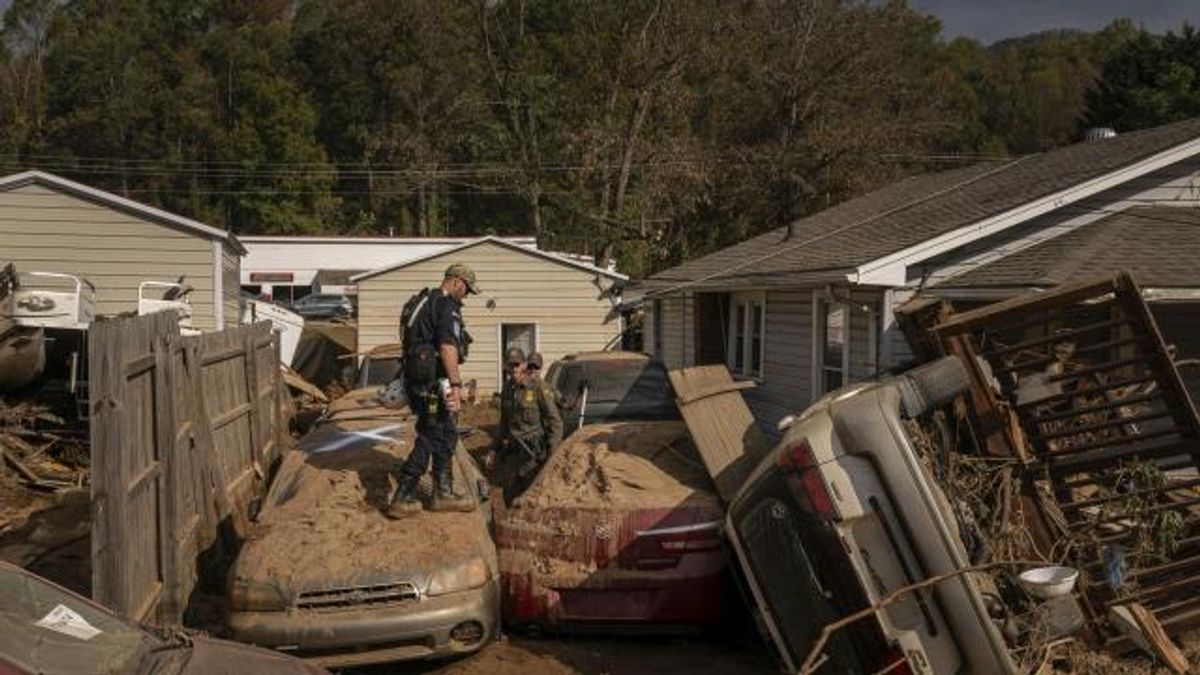
Local, state and federal governments were forced to improvise after Helene caused catastrophic flooding and hundreds of landslides in the North Carolina mountains – wiping out entire towns and hundreds of roads.
The damage to Buncombe County's water systems was "catastrophic," and the backup water supply was inaccessible.
Trucks carrying supplies weren't able to reach these communities because of how badly damaged the roads were. Instead, emergency responders had to airdrop supplies into these communities, which also took days. Some blamed FEMA, but it was actually the state's responsibility to deliver these supplies – at the request of local governments.
It's also important to note that, for days, there was basically no cell service in these mountain communities – making it incredibly challenging for agencies to communicate with one another.
WRAL's Heidi Kirk was embedded with the National Guard for 36 hours on Sept. 30 and Oct. 1 as they responded to Hurricane Helene in western North Carolina.
It's easy to take for granted the ability to fill up a gas tank, hop in the car and pull up your navigation. However, some people traveling in and out of western North Carolina to assist in the emergency response faced challenges without those services.
Kirk spent two days with the North Carolina National Guard in Asheville and the surrounding communities, documenting some of these challenges.
The group she joined was tasked with bringing supplies from a warehouse in Weaverville to various locations across the western part of our state.
It might sound simple, but behind the scenes, Kirk found there were more challenges than meets the eye.
"There have been challenges that we couldn't even have forecasted, and we've had to react to them," Lt. Col. Bethany Barden said.
For the first several hours of their journey, she saw guardsmen struggle to communicate with emergency management due to a lack of signal, making it hard to get their assignments.
She captured the 10-mile trek from Weaverville to Asheville, where they found just two bars of service to make calls.
Some people felt that state and federal agencies were too slow to respond, with local groups and organizations reaching some areas faster than these agencies. But these community groups are actually a critical part of any disaster response; they're even included in FEMA's National Response Framework.
"Each community provides opportunities for sharing information and promoting collective action," FEMA's National Response Framework reads. "These communities may have resources and information to stabilize community lifelines.
"Engaging these groups in preparedness efforts, particularly at the local, state, tribal, territorial and insular area levels, is important to identifying their needs and taking advantage of their potential contributions."
These community groups are sometimes able to mobilize faster, based on proximity and other factors.
To see a full breakdown of the roles and responsibilities for disaster response, click here.
FEMA Facts
- FEMA is actively supporting the North Carolina National Guard with 1,500 active-duty service members to support the delivery of meals, water and other commodities to heavily impacted and isolated communities.
- On Tuesday, active-duty service members distributed more than 690 cases of water, 140 cases of shelf-stable meals and three pallets of humanitarian assistance items.
- FEMA’s Disaster Survivor Assistance teams are meeting with survivors in shelters and canvassing neighborhoods in coordination with county and state emergency management.
- This means survivors have contacted FEMA and completed an application for disaster assistance by phone, online or in person with one of our FEMA Disaster Survivor Assistance teams in shelters or affected neighborhoods.
- You can go to these centers if you need help applying for assistance; translators are available. You can also apply online.
- That can include eligible costs for out-of-state law enforcement, search and rescue teams, emergency route clearance, emergency food and water distribution to the state and other disaster response operations.
Related stories
- Fact check: No, FEMA and other Helene responders aren't 'confiscating' supplies
- Fact-checking 5 misleading claims about Helene relief efforts
- Fact check: No, Democrats didn't withhold aid to right-leaning NC counties after Helene
- Fact check: Is government seizing North Carolina lithium after Helene?
- 5 On Your Side: How to apply for FEMA assistance after Hurricane Helene