The defense starts its arguments on Tuesday in the Austin Thompson sentencing hearing. The mass shooter's legal team will try to convince a judge that Thompson should have the chance at parole.
In January, Thompson pleaded guilty to killing five people on Oct. 13, 2022, when he was 15 years old. Since Thompson was a minor at the time of the shooting, he cannot automatically get life in prison without parole.
Other WRAL Top Stories
Thompson’s lawyers will work Tuesday to convince the judge that Thompson is capable of reform and deserves parole. If the facts and testimony do not prove that he is, he could be sentenced to life in prison without parole.
Here's a running log of Tuesday's proceedings:
- 5 p.m.: Court ends for the today. The hearing picks back up at 9:30 a.m. Wednesday.
- 4:56: Corvin says "The why, in my opinion, is not because he was angry and wanted to blow up the world. I doubt, despite him saying that humanity is destroying the world, I don't find that to be a credible assertion given my analysis of him. It’s more likely, but that it doenst mean that’s what happened."
- 4:45 p.m.: The defense asks Corvin about Thompson's prospects for functioning in an adult prison environment.
- "He's kind of got a gullibility around him, sorry to say, that n the wrong population, could be taken advantage of ... it is a concern I've had that he will eventually go to such a facility, and even though he's 18, in many respects he's still functioning at an age much less than that."
- 4:22 p.m.: Corvin continues with some of the trends observed about Thompson's behaviors.
"The things he says, he doesn’t want to be a bother to people," Corvin said. "He wanted to plead guilty to put to rest for the families. He enjoys the interaction with folks. Others other than me, humor and laughing seems to be a preserved affect for him. But when you talk to him about these difficult things, you can see mechanisms of distress. Body posture, shaking…. He uses words to say, he feels horrible about what he did."
- 4:18 p.m.: Corvin said the damage to Thompson's frontal lobe can be what led to the mild neurocognitive disorder.
"I think he’s an emotional being, but it’s different now," Corvin said of Thompson. "The part of the brain that modulates that is not working correctly so it’s not normal. It’s not gone but changed."
- 4:11 p.m.: Court returns
- 3:59 p.m.: Court recesses for 15 minutes. Proceedings will return by 4:15 p.m.
- 3:54 p.m.: Corvin said that Thompson told him that he killed some of the others that day so they wouldn't call the police.
- 3:44 p.m.: Corvin said that Thompson told him that he recounted the day he committed the murder, specifically of his brother. Then the prosecution said that timeline of his murder is not in discovery, and that Thompson's recollection came only when he was talking to Corvin.
Corvin said that because Thompson's exact memory from that day due to his brain injury, Thompson was building the memory of that day in the months after. Corvin said, "It's like remembering a dream."
- 3:32 p.m.: Corvin testified that during his time in custody, Thompson hadn't had problems regulating behavior, noting that it is a controlled environment. Corvin said, "People with those injuries can have behavioral disturbances associated with neurocognitive disorders.
- 3:20 p.m.: Corvin tries to find holes in the letter found in the Thompson house. He said that as a forensic psychiatrist, Corvin can't take the letter at face value because he can see inconsistencies in a greater context beyond Thompson himself, such as considering his age and violent video games.
- 2:55 p.m.: The prosecution begins cross-examining Corvin with a tense line of questioning regarding what Corvin said in court and what the language stated in his report said. The prosecution states that Corvin originally said was that dissociation was the "only" situation, but Corvin argues that he did not say "only."
The prosecution clarifies that when it came down to nuts and bolts, Corvin doesn't know why Thompson committed these crimes. Corvin agrees that no expert knows why.
Corvin states, "I can't give the answer to why this happened, and that's pretty unusual in these cars. It's unusual and frustrating to be unable to ascertain."
- 2:53 p.m.: When trying to determine Thompson's why, Corvin, in a simplified statement, said dissociation became his likely scenario. Corvin said, "It's rare, but once ruled out, rare things do happen, and there is evidence to support that conclusion but limiting my finding."
- 2:47 p.m.: When talking about Thompson's search history, Corvin said Thompson could have had a "morbid curiosity" when it came to looking up violent searches. Since Thompson allegedly was interested in law enforcement/forensics subjects while in school, Corvin attributes his interests to these searches.
Corvin said, "In this instance, we have a teenage boy into guns and who is enrolled in a public safety class in school who wants to take some higher-level law enforcement class...Some topics are a morbid curiosity. This is not unusual in teenage boys."
- 2:34 p.m.: Court returns from lunch with Corvin's testimony.
- 1 p.m.: Court breaks for lunch. The proceedings will return at 2:30 p.m.
- 12:47 p.m.: In a simplified statement, Corvin said that with these medications with intense psychiatric side effects, people can be on them for an extended period of time and dissociative emotions can happen suddenly and acutely.
- 12:35 p.m.: Corvin is asked about minocycline, the acne medication Thompson was on that his defense argues is what caused his mental downfall before the shooting.
Corvin states that minocycline could induce psychiatric side effects, "including and up to depersonalization, a sudden onset of an associative episode where one can engage in conduct but is not really there. They're there and doing things, but almost like they're playing out a dream."
- 12:22 p.m.: Corvin said as a result of the brain injury, Thompson has a new normal. Corvin states, "I'm surprised the new normal is as high functioning as he is but if you mean, will he become who he was before? That's not possible. He wouldn't be who he was at 15 anyway but that's not going to occur.
- 12:18 p.m.: Corvin notes that Thompson finished high school and earned a diploma while in custody. In a report, Thompson demonstrated a path to mental recovery, noting the "continued course of improvement in executive functioning."
- 12:12 p.m.: When asked if Thompson has ever told Corvin why he committed the shootings, Corvin said no.
Corvin stated, "What is the most difficult part of this forensic assessment is that while he's never challenged the conclusion that he did these events, he's never said, 'I didn't do this.'"
- 12:06 p.m.: Corvin said that while Thompson was recovering, his IQ was below average for someone his age and could not communicate effectively. Corvin stated, "He really was not viewed as understanding his situation most in terms of what had happened as a criminal defendant."
Corvin said these injuries and the mental impacts of them are what contributed to the inappropriate gestures he made. Corvin said, "Given his condition, people will do and say things that are completely out of character, atypical, abnormal anyway you look at it.
- 12:03 p.m.: Court returns to session with Corvin's testimony.
- 11:48 a.m.: Court takes a 15-minute break.
- 11:36 a.m.: Corvin says that the frontal lobe is the seed of humans' personalities. He said, "Who we are as human beings and who we are as unique human beings are largely defined by the function of that part of the brain."
- 11:30 a.m.: Corvin testifies that when he examined Thompson, his mental state was "very cooperative, genial and child-like."
Corvin continued:
He's still a very young person but almost flighty...very talkative, very compliant, very pleasant, very restricted range of emotional expression. He has an innate sense of humor, laughs at things that are funny, laughs at things that aren't...He's a likable individual in his current conditions. Placid, calm, not a lot of upset. He will tell you what he thinks about htings, doesn't hold back. But at the same time, he's concrete in his way of looking at things.George Patrick Corvin on Austin Thompson
- 11:29 a.m.: Corvin says the Thompson now is a second version, in a way. He said, "[Thompson is] not the same human being he was as a 15-year-old with intact frontal lobes. He's now 18 with a very limited pre-frontal lobe cortex. He's different human being."
Corvin said he was shocked that Thompson survived the gunshot and recovered to the extent he has.
- 11:22 a.m.: Elise is released from the stand. Austin Thompson's defense team calls up George Patrick Corvin, a general and forensic psychiatrist.
- 11:15 a.m.: Elise tells the prosecution that she was with Austin during his recovery and while he was in prison awaiting trial, and even after his sentencing, she wants to stay in his life.
- 11:06 a.m.: The prosecution cross-examines Elise.
- 11:05 a.m.: Elise testifies that he hopes Austin can be re-evaluated and have something done to see if he can go back into society.
When asked if her dreams for Austin changed, Elise said, "They're gone. I know he did this horrible crime and he has to pay for this crime...I just hope that after, I believe someone told me 40-year sentence, that hopefully he can be re-evaluated and have a mental analysis with a neurologist and something can be done to see if he can go back into society, if he's capable of doing that."
Elise said that Austin told her he would want to become a dental hygienist in whatever prison he goes to.
- 11:01 a.m.: Elise said she still loves Austin, even though it "still hurts terribly, but I love him dearly."
- 10:59 a.m.: Elise said that after the shooting, she was able to see him every Sunday for 30 minutes until the end of the summer. But they've been able to talk every day for 15 minutes.
When asked what might have changed about Austin after his brain injury, Elise said, "He's still functioning but it was just kind of an even keel as the personality. Not sad, or angry. He will still laugh but the emotion is gone. The frontal lobe has been shot out which is where you keep the emotion."
- 10:53 a.m.: Elise said that during the boys' transitions into high school, they both did well. She said, "I didn't notice any issues or mood swings or was disgruntled going to school. They [were] responsible."
- 10:43 a.m.: Elise testifies that she and Alan told the boys, as they got older, about gun safety and how to respect guns. She said they told them that guns are not toys and should only be used for hunting.
Elise said Austin took to hunting more than James.
- 10:37 a.m.: Elise recalls the day Austin went to get a cavity filled and the dentist attempted to give him "laughing gas." Elise said that when the dentist did and put on a movie at the same time, Austin was not reacting to the medication. Instead, she said he would have more of an "angry response."
Elise said that response is normal for children who don't do well with laughing gas.
- 10:16 a.m.: Court returns.
- 10:05 a.m.: Court is taking a brief recess as they try to figure out technical issues that arose during the defense's presentation of Austin Thompson's baby photos.
- 9:53 a.m.: The defense puts up a slideshow of baby photos of Austin from a flash drive. Elise breaks down each photo and provides a bit of familial background to each.
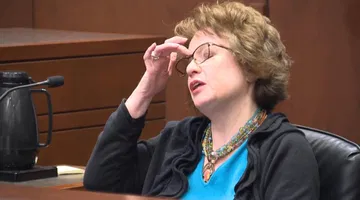
- 9:50 a.m.: Elise Thompson, Austin's mother, takes the stand to testify in his defense.
Elise testified for the prosecution last week when she read a letter to the court and detailed what it was like that day when she found out her son was behind the massacre.
- 9:40 a.m.: The defense pushes their argument that acne medication is what led to Thompson's downfall. Defense attorney Deonte' Thomas said, "Austin didn't know what he was putting in his body. And there are distinct genetic markers that make Austin more susceptible to these kids of side effects."
- 9:35 a.m.: Thompson's defense team begins by saying that it was their "team's hope that handling this entire process without a trial would be the start of some closure for all parties involved."
The defense says that while the court knows the facts, they still don't know "why." The defense said their presentation will tell them why.
The case against Austin Thompson
The earlier proceedings produced emotional testimony from his parents, family members of people who died and officers who responded and investigated the deaths. The court was dismissed on Thursday after the state rested its case after more than three days of testimony.
Among those who took the stand was FBI behavioral analyst Dr. Karie Gibson, who has profiled and reviewed cases for mass shooters. She has not analyzed Austin Thompson.
Her testimony focused on what mass shooters have in common through the pathway of violence.
"Research has shown at least one bystander has witnessed one or more concerning behaviors in 100 percent of cases," Gibson said. "We have found in research we’ve completed [that] bystanders will see concerning behaviors, and it can be one but more likely been even more than that."
It's unclear when -- or whether -- Austin Thompson will take the stand. You can watch Tuesday's court proceedings live on WRAL.com or YouTube starting at 9:30 a.m.