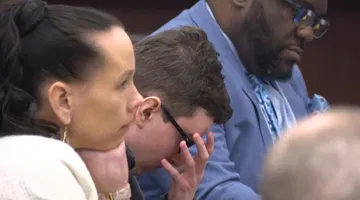
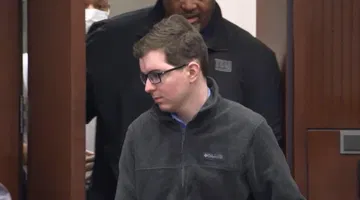
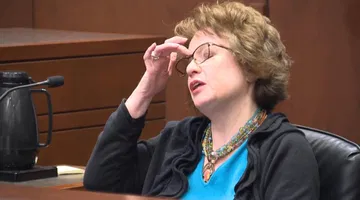
Friday was the fourth day of a Raleigh mass shooter's sentencing hearing in Wake County court.
Here's a running log of Friday's proceedings:
Other WRAL Top Stories
- 11:26 a.m.: The state rests its evidence presentation. Court will recess until 9:30 a.m. Tuesday to start the defense's presentation.
- 11:18 a.m.: The prosecution asks follow-up questions about other motivators other than revenge, and if bystander witnesses always know what the behaviors are when they see them.
Gibson replies, "Not necessarily. Bystanders are in a position to have that front row seat to look at and interact with that person. What we see a lot of times is that they are looking at that picture, and it becomes more normalized to them, or they're not able to understand the significance attached to it."
- 11:13 a.m.: The defense begins cross-examining Gibson.
She says the research shows that at least one bystander close to a violent person has witnessed one or more violent behaviors in 100% of these cases. She says, "We have found in research we've completed that bystanders will see concerning behaviors, and it can be one but more likely been even more than that."
In 2024, the victims' families sued Thompson's parents and the Hedingham homeowners' association, accusing all of them of knowing that Thompson was a threat and not doing enough to stop him.
- 11:11 a.m: Gibson explains that in their research, her team found that only around 10 to 13%, there is a primary family member who could be a victim at the beginning of the crime. While they don't havekey research to explain why that is, her team has seen that it could be because of their care and love for that person. She says, "They don't want their loved one to see what they're about to do. So they will end up killing them before the attack. We've also seen it as a way to punish people left behind.
- 11:06 a.m.: Gibson explains that when someone wants to be successful in predatory violence, they need to progress their planning and preparing without anyone knowing. She says, "As someone is progressing on the pathway, it's important they keep that quiet and a secret, because if they do not, they will not be successful."
- 10:51 a.m.: Gibson explains the research and planning stage in targeted violence. She says, "The research and planning is a very individualized process and can take up to two years, [according to] what we've seen in our research."
- 10:47 a.m.: Gibson explains violent ideation, which is when someone looks for options and means to solve a grievance, but can't think of any non-violent options. She says, "They focus on violent ideation, so that could be suicidal, homicidal, consumption of violent content online, consuming violent imagery—but [overall] marinates in violence on that step of the pathway."
- 10:36 a.m.: Gibson says her focus in the FBI is researching targeted violence, which is predatory violence where someone considers, plans and prepares before committing, versus affective violence, which is a response to an emotional situation.
She describes a concept mapping for targeted violence, noting that the pathway toward the violence starts with a grievance, which could be a personal slight, humiliation, something unbearable, something the violent person struggled to move past.
"It also is incredibly individualized for that person," Gibson explained. "They're in that space where they have a problem, trying to figure out how to solve it and it progresses to the next step."
- 10:25 a.m.: The state tries to call their next witness, Dr. Karie Gibson, who is the unit chief of behavioral analysis unit of the FBI, but the defense objects to her testimony, saying that Gibson doesn't know this case personally well enough to testify, especially in a sentencing hearing.
Judge Ridgeway says he will hear from Gibson anyway, but will determine the weight he assigns to the information, knowing that she has not thoroughly examined Thompson specifically.
- 10:22 a.m.: The prosecution asks one more clarifying question, which Pike confirms that everything searched on Thompson's phone was viewed within a two-year span of the shooting since Thompson got a phone less than two years before the crime. Both teams' line of questioning were finished for Pike.
- 10:21 a.m.: Thompson's defense team goes line-by-line through the digital searches found on his devices, noting that less than .5% of his overall search history was about assaults and shootings.
- 9:35 a.m.: Court starts with the defense's questioning for Sergeant Robert Pike with the Raleigh Police Department. He's the investigator into Thompson's digital evidence and testified about his search history months and days before the Oct. 13 mass shooting.
Based on the timeline laid out by presiding Judge Paul Ridgeway, Friday is expected to be the last day of the prosecution's presentation. Then all eyes will be geared toward next week, when Thompson's defense team will present its own witnesses and expert testimonies.
Before Friday's proceedings
The widow of the off-duty police officer killed in the shooting, Gabriel Torres, presented her emotional victim impact statement to start off Thursday's hearing. She played a recording of her now-five-year-old daughter—who was two at the time of her father's death—who said she had a message for Thompson.
Investigators then combed through a note written by Austin Thompson and went through his Google search history in the months before the shooting and the hours after. The court also heard powerful testimony from his father, who was stunned by what unfolded and, to this day, said he doesn't understand why his son would commit a mass murder.
On Wednesday, Thompson's mother, Elise Thompson, recalled the day that Austin opened fire in the east Raleigh street they lived on, forever changing numerous lives.
Raleigh police officers who responded to the mass shooting went over photos of the crime scene, including those inside the Thompson home where his brother James was found dead and in the shed where Austin turned the gun on himself.
Last month, Thompson pleaded guilty to five counts of murder, two counts of attempted murder, two counts of assault with a deadly weapon with intent to kill and one count of assault with a firearm on a law enforcement officer. Five people, including a police officer, died in the Raleigh mass shooting on Oct. 13, 2022, in the city's Hedingham neighborhood when Thompson was 15.