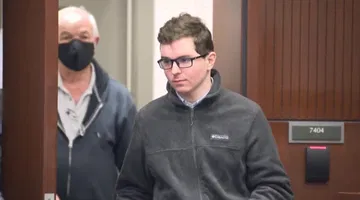
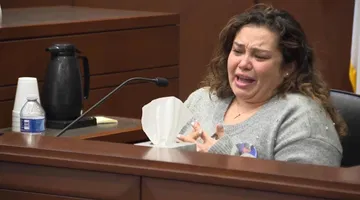
The defense continued and finished its arguments for parole on Thursday in the sentencing hearing of Austin Thompson, who pleaded guilty to shooting and killing five people in Raleigh's Hedingham neighborhood and the Neuse River Greenway Trail in October 2022.
Thompson faces a mandatory minimum sentence of life with the possibility of parole after 25 years. The maximum possible sentence for Thompson would be five life sentences plus an additional 1,634 months in prison.
Other WRAL Top Stories
Closing arguments began after lunch on Thursday.
Here's a running log of Thursday's proceedings:
- 4:15 p.m.: Judge Paul Ridgeway dismisses the court and says they will reconnect at 9:30 Friday morning.
- 4:14 p.m.: Mannette asks the judge for a sentence of consolidated life with the possibility of parole. She expressed that Thompson is "redeemable" and that his life has value. She said Austin is not as fearful as other young clients she has worked with.
"That’s not what I get from Austin," she said. "A lot of emotion, but not fear. He’s fully and totally accepted whatever outcome is."
- 4:08 p.m.: Mannette mentions Thompson's graduation from school, his baptism and engagement with religious services as a measure of his growth in the three-plus years since the shootings.
- 4 p.m.: Mannette speaks to a video of Thompson in a trailer park after the shootings. She later said his actions are reminiscent of a first-person shooter video game. "It's odd," she said. "I don't think there's another way to describe it...I think another way is feeling like you’re in a dream is feeling like you’re in a video game."
- "I know it's more comfortable to believe he's just evil. I know it’s safer to put him in a box. Like he’s just like anyone else who commits a mass shooting, that’s not the truth."
- 3:50 p.m.: Mannette says some of Thompson's motivation to search for high-profile crimes and gun-related queries on the Internet was backed by his curiosity and general interests.
"Searches on a phone are always going to look bad if filtered down to only the ones that fit the state’s theory," Mannette said. "I relate to this web browsing pattern of quick browsing. We've heard Austin referred to as someone who is curious and has a thirst for knowledge...He had an interest in criminal justice topics."
- Manette said Thompson did not communicate plans for the shooting to anyone else or scaled any plan or design for his intentions.
- 3:43 p.m.: Mannette points to the defense's stance that the shooting was planned and that Thompson "fit the mold" of a typical mass shooter from a psychological standpoint.
"Austin had no grievance, no cause, no extremism, no preoccupation, no escalating marinating in violence. The state wants you to believe this was well-planned and he fits the mold of a typical mass shooter."
- 3:37 p.m.: Court returns. Defense attorney Kellie Mannette speaks first in the defense's closing argument.
- "This is without a doubt one of the worst crimes that Wake County has ever seen," said Mannette. "The gun was bigger than he was. The gun is bigger than Austin Thompson is. The horror and pain is bigger than he could repay in 10 lifetimes."
- 3:30 p.m.: Latour wraps up his argument. Court is in recess. The defense will begin its closing argument after the break.
- 3:25 p.m.: Latour says Thompson's impulse controls are irreparably damaged and mentions how he is still interested in the same subjects and consuming the same types of media. One anecdote included Thompson asking a social worker about two moves involving civil war and warfare. Latour said that could impact his ability to be rehabilitated. Thompson's defense said he found God while he was in custody.
"This is not the transient properties of youth manifesting themselves," Latour said. "This is the defendant showing who he was at that time and acting upon it. What that requires is you to sentence to every day he can possibly serve in the department of adult corrections."
- 3:05 p.m.: Latour goes over some of Thompson's more troubling search queries and points to excerpts from the confession letter to prove he was aware of the severity of what he was doing and calculated in his actions.
"None of us want to accept the fact that a 15-year-old would do something like this, but we’re all becoming more and more aware this is the state of the world we’re in and country we’re living in," Latour said. "Thoughts and prayers only go so far if we refuse to admit people do things like this because they know what they’re doing and acted upon it."
- 2:50 p.m.: Latour addresses Thompson's ability to change in the future, bringing up his behavior since the shooting and his traumatic brain injury.
- "What damage is done to this frontal cortex that's catastrophic, that controls impulse control that he already had an issue with," Latour said. "He's aging, growing, different than he was then in some regards...he is still interested in the same types of things he was then."
- 2:40 p.m.: Latour continues to challenge the notion that Thompson was suffering from depersonalization.
- "He's a 15-year-old young man at this point, who is on the mature end of that, at least to what I would say publicly, and that he's showing responsibility. His parents found him so mature, they left 13 guns because we trust he knows how to handle himself around firearms...this is a thought-out methodical process that today was the day for whatever reason he put the plan in motion."
- 2:20 p.m.: Latour focuses his argument around Thompson's search history in the time leading up to the shooting and opposing the position that Thompson's acne medication led to a depersonalization, which was argued for on Tuesday.
- 2 p.m.: The court returns. The state presented a collection of photos of the victims who died in the shooting and others who were hurt to show to the room.
- "Each of those people were walking about and going about their day-to-day lives that day, October 12, day-by-day. Things go by and you feel nothing is going to change and in blink of an eye, everything changed for those people and those left behind," said attorney Joseph Latour.
"...The reality is, we’ll never know why he did this," Latour continued. "We do know he did it. I would submit to you, he knew what he was doing when he did it. And the why is not the inquiry this court is to decide today. What you’re here to decide at end of the day, what is an appropriate sentence for what happened?"
- 12:05 p.m.: The defense rests its presentation. Court will recess for lunch, and after it comes back, the state will present its closing argument first and, when time allows, the defense will go last.
Judge Ridgeway said if both closing arguments are wrapped up Thursday, court will recess until 9:30 a.m. Friday when the judge could render sentencing.
- 11:57 a.m.: The state begins cross-examining Fermanides.
- 11:55 a.m.: When asked if he cared for Thompson, Fermanides said, "Absolutely." He said his favorite thing about Thompson was that "he's an overcomer. He's very genuine, real, as real as a 15 to 18-year-old can be."
- 11:42 a.m.: Court returned with a testimony from Robery Fermanides, who is a volunteer chaplain at the Cumberland County Detention Center.
Fermanides said he developed a relationship with Thompson, especially when he started to open up spiritually to Fermanides.
Fermandies said he baptized Thompson two weeks before his 18th birthday.
- 11:28 a.m.: Court will recess for 15 minutes. The defense said they have one more witness to bring up.
- 11:25 a.m.: The defense shows a photo of Thompson from his graduation.
- 11:21 a.m.: Jones says that Thompson is the first to graduate from high school in the Cumberland County Detention Center.
Jones testified that Thompson graduated in January 2025, which was a semester earlier than when he started high school.
- 11:06 a.m.: The defense calls their next witness, Phyllis Jones, who is retired as Principal from the Department of Juvenile Justice. She worked as Principal at the Cumberland County Detention Center for more than 10 years, retiring in December 2024, the same time when Thompson finished his coursework for high school. He graduated in January 2025.
Jones says she knew Thompson during his time at the detention center. She helped facilitate Thompson's education support.
- 11:03 a.m.: The prosecution recrosses Sapia.
- 11 a.m.: The defense redirects questions for Sapia.
- 10:50 a.m.: Sapia says that because of his age and his brain recovery, Thompson's developmental trajectory "tells us yes, he's a different person. That person at 15 who committed those acts is no longer."
- 10:34 a.m.: When asked by the prosecution about what Thompson's "why" was for the shooting before his brain injury, Sapia said, based on what the court has heard, there were no warning signs. While he did write a possible motive on notes, Sapia said Thompson doesn't recall writing the note.
Sapia added that "anything is possible" in terms of Thompson's state of mind that day. She said, "Given the family dynamics and given that he didn't express any of those [concerns], no one noticed those things, it's not general typically. If an adolescent is going through something emotionally, a lot of times they do disclose, or it comes out in behaviors. [It's] certainly possible something happened that day."
- 10:18 a.m.: Sapia says she cautioned Thompson to try and remember what he actually knows. Keeping in mind his brain injury, Sapia told him not to remember based on what he's read and what he's been told.
Sapia added that Thompson told her that he couldn't recall writing the notes found at the house, but he does remember getting a gun and shooting his brother James in the head.
- 10:14 a.m.: The prosecution cross-examines Sapia.
- 10:08 a.m.: Sapia says, "He's a different person than he was at 15, developmentally, age-wise and because of his brain injury."
Sapia says Thompson would benefit from counseling and rehabilitative services because his brain is adaptable and flexible, especially as an 18-year-old. She says, "There's growth possible with exposure, kids learn from experience, adolescents learn from experience, so do adults."
- 10:02 a.m.: When asked how Thompson's brain can compensate with the frontal lobes partially removed, Sapia can't really say how. But she said she doesn't see anything to suggest he hasn't been able to recover, since he's finished high school while incarcerated with no special education services and his IQ is back to a normal range.
- 9:58 a.m.: Sapia said she and another doctor tested Thompson's IQ around the time of his recovery from his injury and when he was 16. Sapia said his score changed from 73 to 91, a "tremendous gain...but still had deficits in processing information, the speed with which he could do that and his working memory."
- 9:52 a.m.: Sapia says Thompson's traumatic brain injury at 15 has caused a major disruption to his development. He had to re-learn some of the most basic of skills and be able to attend to what's going on around him.
- 9:40 a.m.: Sapia breaks down the conversation she had with Thompson after his head injury. She notes that he's very talkative, detail-oriented and sometimes digresses from conversation, but was able to be redirected.
Sapia said, "[Thompson] understands cognitively what has happened and taken responsibility, understands he'll go to prison for a long time but it was adolescent magical thinking. He thinks of a future of being a dental hygienist, but is not able to fully appreciate and put himself in that kind of future."
- 9:30 a.m.: Court begins. The defense calls up Dr. Jennifer Sapia, a clinical and forensic psychologist, to the stand. She said she was contacted by the defense in July 2025 to meet with Thompson and identify emotional, psychological and developmental factors. Since Thompson was 15 at the time of the shooting, Sapia was asked to look at adolescent brain development.
The defense said they have more witnesses in the hearing, but those witnesses were not available to testify on Wednesday. It's not clear how much more evidence the defense plans to present or if Thompson will speak before his sentencing is decided.
If the defense finishes their evidence presentation Thursday, closing arguments could begin and a final sentencing decision from Judge Paul Ridgeway could wrap an emotional years-long battle for those directly involved and the Hedingham community.
You can watch the trial live on WRAL.com and WRAL's YouTube, starting at 9:30 a.m.
Keep up with the trial on the WRAL YouTube page wherever you are. Live stream the sentencing and get daily recaps from reporters inside the courtroom.
Before Thursday's proceedings
The sixth day of Thompson's sentencing wrapped up early Wednesday after the defense presented testimonies from juvenile detention center workers and a DNA expert.
The defense began Wednesday's proceedings with a testimony from Dr. Maher Noureddine, a forensic DNA evidence consultant. Noureddine testified to examining Thompson's genetic background after the defense approached him to provide advice on how specific medications could affect Thompson.
The defense has been beefing up its argument all week that minocycline, an acne medication, contributed to the mental downfall of Thompson and led him to commit a mass shooting in Raleigh's Hedingham neighborhood in October 2022.
Noureddine said that from Thompson's results, he harbors a genetic deficiency in processing some proteins. But for processing medications, such as minocycline, "that needs more research," Noureddine said.
After Noureddine's testimony, the defense brought up Thompson's kindergarten, middle school and high school teachers and workers from the Cumberland Juvenile Detention Center who interacted with him. All mostly talked about Thompson's achievements and work ethic in school and while in the detention center after the shooting.