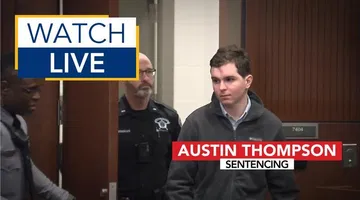
One key question was at the center of Austin Thompson's sentencing hearing on Tuesday.
Did his acne medication contribute to his actions, the day he killed five people in Raleigh's Hedingham community?
Other WRAL Top Stories
The defense started building a case Tuesday as they try to convince a judge that Austin Thompson deserves a chance at parole.
For the second time, Elise Thompson took the stand in her son’s sentencing hearing. This time, focused on his life as opposed to the shooting.
Elise was asked if she still loves Austin.
RELATED: Thompson guilty: Plea accepted in Raleigh mass shooting
"Yes, dearly," she responded. "It still hurts terribly, but yes, love him dearly."
She also said her two sons had a great relationship, as shown through dozens of family photos over the years.
"They got along very well," she said.
His defense team indicated we may never know why Austin Thompson shot and killed five people. But they have a theory.
Defense attorney Deonte' Thomas indicated that Thompson’s acne medication had an adverse reaction that led to him going on this rampage.
"Talking about minocycline and the disastrous effects this had on Austin," Thomas said. "It induces psychiatric side effects."
Raleigh psychiatrist Dr. George Corvin has evaluated Thompson. Corvin said the side effect from Minocycline could include depersonalization. Corvin was on the stand for more than four hours, and the day ended with him still being questioned.
"They’re there, but they’re not there," Corvin described the effect. "They’re there and doing things, but almost like they’re playing out a dream."
Corvin compared it to documented memory loss reactions people have had to sleep medication. And that type of reaction could pop up out of the blue. The doctor also said Austin Thompson may not remember the shooting, poking holes in the note he left behind that day.
"Not a whole lot you can do," Corvin said. "There is no warning."
But putting the why aside, Corvin explained the person sitting in court now should be treated differently from the one behind the trigger.
"His damage to the frontal lobes was catastrophic," Corvin said.
He said the self-inflicted gunshot essentially rearranged who Austin Thompson is.
"This is Austin 2.0 in a way," Corvin said. "He is not the same human being he was as a 15-year-old with an intact frontal lobe."
He’s finished his high school education while behind bars, but his IQ is much lower than before, now in the 90s. When asked if he misses his brother, Corvin said Austin told him "not really."
His emotional state is also different.
"Not sad or angry," Elise Thompson said. "He’ll still laugh, but there’s no … the emotion is gone."
"He’s a different human being," Corvin said.
According to Corvin, Austin Thompson is able to be reformed.
"Will he become who he was before? That is not possible," Corvin said.
Ultimately, Corvin said he didn't know why Thompson committed the crimes and agreed that no expert has a definitive answer.
"I can't give the answer to why this happened, and that's pretty unusual in these cases," Corvin stated. "It's unusual and frustrating to be unable to ascertain."
WRAL News reached out to the drug manufacturer to see if they have any comment, but have not heard back.
Tuesday was the first day of the defense's testimony, and they are expected to go through Friday.
Austin Thompson faces a mandatory minimum sentence of life with the possibility of parole after 25 years. The maximum possible sentence for Thompson would be five life sentences plus an additional 1,634 months in prison.