Log in to WRAL.com with one click using your favorite social network:
OR
Log in using your WRAL.com account:


Wrong email/password combination.

Forgot password?

Register with WRAL.com using your favorite social network:
OR
Register for a WRAL.com account using our web form.

Login Options

2:45 a.m. • 2-11-12

Weather Forecast for Raleigh

  • Today: Mostly Cloudy.
    • Hi: 52° F
  • Sun: Clear.
    • Hi: 43° F
  • Mon: Mostly Cloudy.
    • Hi: 50° F

Other Locations

> 7 Day Forecast

Doppler Image

Marketplace Links

Social Links

Main Menu

Do greener cleaners live up to Earth-friendly promise?


e-mail print friendly
Do greener cleaners live up to Earth-friendly promise?

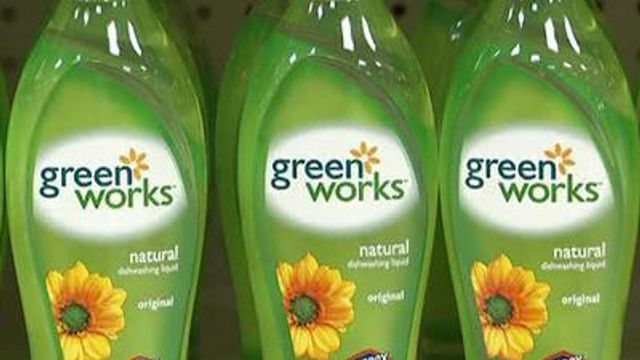
Many companies are selling household cleaners that claim to be more environmentally friendly than their predecessors. Do the “green” cleaners live up to their promises?

Ginger Pasley, an environmental scientist and instructor at Wake Tech Community College, says many "green" cleaners are, in fact, better for the environment.

She suggests that consumers read the labels and look for biodegradable ingredients.

"(This cleaner) contains no phosphates. That's a good thing,” Pasley said as she looked at one product. “Once this is released into the environment, it's going to last less than 30 days."

Green cleaners use plant-based ingredients. Cleaners that use ammonia, chlorine or phosphates are not as Earth-friendly.

Greener cleaners are more expensive. However, Pasley says families can save money by making their own products.

"Baking soda, vinegar and lemon juice – that's about all you need to clean your house," she said.

Vinegar is a de-greaser, baking soda is a mild abrasive and lemon juice is a natural disinfectant.

"It's a little bit more work for you, but a lot better for your health and for the environment,” Pasley said.

Kelly Reaves, who has children in her house and a baby on the way, said a healthy environment is very important to her.

“I know a lot of this stuff is new, so I haven't really gotten to try it. But, definitely, it's something we would think about,” she said. “You never really know what's in certain things."

Pasley shared some of the following Earth-friendly household cleaner recipes:

  • Mix three parts water, one part white vinegar and a few drops of concentrated castile (plant-based) soap to create your own biodegradable spray cleaner. A few drops of tea tree oil can be added as a natural disinfectant and to give it a fresh scent.
  • Vinegar cleans glass and leaves no streaks. Dilute or use at full strength. Add lemon rind to your spray bottle for a nice scent.
  • Use a lemon, cut in half, to disinfect your counter. Add salt on it to scrub away dirt/lime scale. Salt can be used as a mild abrasive and it won't scratch porcelain. Let the lemon juice dry, then wipe it off with a wet rag.
  • Cornstarch will remove grease from counter-tops. Sprinkle cornstarch on grease, let it soak in and then wipe it away with a damp cloth.
  • Borax can be used to clean stains from carpets. Make a paste by mixing Borax with water. Apply it to a dry stain and then vacuum it once the paste dries.
  • Baking soda or Borax can be added to laundry to boost the detergent's cleaning power.
  • Clean your drains by pouring equal parts of baking soda and vinegar (at least a half-cup each) down the drain. Let it set for a few minutes, then flush it down with a kettle of boiling water.
e-mail print friendly

14 Comments


WRAL.com welcomes your comments on this story. All comments are moderated prior to publication based on our posting guidelines. Please review them prior to posting and if your message is not approved.

View Comments VIEW ALL 14 COMMENTS

This story is closed for comments. Comments on WRAL.com news stories are accepted and moderated between the hours of 8 a.m. and 8 p.m. Monday through Friday.

Latest Comments
I wish people would do a little research before they start spouting off how "dangerous" CFL's are. Modern CFL's contain an average of 4mg of mercury, with some as low as 1.5mg. A standard 4 foot flourescent tube (like found in offices, stores, schools) contains an average of 8mg of mercury. As a CFL ages, most of the mercury becomes chemically bound up in the phosphors and is no longer very dangerous. In the USA last year we released about 105 metric tons of mercury into the air, mainly from coal burning power plants. If you took all 305 million of the CFL's sold in the USA last year and broke them open in your yard this would about to about 0.17 metric tons of mercury released! Using a CFL is SO much more energy efficient that it actually lessens the mercury impact on the environment because they use less energy from coal burning plants. If you break a CFL in your house just clean it up well trying not to touch it. Double bag the shards. Wash your hands. No big deal.

hi_i_am_wade,

Another "green" item that is actually very dangerous are these compact flourescent lightbulbs that are being pushed on us. These contain mercury, and if one breaks in your house, you have to call the HAZMAT team.

Have problems with black mold that won't go away? You have to kill the spores.

Mix 1 quart Chlorox, 2/3 cup Borax, 1/3 cup Tide powder and fill sprayer with water to make one gallon total solution. Works wonders, especially on white structures outdoors.

Also works on green mildew.

Correction. I just said "maybe, maybe not" about chemicals harming the planet. Chemicals do get into our water supply and then we drink them. That sounds pretty harmful to me.

"Here's a thought, buy the cleaner that's just a simple non-green cleaner. You'll save a buck each time and the earth will never know the difference." -deathrow

Maybe, maybe not. However, harsh chemicals do affect your health. Using greener products would be beneficial to your body.

View Comments VIEW ALL 14 COMMENTS
Report It

Multimedia

Click Here