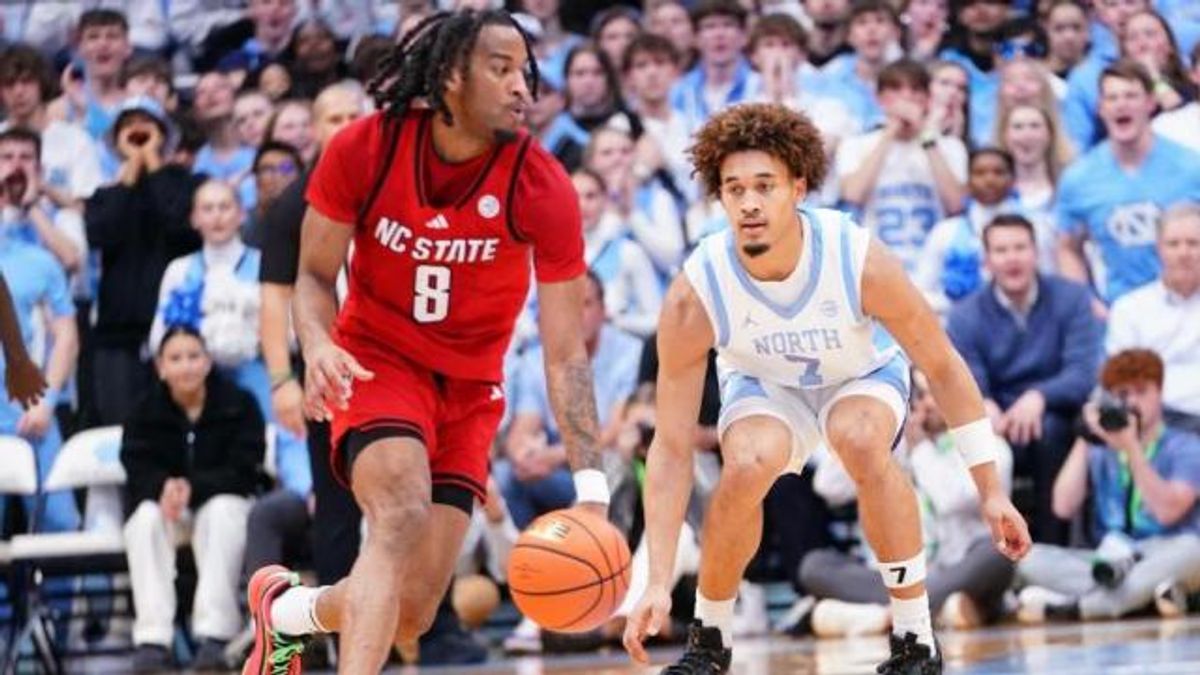
North Carolina and NC State played for the first time in football in 1894. They first clashed in men’s basketball in 1913.
Under a new bill filed Thursday in the North Carolina House, the longtime Atlantic Coast Conference rivals would be required to play each other annually in a number of sports. House Bill 469 is the Restoring Rivalries Act.
Other WRAL Top Stories
“Essentially what we want to ensure is that UNC and NC State will continue to play in a world where they are not both in the ACC,” said Rep. Brenden Jones, the House’s Republican majority leader and a lead sponsor of the bill.
The bill would require that the schools play annually in football, men’s basketball, women’s basketball, baseball and softball. In baseball and softball, the teams would have to play three games in an academic year.
Both UNC and NC State are founding members of the ACC, which was born in Greensboro and is now headquartered in Charlotte. Though the league is generating record annual revenue — more than $700 million in its latest public filing — it has fallen behind the Big Ten and Southeastern conferences in revenue, prestige and power in college athletics.
The league agreed to a settlement with disgruntled members Florida State and Clemson that reduces the penalty for schools that leave the league before 2036. If schools were to leave after the 2030-31 season, they would owe a $75 million.
UNC, in particular, is viewed as a prime candidate if either the SEC or the Big Ten opt to expand again. North Carolina is the most populous state without a team in either conference, if you consider Rutgers to be part of the New York market.
“I think it should be said as well that I hope UNC and NC State are never in separate conferences, and if the Big Ten or SEC were to ever invite either State or Carolina, this bill would indicate that they are a package deal,” Jones said.
The bill doesn’t stipulate that the schools remain in the same conference. If a conference were required to take both schools, it may be a dealbreaker.
Politicians and politics have played a significant role in conference realignment decisions over the past few decades, including Virginia Tech's addition to the ACC in the early 2000s. The UNC System Board of Governors, which oversees public universities, last year granted itself more authority over conference changes.
Similar legislation has been introduced previously, including a 2024 bill that would have required UNC and NC State to play other Football Bowl Subdivision programs East Carolina, Appalachian State and Charlotte regularly. But such measures have not advanced.
As a member of leadership, Jones could have more power to move the bill along this year.
“We’re hoping that because of the changing college sports landscape, legislators will see the need for this bill more now than in previous sessions,” he said.
Private schools Duke and Wake Forest are also members of the ACC, which holds numerous championship events in the state. Lawmakers previously approved a $15-million incentive package to keep the conference headquartered in the state, contingent on the league holding a number of conference championships in North Carolina.
Republican Reps. Kyle Hall, Jeff. McNeely and Mike Schietzelt are listed as cosponsors along with Jones.