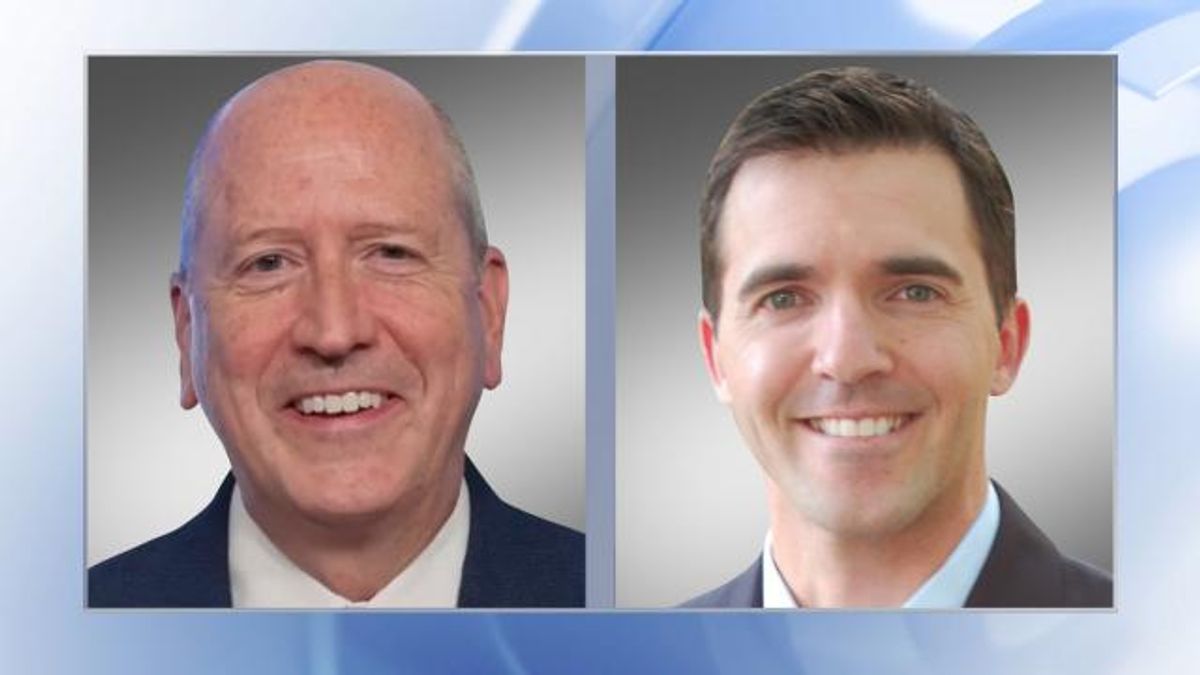
The Democratic nominee for North Carolina attorney general has seized support among younger and urban voters to build a lead in the race, according to a new WRAL News Poll.
Two of North Carolina’s congressmen are running for the state-level position: Democrat Jeff Jackson and Republican Dan Bishop. The seat is open because Attorney General Josh Stein, a Democrat, is running for governor.
Other WRAL Top Stories
Forty-three percent of likely November voters support Jackson and 36% support Bishop, with 21% undecided, according to the poll of 676 likely voters, which was released Tuesday. The gap has widened significantly since March, when a previous WRAL News Poll showed Jackson with a 41%-to-40% lead over Bishop.
The recent poll, conducted in partnership with independent pollster SurveyUSA between Sept. 4 and Sept. 7, reported a credibility interval of plus or minus 4.9 percentage points. A credibility interval is similar to a margin of error but takes into account more factors and is considered by some pollsters to be a more accurate measurement of statistical certainty.
A large number of undecided voters leaves the race harder to predict than others, said Chris Cooper, a political science professor at Western Carolina University. The same WRAL poll found 5% of respondents undecided in the presidential race and 11% undecided in the gubernatorial race between Stein and Republican nominee Mark Robinson, the state’s sitting lieutenant governor.
“With one in every five voters saying, ‘I just don't know,’” Cooper said, “We just don't know.”
However, poll results show significant shifts in support among certain voting blocs since March.
For instance, among voters ages 18 to 49, Jackson now leads by 14 percentage points (46%-to-32%) after trailing Bishop by 2 percentage points in March. Jackson is also now tied with Bishop among all male voters at 41% each, after trailing Bishop by 10 points in March. Jackson has also extended his lead with Black voters: he leads Bishop 80%-to-11% after leading 59%-to-11% in March.
Young voters and Black voters tend to vote for Democrats. So Jackson’s support among those groups isn’t unexpected, said Michael Bitzer, a political science professor at Catawba College. Bitzer said Jackson’s support among men — of all ages and races — is what stands out.
Voters between 18 and 49 years old and Black voters “are a natural component of that consolidation effect,” Bitzer said in an email. “What’s really interesting is the male vote: typically that is a core Republican constituency, as in the gender gap. For Jackson to be tied with Bishop among men is pretty notable at this stage.”
Those shifts have likely helped Jackson take leads in urban areas, where turnout is key to Democratic success in statewide elections. Jackson has erased Bishop’s lead in both Greensboro and Charlotte.
In Charlotte, an area that both men represent in Congress, Jackson leads by 5 percentage points (42%-37%) after trailing by a percentage point in March (40%-39%). In Greensboro, Jackson leads by 4 percentage points (39%-35%) after trailing by 6 points in March. Jackson also widened his lead in Raleigh by 23 points after leading by only 6 points in March.
Bishop, meanwhile, has built a lead in southern and coastal North Carolina. The Republican now leads by 16 percentage points (48%-32%) after leading those regions by only one point in March (42%-41%).
“Jackson is gaining ground,” Cooper said. “Some, perhaps most, of this is likely because a [Kamala] Harris tide is lifting all Democratic boats.”
The WRAL News Poll found the vice president leading Republican Donald Trump by 3 percentage points — an improvement for Democrats since March, when a WRAL poll found Trump with a 5-percentage-point lead over President Joe Biden.
Jackson’s lead over Bishop is smaller than Stein’s 14-point lead over Robinson in the gubernatorial race but larger than Mo Green’s 2-point lead over Michelle Morrow in the race to be North Carolina’s superintendent of public instruction.
That could be because Jackson hasn’t spent nearly as much as Stein on campaign ads — but likely has more name recognition than Green, who has never held elected office. Jackson, a former legislator, has built a following in the Charlotte area and on social media.
Cooper said it’s very possible that poll respondents either know who Jackson is or know someone who has seen one of his many videos on social media platform TikTok.
“I don't think it's a stretch at all to say that [Jackson’s social media strategy] is working,” Cooper said.