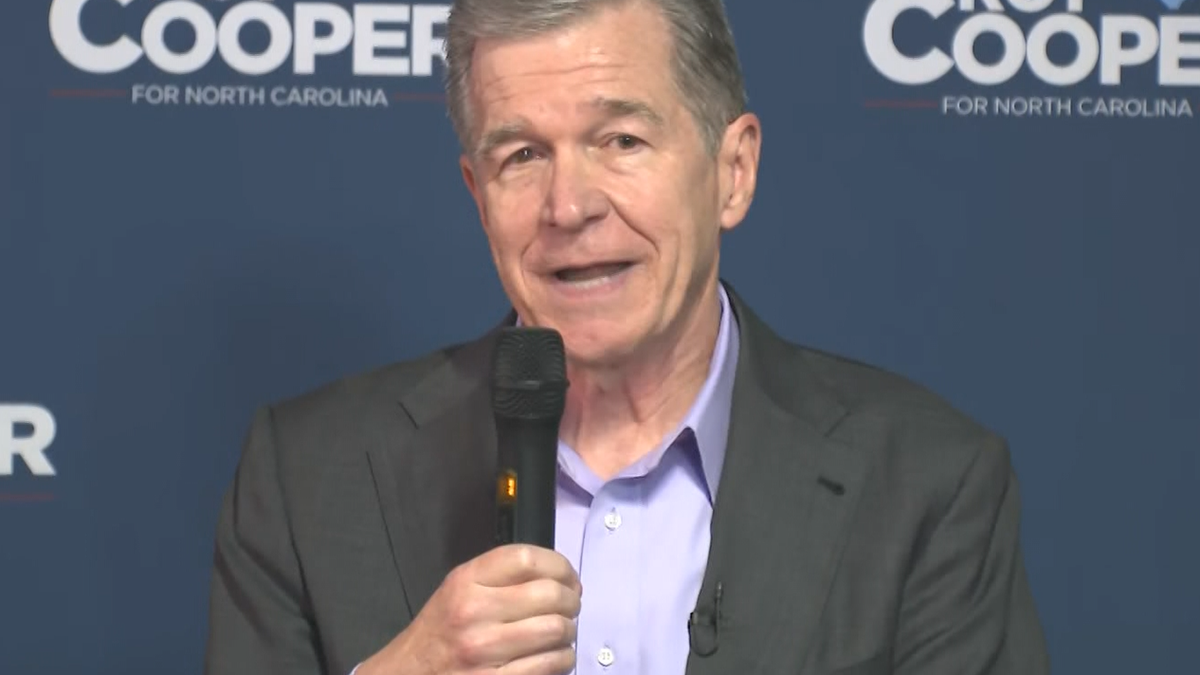
Republican lawmakers in North Carolina are demanding more attention to a lawsuit settlement that former Gov. Roy Cooper signed during the Covid-19 pandemic, releasing people from state prisons. The deal has become the focal point of GOP attacks against Cooper, a Democrat who is running for the state’s open U.S. Senate seat.
National Republican political groups see the settlement as a political weak spot for Cooper, who is leading Republican Michael Whatley in recent polls.
Other WRAL Top Stories
“Public safety is the most important responsibility of our government,” House Speaker Destin Hall, R-Caldwell, said Monday in a statement announcing a new oversight committee targeting the settlement. “If Roy Cooper or any other official failed at this most basic responsibility, the people of this state deserve to know about it.”
A recent Catawba College poll showed Cooper leading Whatley by 14 points. And Republican political groups are spending big to boost Whatley’s chances in the race. The Senate Leadership Fund — a group affiliated with Republican U.S. Senate leadership — recently announced it would spend $71 million boosting Whatley. Part of its support is a weekly email blast, highlighting various prisoners who were released under the terms of Cooper’s settlement.
Cooper’s campaign has defended his record on crime, pointing to his actions handling appeals for prosecutors around the state when he was attorney general, as well as his actions while governor.
“Roy Cooper is the only candidate who spent his career prosecuting violent criminals and keeping thousands of them behind bars as attorney general, and signing tough on crime laws and stricter pretrial release bail policy as governor,” Cooper spokesman Jordan Monaghan told WRAL earlier this year.
On Monday, Monaghan addressed the settlement more pointedly, characterizing the messaging from Republicans as "blatant lies.”
Republicans have attempted to blame the former governor’s policies for the conditions that led to the death of Iryna Zarutska on a Charlotte commuter train. Whatley said on social media last year that Cooper bears “direct responsibility” for Zarutska’s death because of the settlement, a claim Cooper has denied and PolitiFact has debunked.
Brown wasn’t behind bars when the settlement was made, and he wasn’t released as a result of it. The man charged with killing Zarutska was released from prison before Cooper signed the settlement but was included on the list by prison officials. Documents show officials counted recently released prisoners as part of their quota for the settlement, which allowed them to release fewer people in total.
“After Roy fought against these releases in court, North Carolina law enforcement officials and parole officers looked to similar criteria President Trump used a year prior when his administration released thousands of federal prisoners due to Covid-19,” Monaghan told WRAL on Monday.
Monaghan said North Carolina Republican leaders were regularly briefed on the process more than five years ago. He criticized lawmakers for “only now raising this issue in the middle of a political campaign.”
A spokeswoman for Senate leader Phil Berger, Lauren Horsch, said it's important to press for answers, saying Cooper "refuses to take accountability for setting violent, repeat offenders free."
Hall spokeswoman Demi Dowdy added: "The Cooper campaign's reaction to a little accountability seems pretty defensive. We just want to ask questions and get some answers on behalf of the public."
The settlement
Not long after the start of public-health shutdowns in early 2020 over Covid-19 concerns, the state chapter of the NAACP sued the prison system seeking the release of potentially tens of thousands of inmates for health reasons.
The advocacy group claimed that closely crowded conditions in the prisons during a pandemic violated the constitutional rights of the state’s approximately 30,000 prisoners. The group appeared headed to victory in court after a judge ruled in June 2020 that the NAACP was likely to win the case if it went to trial. After that ruling, Cooper agreed to avoid a trial and settle the lawsuit by releasing 3,500 inmates over the course of 2020 and 2021. Republican lawmakers say the prison system released more than 3,500 inmates.
Prison officials told WRAL at the time that most of those released would be people scheduled to be released in 2021 anyway, and that they would move up their release dates by a few months to meet the settlement’s quota.
Berger, R-Rockingham, indicated the committee plans to focus on Cooper — who signed the settlement since the prison system is under the governor’s control — and on his successor, Democratic Gov. Josh Stein, who was attorney general at the time of the settlement and therefore provided the lawyers for the prison system. State lawmakers heard testimony, at a committee hearing years ago, that Stein wasn't personally involved in the case or settlement.
“Republicans in the General Assembly are going to hold [Cooper] and Governor Stein accountable for releasing violent, repeat offenders and endangering our citizens,” Berger said in a statement announcing the new committee. His spokeswoman told WRAL the committee wasn’t yet ready to announce if, or when, it might ask Cooper, Stein or others to testify.
Lawmakers voted in 2023 to give the committee handling this new investigation vastly increased powers, including the authority to seek criminal charges against people it believes to be uncooperative.
Republican lawmakers have used other recent committee hearings to grill various other Democratic politicians.
Some of the recent hearings have focused on Attorney General Jeff Jackson’s work on Medicaid fraud investigations, concerns over LGBTQ-themed books in Chapel Hill-Carrboro Schools, and conservative activists’ allegations of government officials being too pro-diversity in Raleigh, Asheville and the UNC System.