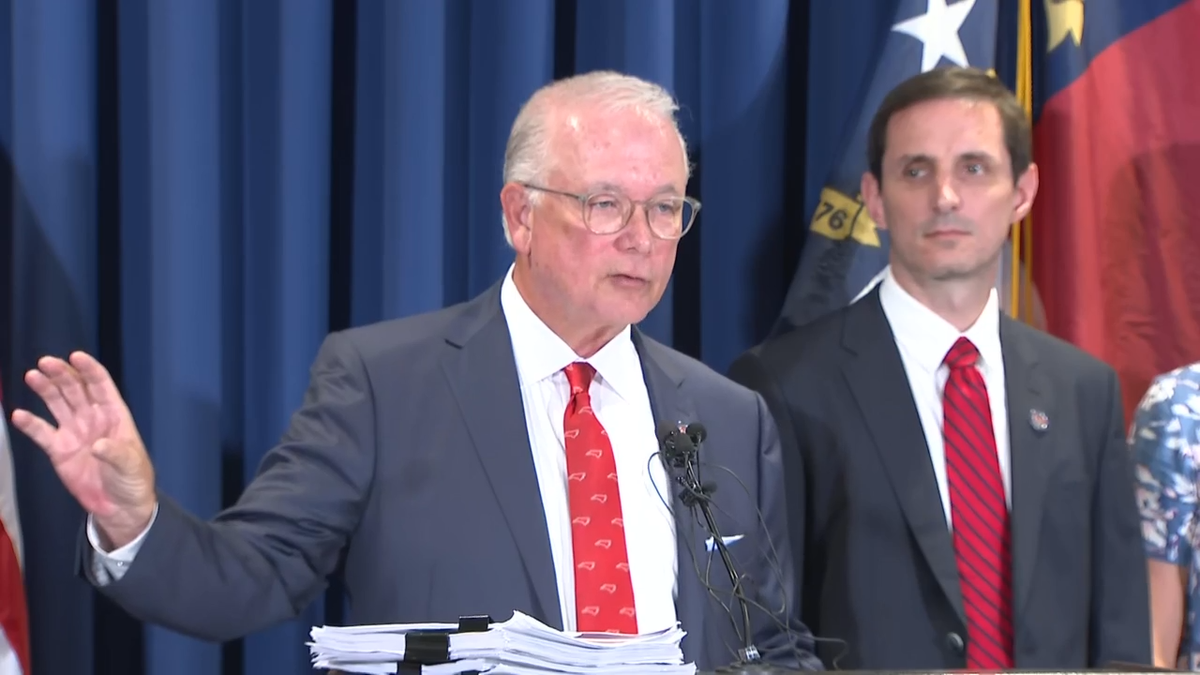
Republican State Auditor Dave Boliek said Monday that he shouldn’t have to recuse himself from a possible recount in an undecided state Senate primary because he doesn’t have any role in the vote-tallying process. The stance comes days after a candidate questioned Boliek’s ability to fairly oversee a recount because he endorsed a candidate in the race.
Rockingham County Sheriff Sam Page leads incumbent Sen. Phil Berger by 23 votes in the Republican primary for the state’s 26th Senate District. Page says Boliek — who oversees elections administration in the state — has a conflict of interest because he endorsed Berger. A win for Page would upend leadership in the chamber; Berger has led the Senate for more than a decade.
Other WRAL Top Stories
Boliek says his role in elections oversight is limited in such a way that ensures he doesn’t have a hand in tallying ballots.
In 2024, the Republican-led General Assembly passed a law that gave the state auditor’s office the responsibility of overseeing statewide elections, removing that power from the governor’s office. When the law was passed, Democratic Gov. Josh Stein was about to enter office. Boliek, a Republican, had just been elected to take over the auditor’s office.
Stein is in the midst of a lawsuit challenging the power shift. He and former Gov. Roy Cooper, who was governor when the law was passed, argue that the 2024 law violates the state constitution. Former Gov. Pat McCrory, a Republican, has also opposed the law.
While he may not have a role in counting ballots, Boliek does wield influence over who manages elections. Boliek has shaken-up election administration since being assigned oversight, appointing several Republicans to the state elections board and dozens more to county board leadership positions. Boliek recently launched a bipartisan commission to look at modernizing North Carolina’s election technology from 1998. His goal is to make campaign finance reporting easier and to ensure votes are tabulated quickly and accurately.
“[The] only goal in terms of running elections is to make it easy to vote, make it hard to cheat, and accurately tabulate the votes across the state of North Carolina,” Boliek said last month.
Boliek has also campaigned for some candidates, which isn’t uncommon for someone who oversees elections in this capacity. He was with Berger at the polls in February, which raised eyebrows with Page — particularly now that his race appears headed toward a recount.
Boliek responded to Page’s concerns during a Monday news conference that was called to discuss the findings of an unrelated municipal audit.
“There's nothing to recuse myself from,” Boliek said. “The process is clear, and in fact, the process did not involve the governor previously making any decisions [about election outcomes],” Boliek said. “And it does not involve the auditor making any decisions. Those decisions are made by the appointed board.”
Page reiterated his concerns on Monday, saying that even the appearance of a conflict of interest is problematic to him.
“If he removes himself, it removes any potential perception of impropriety,” Page told WRAL. “Voters should be 100% confident that their votes are being counted. … I still see this as a conflict and I would hope he, as state auditor, sees that as well.”
'A lot of fail-safe methods'
Page’s allegations underscore a messaging challenge the state auditor’s office faces with its added elections responsibility. While Boliek’s elections role is separate from the auditing role, his title — auditor — brings perhaps higher expectations of independence than other elected positions.
Auditors by profession are expected to avoid conflicts of interest or the appearance of such conflicts. Government auditing standards outlined by the U.S. Government Accountability Office take into account situations when an auditor might be bound by statute to serve in official roles that might raise questions about independence. In those cases, standards-setters encourage auditors to identify risks to independence and to ensure there are processes in place to reduce threats to independence.
State law also attempts to reduce the risk of bias in administering elections. The people Boliek appoints to elections boards are banned from donating to or making public statements in favor of or in opposition to active candidates. But the state auditor isn’t banned from doing those things, nor was the governor when that office oversaw elections.
On Thursday, State Board of Elections member Bob Rucho, a Republican who was appointed by Boliek, resigned after giving donations to county sheriff candidates and after making statements in support of Berger and against Page.
Rucho didn’t immediately respond to a message seeking comment.
Boliek told WRAL that Rucho “should have known.” Asked if he as auditor should be held to the same standard regarding donations and endorsements, Boliek said: “With respect to counting votes and certifying elections, the auditor just has no role in that. The roles and responsibilities of the state board are very clear, and our state board put that out in detail — more detail, I would say, than has ever been put out before. They've also taken strong steps on transparency — broadcasting, for example, live accounting and acceptance, or non-acceptance, of provisional ballots, which is an additional transparency and accountability effort that our state board and that [elections director Sam Hayes] and the state board has added to our elections.”
Jason Tyson, a spokesman for the state Board of Elections, last week dismissed the notion raised by Page that Boliek could sway the ballot-counting process. “There's no influence here from the auditor's office at all,” Tyson said Wednesday. “The public can be assured that this is going to be a safe and secure process that's outlined by law, that is not going to have influence, political influence in any way, shape or form.”
At a news conference about budget priorities on Monday, Stein was asked about his confidence in the vote-counting process. He said he has no reason to believe the vote count in the Berger-Page race is inaccurate, noting that he has faith in the process.
“One great thing about our system is that it has a lot of fail-safe methods to ensure accuracy,” Stein said.