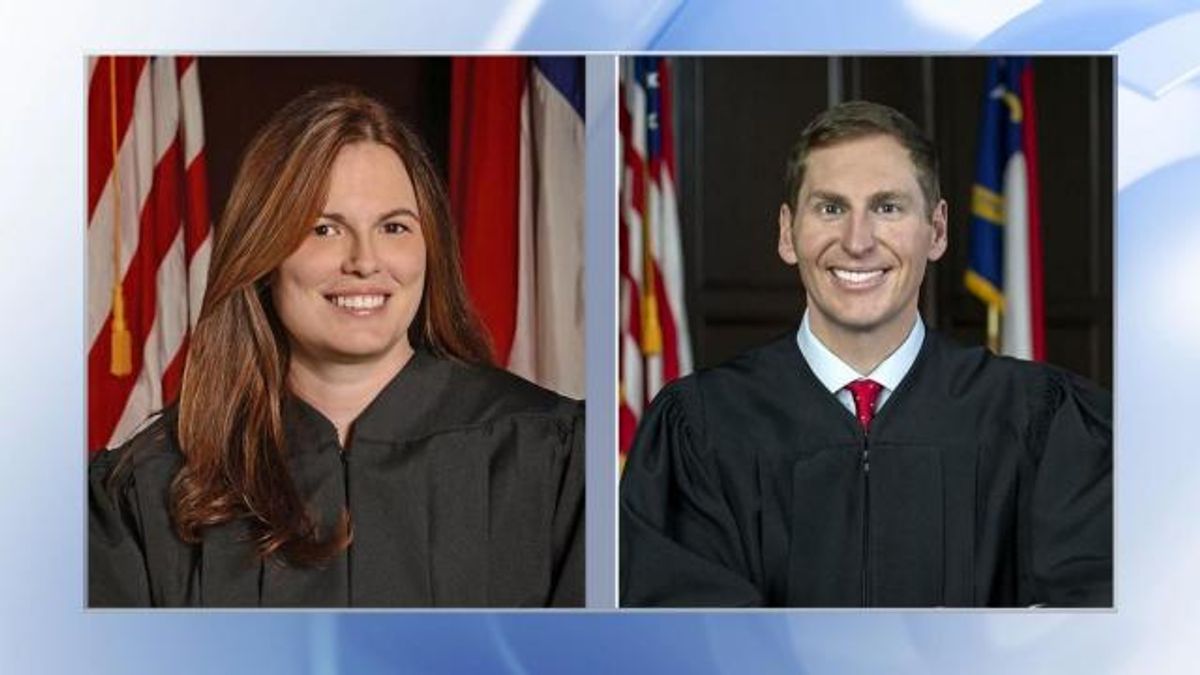
The North Carolina Supreme Court has blocked state elections officials from certifying Democratic Supreme Court Justice Allison Riggs' apparent victory in the 2024 elections, ruling Tuesday that more time is needed to look into her Republican challenger's claims of invalid voters.
The State Board of Elections has already voted to reject those claims launched by Riggs' Republican opponent, state appellate judge Jefferson Griffin. Under state law, Griffin should've appealed that decision in Wake County Superior Court for a trial on the evidence. He did not, and the deadline to do so passed last month.
Other WRAL Top Stories
Instead Griffin has asked the state Supreme Court — which has a 5-2 Republican majority — to take the issue up on its own and throw out the ballots in question, cast by more than 60,000 voters, without first taking the case to trial. Griffin has said in court filings he thinks he will end up the winner of the race, if the Supreme Court does that.
But because he didn't follow the proper appeal procedure, the elections board could've certified Riggs as the winner as soon as this week. Tuesday's order from the Supreme Court will stop the board from declaring Riggs the winner, at least while the legal fight plays out.
Former Gov. Roy Cooper, a Democrat, wrote on social media that the Supreme Court needs to allow the ballots to be counted since there's no indication that any fraud occurred.
"Allison Riggs won and the recount confirmed it," Cooper said. "Republicans want to toss thousands of legal votes in the trash because they don’t like the outcome. This shouldn't be about party politics. This should be about making sure every vote counts [and] that our elections still mean something."
Griffin says he doesn't think the state can be sure the voters in question are who they say they are. He has also raised questions about rules for people who voted while living overseas. Democrats say he hasn't been able to show evidence that even one of the 60,000-plus voters actually is an impostor.
Bipartisan dissent
The Supreme Court's decision to allow Griffin to argue his case wasn't unanimous. Two justices dissented, essentially arguing that Griffin's case should be thrown out and Riggs declared the winner — Democrat Anita Earls and Republican Richard Dietz.
An initial version of Tuesday's order stated that Earls, the lone Democratic taking part in this case since Riggs has recused herself, was the only dissenting vote. The court later published an updated order showing that Dietz also dissented.
Earls wrote that Griffin has made no valid arguments to throw out the ballots and shouldn't be allowed to continue with his efforts to do so, particularly since he already failed to follow the proper legal procedure set out by state law.
Dietz wrote that while he personally shares some of Griffin's concerns about state election rules, it's simply too late to act. The voters in question appear to have followed the rules in place for the 2024 election, he wrote, and courts shouldn't swoop in to change the rules after the fact.
"Permitting post-election litigation that seeks to rewrite our state’s election rules — and, as a result, remove the right to vote in an election from people who already lawfully voted under the existing rules — invites incredible mischief," Dietz wrote. "It will lead to doubts about the finality of vote counts following an election, encourage novel legal challenges that greatly delay certification of the results, and fuel an already troubling decline in public faith in our elections."
With Riggs' recusal, the court's vote was 4-2 in favor of allowing Griffin's challenge to move forward. Republican Justice Trey Allen responded to the dissents from Dietz and Riggs, writing that just because the court decided to let Griffin make his arguments doesn't mean Griffin will necessarily win the case.
"The court has merely ensured that it will have adequate time to consider the arguments made by Judge Griffin," Allen wrote.
Several of the voters who Griffin is challenging have come forward publicly to criticize his efforts to throw out their ballots; the list of voters whose ballots Griffin wants thrown out include multiple Democratic elected officials as well as both of Riggs' parents.
"Justice Allison Riggs won her seat fair and square and that will continue to be demonstrated before the courts," North Carolina Democratic Party Chair Anderson Clayton said in a written statement. "Justice Riggs deserves her certificate of election and we are only in this position due to Jefferson Griffin refusing to accept the will of the people."
In addition to any immediate effects this year's race would have on the balance of the court, it could also affect the next round of redistricting — and therefore national politics, too. National political groups are well-aware of that fact and have spent tens of millions of dollars on North Carolina Supreme Court elections over the past decade.
A Griffin victory would make it harder, though not yet impossible, for Democrats to retake control over the court before the 2030 Census and subsequent round of redistricting.
There are three Republican-held seats on the court that will be up for election in 2028. If Democrats flip all three, they'll retake the court as long as they also successfully defend at least one of their party's two seats currently held by Riggs and by Democratic Justice Anita Earls, who's up for reelection in 2026.
Legal back-and-forth
Complicating matters in this case is the fact that Griffin's legal theory underlying most of the challenged voters has already been rejected in federal court, with the 4th Circuit Court of Appeals ruling in October that those voters were allowed to vote and that furthermore state courts weren't allowed to take up the matter. Riggs' campaign, as well as the State Board of Elections, are trying to keep Griffin's lawsuit in federal court due to that precedent.
Late Monday, however, a federal trial court judge sent the case back to the state Supreme Court.
The Board of Elections quickly filed a notice of appeal in that case, trying to get it sent back to federal court. In Tuesday's ruling, the North Carolina Supreme Court's Republican majority said the justices were aware of that effort to take the case out of their hands — and therefore wanted to quickly file an order granting Griffin's request to stop the Elections Board from declaring Riggs the winner.
"This matter should be addressed expeditiously because it concerns certification of an election," the court's majority opinion said, laying out a schedule for both sides to file all their arguments with the Supreme Court before the end of January.
Earls said there was no reason to grant Griffin's request to block Riggs from being declared the winner because there is no indication that Griffin will succeed in his effort to have tens of thousands of voters disqualified after they already voted.
"There is no likelihood of success on the merits and the public interest requires that the Court not interfere with the ordinary course of democratic processes," Earls wrote, also calling Griffin's request to throw out ballots "fact-free post-election gamesmanship."