State elections officials on Wednesday denied efforts by the North Carolina Republican Party to throw out tens of thousands of ballots cast by voters in this year's elections.
The GOP had launched its protests to aid its party's trailing candidate in a still-uncalled race for a seat on the North Carolina Supreme Court — the latest step in one of the election cycle’s closest, most drawn-out contests.
Other WRAL Top Stories
The race might still not be over, however. Republicans can now appeal the board's decision in state court, but they have more than a week to decide whether to do so. The elections board still has not formally called the race, or three other state legislative races that could be affected by these protests, since there's still the potential for further legal battles.
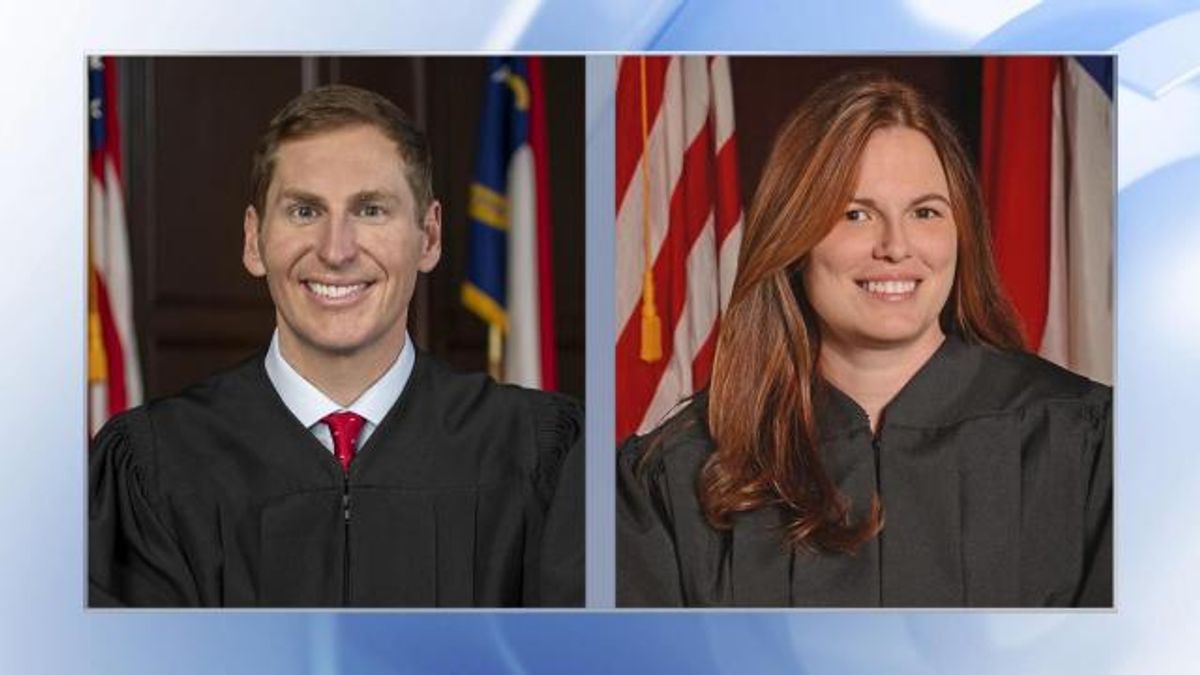
In the Supreme Court race, Republican Jefferson Griffin trails Democratic incumbent Justice Allison Riggs by fewer than 800 votes, two recounts have found; the latest results were announced by state officials on Tuesday.
The results have been prevented from being made official, however, as Griffin's campaign and allies seek to have officials throw out more than 60,000 ballots cast in this year's elections, based on what GOP leaders claim are instances of fraud or irregularities.
Just before casting the deciding vote to throw out that claim, State Board of Elections Chairman Alan Hirsch called the GOP effort an affront to democracy itself.
"The idea that someone could have been registered to vote, came to vote — and then had their vote discarded — is anathema to the democratic system and simply cannot be tolerated," he said. "And so therefore I'm going to vote to deny the protest."
The five-member elections board has a Democratic majority: Three Democrats and two Republicans. Wednesday's votes to deny the efforts to throw out the ballot came in four separate votes. One of the votes, concerning a small number of ballots cast by people living overseas, was unanimous. The rest came down along party lines.
Riggs spoke briefly with reporters after the meeting Wednesday and praised the elections board for protecting people's right to vote — including both of her parents, who were among the voters whose ballots the GOP had sought to throw out.
"Every lawful vote has to count," she said. "And as most of you know, I know some of the voters whose votes are challenged, and I can personally attest that they are, in fact, lawful votes. My parents were on that list."
The GOP protests cover half a dozen topics, but the vast majority of the ballots challenged deal with people for whom the state doesn't have personal information like a driver's license number saved in an internal database.
The Republican Party and other conservative activists launched the same argument before this year's elections, claiming the missing data made it impossible to know that those voters are who they say they are. It was rejected at the time by the state elections board as well as in federal court. Wednesday's vote marks another rejection for the attempt to question those voters' legitimacy.
The board also voted Wednesday, again along party lines, to find that Republican Party officials had failed to properly notify the voters whose votes it was seeking to throw out, as required under state law. The GOP sent out post cards with vague language that directed people to follow a QR code on their smartphone to learn more. The board's Republican members said that seemed fine, but the Democratic members say it was at best confusing and at worst purposefully designed to look like junk mail that people would throw away instead of paying attention to.
"I can't wrap my mind around an arbitrary postcard being noticed for something as important as my right to vote," said board member Jeff Carmon, a Democrat.
After the vote the North Carolina Republican Party blasted the elections board for voting against the GOP requests, blaming it on partisan politics.
"Unsurprisingly, the most partisan State Board of Elections in history has once again failed the people of North Carolina," NCGOP chairman Jason Simmons said. "The board’s continued efforts to engineer political outcomes for Democrats is shameful."
During Wednesday's hearing lawyer for Riggs, Ray Bennett, criticized Republicans for what he called a last-ditch effort to change the rules for voting after the election is over, and then punish people who couldn't have possibly known they weren't following rules that didn't exist.
"Election protests here violate a bedrock principle so basic, you learn it in elementary school: If you lose, you don't try to change the rules so you can claim that you won," Bennett said.
Bennett added that while the GOP is seeking to throw out tens of thousands of people's ballots because their driver's license number isn't listed in a state database, the GOP hasn't been able to identify a single person who's actually ineligible to vote under North Carolina's current rules for elections.
Hirsch asked GOP attorney Phil Strach to address that claim. Strach acknowledged that they haven't identified any ballots cast by a voter who was absolutely ineligible to vote. But Strach said that's only because they don't have enough data, which he blamed on poor practices by the elections board.
Supermajority also at stake
In addition to the state Supreme Court race, the board's decision Wednesday affected three state legislative races. Two are closely contested state Senate seats. The other is House District 32, a hugely important race for the broader balance of power within state government.
In that race Rep. Frank Sossamon, R-Vance, trails Democratic challenger Bryan Cohn by around 200 votes. Of the more than 60,000 ballots Republicans are challenging statewide, approximately 500 are from voters in that House district.
But the ballots Republican officials are challenging don't only include Democratic voters. So throwing out the ballots wouldn't necessarily guarantee a victory for Sossamon, Griffin or any of the other losing Republican candidates.
“We challenged registered Democrats, registered Republicans and unaffiliated voters without any favoritism," GOP attorney Craig Schauer said during Wednesday's hearing. "We believe the law matters, and that election laws should be enforced. And if you are ineligible to vote, your vote should not be counted. No one is above the law, not even voters who may have voted for my clients."
The other side said there's simply no evidence that the GOP's claims are legitimate.
"Protesters only now challenge these rules because they don't like their election results," said Democratic attorney Will Robertson said. "... They're an affront to democracy, and the rule of law."
Details of election protests
Republicans are launching two main types of complaints. One targets voters for whom the state doesn't have their driver's license number or Social Security number in a database. The GOP says that means there's no way of knowing those voters are who they say they are.
Hirsch said that doesn't make any sense because of the state's new voter ID law that's intended to verify people's identity. Anyone who didn't have an ID and wasn't able to claim a legitimate exemption from that rule has already had their ballot thrown out, Hirsch noted.
"They had to present a driver’s license, which obviously contains their driver’s license number — or the last four of their social, if they filled out an exemption form," Hirsch, a Democratic appointee to the elections board, told Schauer Wednesday. "So the same information that you’re concerned about was already available when they came in to vote."
Another category of ballots the GOP is challenging are those cast by voters who are American citizens but live overseas and have never lived in North Carolina, but who are still allowed to vote in North Carolina because their parents are or were registered to vote here. The rule mostly applies to children of soldiers and religious missionaries. State law explicitly says that's allowed, and one of the election board's Republican appointees, Kevin Lewis, openly questioned whether the GOP really thought the elections board had the power to overrule that state law.
In total, Griffin and other Republicans have launched about 66,000 challenges to people's votes, but some of them target the same voter in multiple ways. Complicating matters is that while state officials heard and rejected most of those 66,000 challenges today, there are still close to 1,000 that are in front of county-level boards of elections. Those could all be wrapped up next week, officials said Wednesday.
Prior to Wednesday's decision to reject the GOP claims, state Republican Party spokesman Matt Mercer said on Tuesday he believes state elections officials have been uncooperative, and that the GOP's actions challenging those thousands of ballots will improve public confidence in elections.
"We are committed to ensuring that every legal vote is counted and believe these protests should succeed," Mercer told WRAL.
Democratic officials and their allies held a news conference early Tuesday outside the state Supreme Court building and strongly criticized Griffin and other Republicans for initiating claims they say would disenfranchise legal voters. North Carolina Democratic Party Chair Anderson Clayton said she fears the state Supreme Court could ultimately side with Republicans and remove the challenged ballots, based on what she sees as an illegitimate legal argument.
"What's happening in North Carolina is sinister, and it will have a chilling effect on our democracy and our country if they're able to get away with what they're trying to achieve," she said Tuesday.
Close race
Griffin led Riggs by about 10,000 votes on election night, but that lead dwindled and flipped to Riggs as qualifying provisional and absentee ballots were added to the totals. Griffin then requested a recount.
Riggs was ahead by 734 votes following the first recount in the race, which finished last week. Griffin asked for a second recount, in which officials investigate a random sampling of ballots and compare what they see on the paper ballots to the results tallied by the ballot-counting machines. The State Board of Elections announced that the second recount found an additional 56 votes for Griffin and an additional 70 votes for Riggs, for a net gain of 14 votes in Riggs' favor.
Rigg's lead in the election still formally stands at 734 votes, since the second recount's findings aren't considered official election results, a spokesman for the State Board of Elections said.
Under state law, Griffin would only have been allowed to call for a third recount if this second one had shown him chipping away at Rigg's lead.
The Associated Press contributed to this report.