Apex physician doesn't accept health insurance
Access Healthcare displays fees for individual services in its waiting room. Patients pay upfront for the various services, and the clinic doesn't accept payments through health insurance coverage.
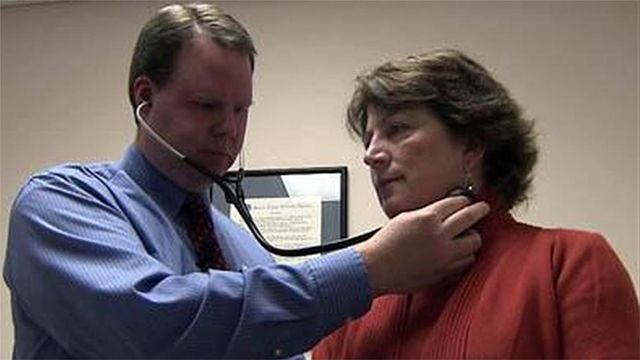
Posted — UpdatedDr. Brian Forrest opened Access Healthcare in 2002 to make health care more affordable for people without insurance.
The practice displays fees for individual services – $49 for a physical and $30 for a cholesterol test, for example – in the waiting room. Patients pay upfront for the various services in what is called the "direct pay model."
"We don't file or accept insurance of any type," Forrest said recently, noting that eliminating the paperwork involved with insurance claims saves his practice about $250,000 a year.
"If you were to go to a traditional office, you see someone who's filing insurance, somebody who's doing the billing, somebody who's doing the coding," he said.
Access Healthcare's staff includes only a receptionist, a medical assistant and a nurse practitioner in addition to Forrest and another physician.
"We can pass those savings directly onto the patients," Forrest said. "(Our) prices are generally 80 to 85 percent less than what they're going to be in traditional medical settings."
He compared the system to owning a car.
People have automobile insurance for a collision or a breakdown. Likewise, people should have health insurance for catastrophic illnesses or surgery, he said.
Yet, people don't use auto insurance to pay for vehicle maintenance, he said. They shop around for the best price and service, and the same model could be applied to health care.
Forrest said about half of his patients have health insurance and file their own claims after paying the Access Healthcare bill.
"Many times, our services are priced so low they can actually be less expensive for them to come there than to go somewhere and use their in-network coverage," he said.
Patient Cathy Boggs said she has used Access Healthcare for eight years and called the care Forrest and his staff provide excellent.
"There are no surprises. You know what you're getting. You know what you're spending for it," patient Boggs said. "You wouldn't buy clothes and not ask how much it costs before you go to the counter or look to see. Why should medicine be any different?"
Forrest also has built a network of specialists with which he has negotiated discounted rates for his patients who will pay cash up front. The network will provide services like mammograms and MRIs, for example, so people who don't have insurance can get medical tests or treatments they need by working out payments they can afford.
Not dealing with insurance allows more time with patients, Forrest said, noting that he schedules just one patient per hour.
"Having more time improves quality," he said.
The direct-pay model accomplishes what many people want out of health care reform – increased access for the uninsured, decreased costs and price transparency – and he said another 250 such practices nationwide will open up with or convert to the model in the next 18 months, including more than 10 in North Carolina.
• Credits
Copyright 2024 by Capitol Broadcasting Company. All rights reserved. This material may not be published, broadcast, rewritten or redistributed.