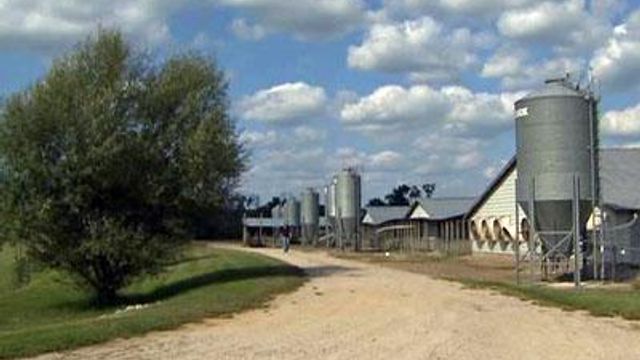
Raleigh, N.C. — Neil Strother runs a small family farm in Wilson County. It's a way of life that is in deep trouble.
About 25 hog farms in North Carolina sit idle and another eight are on the brink of closing, according to Deborah M. Johnson, CEO of the NC Pork Council.
“It’s extreme. We’re just trying to stay in business. I’m struggling and the big guys are struggling,” Strother said.
Farms started seeing problems about two years ago when hog feed prices soared as the need for grain expanded to make bio-fuels. Then the economic crisis made it nearly impossible to pass those costs on to consumers.
Earlier this year, the H1N1 virus, also known as the swine flu, also caused problems for the industry.
“If we could get people talking about H1N1 and stop using that awful term swine flu and get rid of it, and let consumers know pork is safe to eat, that would help us as well,” Johnson said.
Hog prices have remained steady. Costs are up, exports are down, but profits are dwindling.
“It’s dangerous for rural communities to threaten their incomes,” said Kelly Zering, an associate professor of agriculture and economics at North Carolina State University.
Zering said the decline in hog farms can be blamed for $1 billion of the state’s economic downtown.
“Demand for meat is expected to rise by 50 percent, and the big question is, ‘Can we maintain the productivity growth in agriculture so that prices for food do not rise in this country to the point where people start to suffer?’” Zering said.
On Strother's farm, the questions don't have easy answers.
“The option of just throwing the hands up and just walking away from it, that's not an option for any of us in this business,” Strother said. “A few have to do it, but that means a lot of people will be out of a job."
Strother said farm hands, truckers and even pharmaceutical companies are affected when hog farms shut down. He said the impact to local economies could be devastating.
Johnson was in Washington D.C. on Monday to discuss the problems North Carolina hog farms face with congressional staff.
Last week, members of the U.S. House of Representatives and U.S. Senate signed a letter to USDA Secretary Tom Vilsack in support of pork producers.
The letter outlined economic hardships faced by pork producers and requested the USDA purchase additional pork for federal food programs and work with agencies to address swine disease surveillance on farms.


![[SLIDESHOW]](http://wwwcache.wral.com/asset/entertainment/out_and_about/2012/02/02/10707648/bbpics_miyon53519-100x75.jpg)
![[SLIDESHOW]](http://wwwcache.wral.com/asset/lifestyles/travel/2012/02/09/10710709/10710709-1328829176-100x75.jpg)
![[SLIDESHOW]](http://wwwcache.wralsportsfan.com/asset/basketball/2012/02/09/10705803/10705803-1328766083-100x75.jpg)
![[SLIDESHOW]](http://wwwcache.wral.com/asset/lifestyles/travel/2012/02/08/10704761/10704761-1328743348-100x75.jpg)


WRAL.com welcomes your comments on this story. All comments are moderated prior to publication based on our posting guidelines. Please review them prior to posting and if your message is not approved.
This story is closed for comments. Comments on WRAL.com news stories are accepted and moderated between the hours of 8 a.m. and 8 p.m. Monday through Friday.
I suppose if you have children, you'd deny them animal protein as well. I believe there is a couple who are in prison for depriving their daughter of a animal protein diet. She was malnurished and stunted.
Animal proteins and natural fats are far more healther than soy processed junk. You are misinformed.
Check out www.bantransfats.com and learn the real truth about processed fats and the dangers they pose to humans.
October 7, 2009 2:48 p.m.
It's like comparing a "Light" cigarette to regular. Neither is healthy for humans.
Again, here is the link where Dr. Milton Mills shows that human biology is more aligned with herbivores: http://www.vegsource.com/veg_faq/comparative.htm
October 6, 2009 3:44 p.m.
The only thing saving the cattle industry is brood cow numbers never rebounded after cattle prices bottomed in 1995. Cattle numbers are still declining.
The pork industry survived $0.08/lb hogs in 1998. Hopefully this will pass.
Eat up folks.
October 6, 2009 11:24 a.m.
Where are you getting your information from? As with any other source of meat you have to choose the best cut for the requirements of your diet, such as boneless skinless chicken breast rather than a wing, but many cuts of pork are an excellent source of lean protein. Here is some great info on lean pork and chicken from http://www.ncpork.org/pages/consumers/nutrition.jsp
3-ounce cooked serving-- Calories;Total Fat(g);Saturated Fat(g);Cholesterol(mg) * LEAN CHICKEN o Skinless chicken breast*-- 140; 3.1; 0.9; 73 o Skinless chicken leg*-- 162; 7.1; 2.0; 80 o Skinless chicken thigh* -- 178; 9.3; 2.6; 81 * LEAN CUTS OF PORK o Pork Tenderloin*-- 120; 3.0; 1.0; 62 o Pork boneless top loin chop**-- 173; 5.2; 1.8; 61 o Pork top loin roast*-- 147; 5.3; 1.6; 68 o Pork center loin chop**-- 153; 6.2; 1.8; 72 o Pork sirloin roast*-- 173; 8.0; 2.4; 76 o Pork rib chop**-- 158; 7.1; 2.2
October 6, 2009 11:22 a.m.
Pigs are smarter than dogs, folks. And, the human body has no requirement for animal flesh or products. (this article by Dr. Milton Mills proves it http://www.vegsource.com/veg_faq/comparative.htm )
Of course, like tobacco, people will continue to kill themselves and whine about how gov't doesn't give them corporate welfare to do so.
October 6, 2009 11:21 a.m.