Raleigh, N.C. — Some financial analysts have recently said that the recession is nearly over and the economy will be on solid ground within the coming months. That is good news for people seeking work in the Triangle.
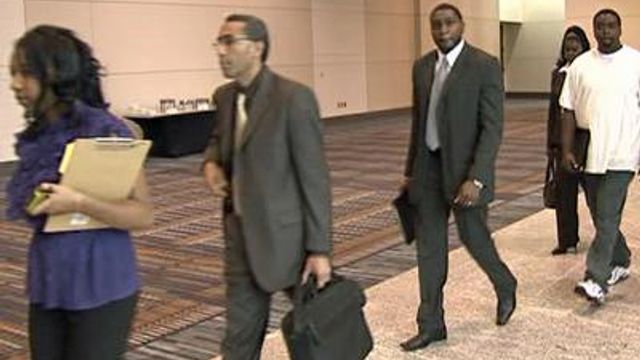
Around 3,500 job seekers attended the WRAL JobLink Career Expo at the Raleigh Convention Center Wednesday. A lot of people at the event have been searching for jobs for months.
“It is humbling because you think you never have to worry about it,” job seeker Dan Wilber said of being out of work.
“I’d been there 29 years,” job seeker Wesley Layton said of his former company.
The unemployment rate in North Carolina is down from its peak in the spring, but finding a job is still not an easy task.
“I'm 29, and I’ve had a job since I was 16. Now when it is time for my career to be in focus, I’m out of work,” job seeker Crystal Perry said at the Career Expo.
“I mean you hear it on the news, but then when you actually come out here (Career Expo) and see how many people are looking, it is a reality check,” job seeker Sharon Thorpe said.
“It is real life, and it is painful,” investment planner Gerald Townsend said Wednesday, of looking for work during a recession.
The state’s unemployment peaked at 11.1 percent in May but since then, has slowly slid to 11 percent in June, 10.9 percent in July and 10.8 percent in August. However, U.S. unemployment increased in August to 9.7 percent from 9.4 percent in July.
Historically, when unemployment is at the highest, Townsend said it signals the end of a recession.
“When ... you have cutbacks, your inventory is low, you are undermanned, (and) understaffed. Then all of a sudden, there is a big snap back effect because now orders are coming in and you have got to fill those orders,” Townsend said.
Many companies at the Career Expo said work is picking up and that they expect to have more job openings in the months to come.
“It was a little bit tough at the beginning of the year. It was a little bit slow and now we are starting to see an increase in our workload,” said Terry Prince, with Hipp Engineering.
Morrisville-based Hipp Engineering had representatives at the Career Expo. The company is looking for contractors to work with clients in the pharmaceutical and bio-tech industries.


![[SLIDESHOW]](http://wwwcache.wral.com/asset/entertainment/out_and_about/2012/02/04/10712136/pics_agunn53833-100x75.jpg)
![[SLIDESHOW]](http://wwwcache.wral.com/asset/lifestyles/travel/2012/02/09/10710709/10710709-1328829176-100x75.jpg)
![[SLIDESHOW]](http://wwwcache.wralsportsfan.com/asset/basketball/2012/02/09/10705803/10705803-1328766083-100x75.jpg)
![[SLIDESHOW]](http://wwwcache.wral.com/asset/lifestyles/travel/2012/02/08/10704761/10704761-1328743348-100x75.jpg)


WRAL.com welcomes your comments on this story. All comments are moderated prior to publication based on our posting guidelines. Please review them prior to posting and if your message is not approved.
This story is closed for comments. Comments on WRAL.com news stories are accepted and moderated between the hours of 8 a.m. and 8 p.m. Monday through Friday.
September 25, 2009 7:50 p.m.
September 25, 2009 7:22 p.m.
CLEAR Misrepresentations. I don't think deliberately, I just think your biased and didn't comprehend as well as you could have." - MakoII
I am referencing sources OTHER than Wikipedia, including the text of Bernanke's speech.
And to answer your question, I subscribe to the Austrian School, that artificial manipulation of market whether by the Fed (or mechanically like Friedman wanted) will result in the boom/bust cycles that we have been experiencing since 1913.
September 25, 2009 5:59 p.m.
Even though we're not on the Gold Standard? Even though all the worlds currencies are NOT the same or to the same standards?" - MakoII
The exact same monetary policies have been used in the last two boom/bust cycles as those that occurred preceding the depression. The gold-exchange standard of that day has been replaced with the dollar being the world reserve currency.
You should know that as the US being the largest debtor nation EVER wields tremendous influence on the world's economies.
Remember, Friedman was still a Keynesian and that is why you like his opinions. He believed that while the Fed CAUSED and exacerbated the depression, if they would have just manipulated monetary policy differently, the outcome would have been better.
This, as a Keynesian, is where Friedman drops the ball.
September 25, 2009 5:50 p.m.
"[3] In their view, the failure of the Federal Reserve to deal with the Depression was not a sign that monetary policy was impotent, but that the Federal Reserve exercised the wrong policies. They DID NOT CLAIM the Fed CAUSED the depression, only that it failed to use policies that might have stopped a recession from turning into a depression"
You haven't read the entirety of Bernanke's speech. They identified four monetary policy episodes. The quote you provided discusses post-crash. They clearly laid the blame for the depression on the pre-crash episodes:
"The first episode analyzed by Friedman and Schwartz was the deliberate tightening of monetary policy that began in the spring of 1928 and continued until the stock market crash of October 1929. This policy tightening occurred in conditions that we would not today normally consider conducive to tighter money..."
September 25, 2009 5:37 p.m.