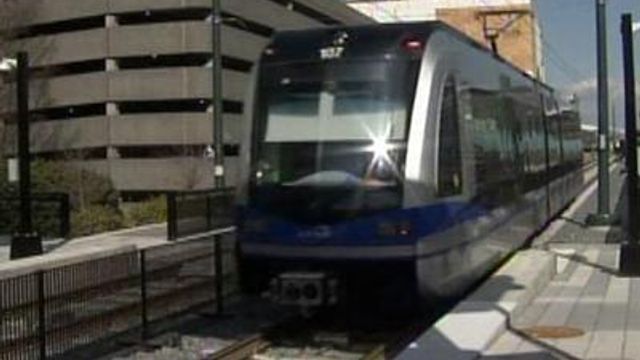
Chapel Hill, N.C. — The future of mass transit began taking shape in the Triangle Thursday as planners unveiled specifics about a proposed 30-mile light rail that would connect Wake, Durham and Orange counties in the next 10 to 15 years.
The Durham and Orange county sections would be completed first, organizers said, and would begin at UNC Hospitals in Chapel Hill, end at North Carolina Central University and have 15 stops in between. The proposed transit map does not yet include Wake County's plans.
“Wake is moving right along. They’ve got more options to consider, so they’re still weighing options,” said Damien Graham with the Triangle Regional Transit Program.
The estimated cost for the light rail proposal through Durham and Orange counties is about $1.4 billion. Durham already passed a half-cent sales tax increase. Orange and Wake counties have yet to hold their referendum to pay for the local portion.
“Anytime you’re talking about an investment the size we’re talking about, it’s a significant piece of infrastructure. It takes a long time to develop this," Graham said.
Transit organizers say if everything goes to plan, construction could begin as early as 2020, and it could be operational by 2025 or 2026.
“I think it would be beneficial to so many people, and it would just help the economy,” said Triangle resident Jerra Collins.


![[VIEW PAGE]](http://wwwcache.wral.com/asset/news/local/politics/2007/02/06/1195254/1296152831-_NCCapitol_800x600-100x75.jpg)
![[VIEW PAGE]](http://wwwcache.wral.com/asset/entertainment/movies/2007/12/29/2229920/2229920-1208172047-100x75.jpg)
![[VIEW PAGE]](http://wwwcache.wral.com/asset/2008/06/05/3000786/swimming_pool-100x75.jpg)
![[VIEW PAGE]](http://wwwcache.wral.com/asset/lifestyles/goaskmom/2011/04/28/9516059/9516069-1304016629-100x75.jpg)
![[VIEW PAGE]](http://wwwcache.wral.com/asset/lifestyles/house_and_home/2008/07/27/3287725/Blueberries-100x75.jpg)
![[VIEW PAGE]](http://wwwcache.wral.com/asset/traffic/2009/07/23/5645694/beltline-100x75.jpg)


WRAL.com welcomes your comments on this story. All comments are moderated prior to publication based on our posting guidelines. Please review them prior to posting and if your message is not approved.
This story is closed for comments. Comments on WRAL.com news stories are accepted and moderated between the hours of 8 a.m. and 8 p.m. Monday through Friday.
May 4, 2012 7:45 p.m.
It’s not about breaking even. No transportation method breaks even; they all get subsidies from roads to buses to planes. It’s about what loses the least amount of money and therefore costs the taxpayers less to subsidize.
Up in DC, those subways moved 287.3 million rides at a total cost of $787.3 Million. That works out to a cost of $2.74 per ride. Up in DC it costs $4.34 per ride on a bus. So if there was no subway, it would have cost an extra $459.68 Million to get the job done. That’s $1.247 Billion to move all those people by bus, as opposed to $787.3M by subway.
Did you want that much larger bill?
I sure don’t! I like lower taxes.
May 4, 2012 6:15 p.m.
May 4, 2012 5:20 p.m.
And because so much of had to be underground, current capacity and expansion is limited by the tunnels. And of course the whole main Metro station is below sea level at the National Mall, and the train to Reagan International goes under the Potomac River.
Yes the DC subway is a monster, but that it the result of endless state vs federal, state vs state, and country vs county politics!
May 4, 2012 5:15 p.m.
May 4, 2012 4:42 p.m.