Komen for the Cure
Get the Skinny on Cancer-Fighting Fat Cells
The latest weapon in the battle against tumors is smaller than a red blood cell and being developed at Duke University.
Posted — UpdatedDURHAM, N.C. — Health experts claim the way drugs are used to treat cancer, the whole body is exposed to the drug, not just the tumor. Plus, there is no way for doctors to measure how much drug actually gets to the tumor. Duke researchers believe the answer is in a special kind of cell.
Duke cancer researchers Dr. Mark Dewhirst and Dr. Ben Viglianti said they have developed a way for the drug to arrive in tiny, fabricated fat cells.
"When I say tiny, they're about one-hundredth the size of red blood cells," Dewhirst said.
The drug-filled fat cells stay intact when the body temperature is at a normal 98.7 degrees Fahrenheit. But, when the tumor is heated just six degrees more, the fat cells melt.
"It melts and when it melts, the drug comes out. It comes out very fast," Dewhirst said.
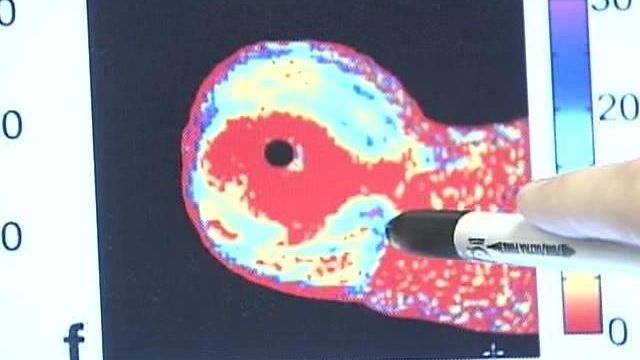
The fat cells also carry a contrast agent so an MRI image can show how much of the drug is in the tumor.
"You're literally seeing the drug being deposited in the tumor in real time, nearly," Dewhirst said.
Observing where the drug is delivered can be important because some cancer drugs can hurt normal tissue such as the heart. Dewhirst said it is a new paradigm for drug delivery.
"I really think this kind of approach will revolutionize how we treat local advanced disease. I really do," Dewhirst said.
The drug delivery system is now in human clinical trials at the National Institutes of Health and at Duke for women with chest wall recurrences of breast cancer.
Dewhirst said the drug delivery system will work for locally advanced tumors that have not metastasized, or spread to other parts of the body. He also said it could work with advanced breast cancer, cervix cancer, colorectal and possibly esophageal cancer.
• Credits
Copyright 2024 by Capitol Broadcasting Company. All rights reserved. This material may not be published, broadcast, rewritten or redistributed.