The state budget is heading into a season one Senate leader compared to the NBA Playoffs: the part that really matters.
Senate Republicans moved their nearly $24 billion spending plan forward Thursday afternoon, pulling two yes votes from Democrats on what was otherwise a party-line affair.
Other WRAL Top Stories
The Republican majority pitched the budget, with its tax cuts for North Carolina businesses and close attention to state reserves for leaner times, as a continuation of fiscal policies that have helped the state's economy grow.
Democrats said the plan doesn't include enough money for schools or a range of other priorities. The budget also doesn't expand Medicaid, which would grant taxpayer-funded health insurance to hundreds of thousands of the working poor. That may well mean Gov. Roy Cooper vetoes the entire thing.
That would set up a standoff that could last for months, now that Republicans control majorities in both legislative chambers but don't have the numbers to override a veto without help from Democrats.
When that conflict finally emerges, Senate Minority Leader Dan Blue said, the playoffs begin. Veteran players know "that the real game is when the playoffs start," said Blue, D-Wake.
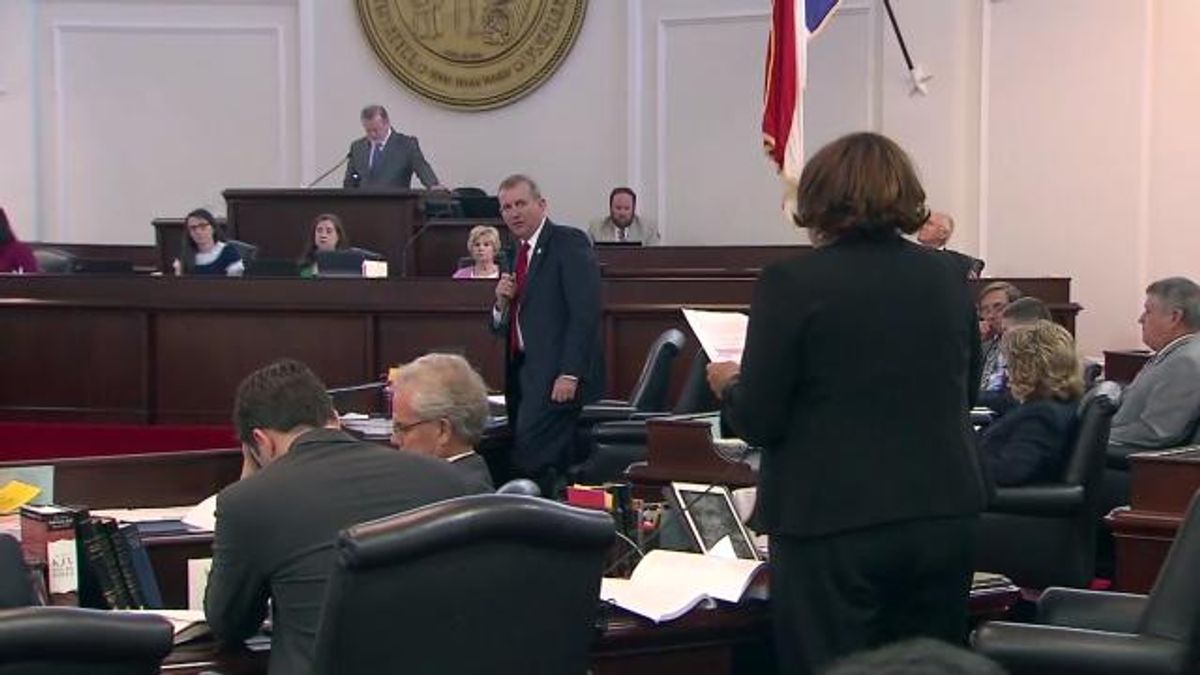
The chamber's afternoon-long budget debate was angry at times, particularly when Sen. Don Davis, D-Pitt, called on his colleagues to drop language that may cost a hospital in his eastern North Carolina district $35 million.
Later, Sen. Terry Van Duyn, D-Buncombe, pressed the body to expand Medicaid, speaking loudly as Senate President Pro Tem Phil Berger asked for quiet so that the body could move on, and Berger turned off her microphone.
"I have not had to do that to any member of this body (in 10 years)," said Berger, R-Rockingham. "I hate that I had to do that."
Sen. Paul Lowe, D-Forsyth, a preacher, blasted the budget as "a dastardly thing" because it cuts half of new North Carolina Supreme Court Chief Justice Cheri Beasley's staff.
Cooper named Beasley to the chief justice seat earlier this year, upsetting Republicans who'd asked him to elevate Justice Paul Newby, the court's senior member and the only Republican left on the Supreme Court after last year's elections.
Beasley is the court's first black female chief, something Lowe noted as he called the cut "morally wrong."
"The last think I want to do is cuss in this chamber, but it's wrong," said Lowe.
There was also a Democratic effort to stop the proposed Department of Health and Human Services move from Raleigh to Granville County, which surprised the department, and most lawmakers when it popped up in the budget this week.
Republicans beat that back, along with a number of other proposed amendments from the minority party, either tabling the proposals or defeating them outright. Among them were:
- Sen. Joyce Waddell, D-Mecklenburg, wanted to add a 2 percent cost of living increase to the budget for state retirees. The Senate budget doesn't include any increase, while the House budget includes a one-time, 1 percent bonus for retirees.
- Sen. Wiley Nickel, D-Wake, wanted to strip increased registration fees for electric vehicles and plug-in hybrids from the budget.
- Sen. Natasha Marcus, D-Mecklenburg, wanted to de-fund pregnancy crisis centers Republicans have given money to through the budget in recent years.
- Sen. Gladys Robinson, D-Guilford, wanted to put more money into the state's Medicaid program.
- Sen. Kirk DeViere, D-Cumberland, wanted to restore master's degree pay bonuses for teachers.
In a couple of cases, Republican leaders told Democrats they would work with them on budgetary changes as the plan moves forward. Blue thanked Berger for that at the end of Thursday's debate and for allowing hours of floor debate on the bill even though Republicans had the numbers they needed to simply push it through.
The vote was 29-18, with Robinson and Sen. Ben Clark, D-Hoke, voting with Republicans.
Berger, in his closing remarks, noted that the bill includes a 5 percent raise for state employees over the next two years, smaller raises for teachers, new bonuses for school principals and corrections officers and a $1.3 billion increase overall for public education. It also invests in the state's "rainy day" reserve fund.
"This budget, on balance, is one of the best budgets that we've passed here in the Senate," Berger said.
It will take one more vote, slated for Friday, for the budget to clear the Senate and head to the House for more debate.