
EDITOR'S NOTE: Amanda Taub is a former human rights lawyer, now writer for the @nytimes Interpreter, exploring the ideas and context behind major world event.
Other WRAL Top Stories
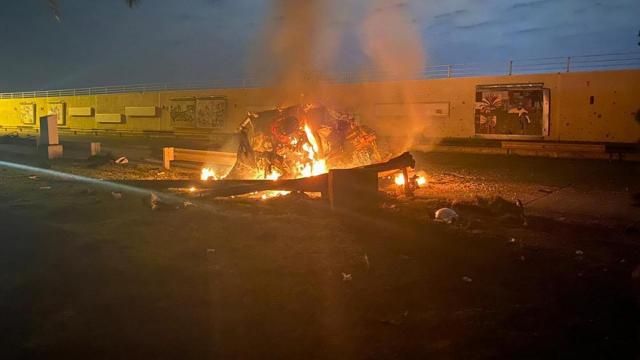
One of the many big questions looming over President Donald Trump’s decision to assassinate Maj. Gen. Qassem Soleimani is this: Was it a good idea?
Some Iranian officials have called the killing of Soleimani — whose role in Iran has been likened to that of an American vice president, chairman of the Joint Chiefs and CIA director rolled into one — an act of war. But if was, it took place without any of the public discussion in the United States that preceded actions like the 2003 U.S. invasion of Iraq.
American officials have justified the attack in Baghdad as retribution for the general’s own actions and deterrence of future American deaths. The strategic implications, though, can be confusing in this quickly unfolding debate.
CRIME(S) & PUNISHMENT
Soleimani planned and directed attacks that killed thousands of civilians in Iraq and Syria, along with many U.S. service members. American politicians on both the left and the right have taken pains to note his past, whether or not they support his being killed.
“Qassem Soleimani masterminded Iran’s reign of terror for decades,” said Sen. Tom Cotton, a Republican who supported the airstrikes. Former Vice President Joe Biden, one of the leading Democratic presidential candidates, said Soleimani “deserved to be brought to justice,” though he criticized the strategic wisdom of Trump’s decision.
“He was a monster, no question,” said Vipin Narang, an MIT political scientist who has studied efforts to halt Iran’s nuclear program. “But there’s a consequentialist argument as well.”
Using retribution as justification can be straightforward in criminal proceedings, where judges and juries can apply the law without considering strategic consequences. But that logic does not apply in foreign policy.
“The underlying reason that we don’t go around killing all bad people is that we usually make a decision about which bad people it’s in our interest to kill at this time,” said Lindsay P. Cohn, a foreign policy scholar at the Naval War College, who spoke in a personal capacity. Relying on retribution alone as a basis for such action, she said, is “fundamentally unstrategic.”
If the killing of Soleimani creates a precedent for assassinating senior government figures, he said, American officials and their allies could become targets as well. And that would be a source of broad global instability.
“We killed people inside their sovereign territory, without the permission of the government,” Cohn said, noting that the U.S. airstrike also killed Abu Mahdi al-Muhandis, an Iraqi militia leader aligned with Iran, and other Iraqis. “This is a massive violation of sovereignty.”
CASE FOR DETERRENCE
The administration has also cited deterrence as a motive. Secretary of State Mike Pompeo, in an appearance on CNN, said the U.S. strike disrupted an “imminent attack” on American interests in the Middle East.
Scholars tend to divide deterrence into two broad categories. Specific deterrence focuses on stopping individuals from specific acts. General deterrence sends a message that goes well beyond the direct targets.
In this case, the narrowest type of deterrence has been effective. Killing Soleimani ensures he will no longer carry out attacks on the United States or its interests. But widen the circle slightly, and the picture becomes less clear.
“The best-case argument for deterrence is, you kill Soleimani and whoever replaces him is more moderate because they’re afraid of the same fate. And that’s possible,” said Narang, the MIT political scientist.
Rupal Mehta, a political scientist at the University of Nebraska who studies Iran’s military and nuclear program, said the U.S. strike could send a message to the surviving members of the network that they should follow a more moderate path.
But when the United States has killed high-ranking members of terrorist organizations in the past, Mehta said, their replacements have tended to be more extreme, not less.
The crucial question, when it comes to deterring future attacks by Iran or its allied militias, Cohn said, is whether the assassination has degraded Iran’s military capability.
If so, the assassination will probably avert further attacks, at least in the short term. Analysts agree that no single individual in Iran can match Soleimani’s military skill and political power.
But it may not need to replace him precisely in order to maintain its military capacity.
Soleimani created a network of armed groups that may withstand his death. It includes Iran’s Quds Force, which conducts Iran’s foreign military operations, as well as militias in Lebanon, Yemen, Iraq and Syria.
Narang of MIT said the deterrence argument “assumes a unitary, rational actor.” While he said that could apply to Iran, which may want to avoid war, it may not apply, say, to Hezbollah, which Iran backs in Lebanon.
THE RISK EQUATION
Trump’s predecessors also had opportunities to assassinate Soleimani but chose not to do so. By going ahead with the killing, Trump may gain leverage by demonstrating to Tehran that he has a higher tolerance for risk than did Presidents Barack Obama or George W. Bush.
“Tehran’s estimate of Trump’s cost tolerance has almost certainly increased,” Kyle E. Haynes, a Purdue University political scientist, wrote on Twitter.
Still, for general deterrence to work in foreign policy, a country needs to send a message — either directly through diplomatic channels, or implicitly via force and threats — that clearly conveys its demands and the threatened consequences for failing to cooperate.
“If I’m one country and you’re another country and I want you to do something or not do something, if you comply with my demands I have to hold up my end of the bargain,” said Elizabeth Saunders, an international relations scholar at Georgetown University. If the demands are unclear, the rewards of compliance will seem uncertain. In this case, Trump has called for Iran’s “aggression in the region” to end, but specifics about what that entails are scarce.
Military force, like the attack on Soleimani, is an especially high-risk means of delivering a message of deterrence. It threatens to create what foreign policy scholars call a spiral, in which tit-for-tat retaliation locks the parties into escalating conflict. To prevent such a spiral, at least one of the parties has to have opportunities to back down without losing face, experts say.
“These cases are all a kind of delicate dance, a mix of public signals and private signals,” Saunders said. Often, the less public a conflict is, the more options there are to defuse it.
By taking public responsibility for Soleimani’s assassination, the Trump administration “blew up that delicate dance,” Saunders said.
The administration is preparing for a potential escalation, which would seem to undermine its deterrence argument. On Friday, the Pentagon announced that 4,000 troops would deploy to Kuwait, “in response to increased threat levels against U.S. personnel and facilities.”