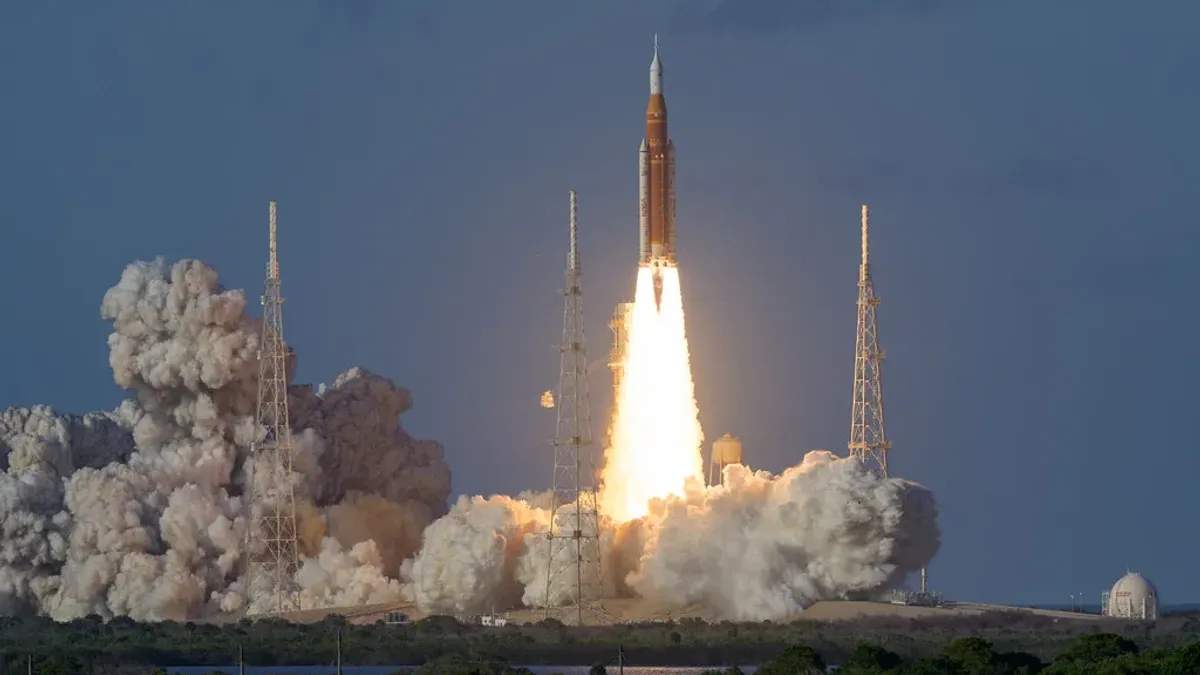
When the Artemis II mission lifted off last week atop NASA’s Space Launch System (SLS), it wasn't just an incredible sight. It was something you could feel miles away and clearly hear even from the press site located 3.4 miles from the launch pad.
One of the most common questions is, "How loud was it?" Researchers at Rollins College in Winter Park, Florida, and Brigham Young University in Provo, Utah, wondered too.
Other WRAL Top Stories
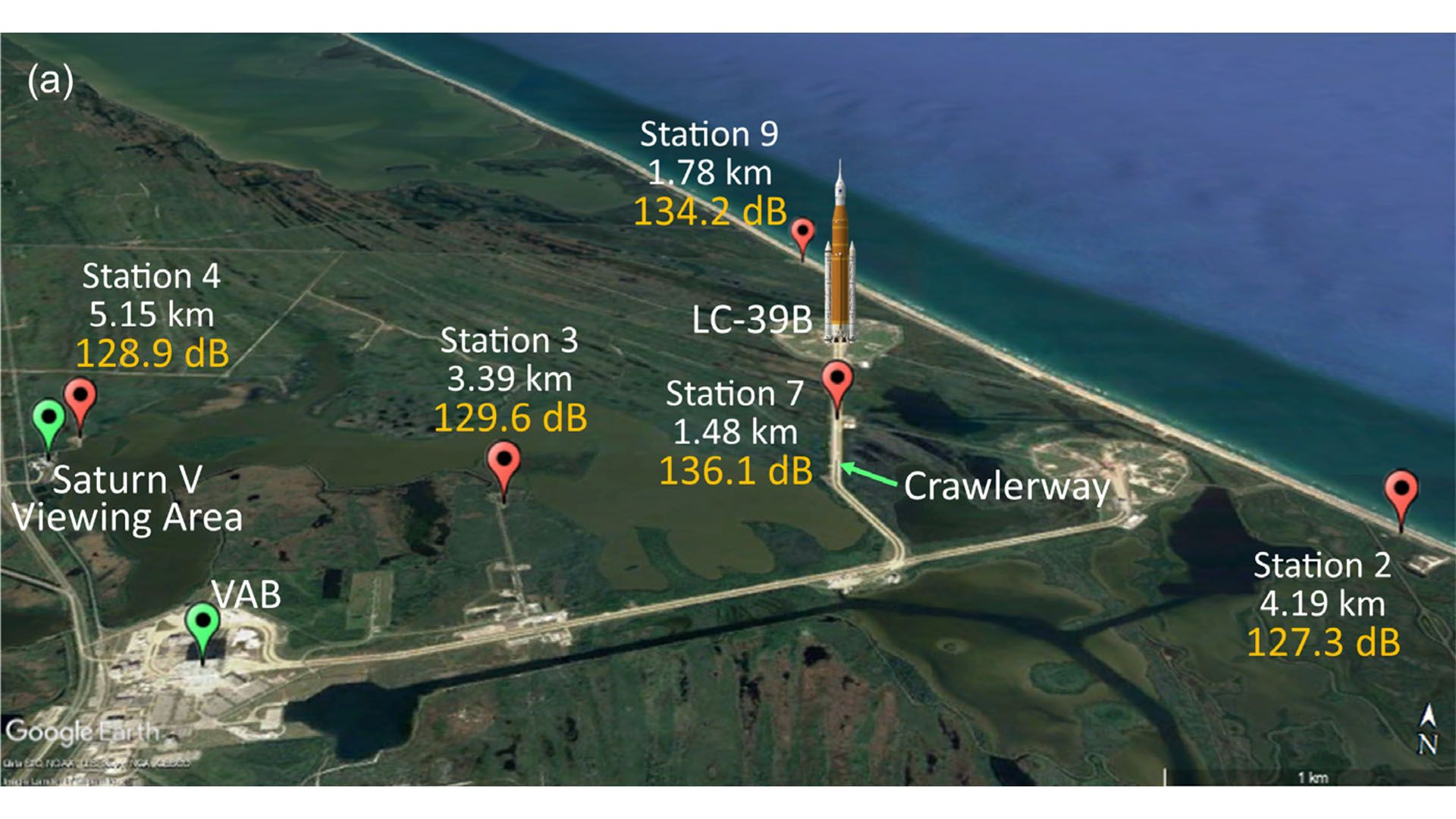
During the November 2022 Artemis I mission, the team deployed nine Portable Units for Measuring Acoustics (PUMA) around the launch pad. The closest instruments were placed just outside NASA’s one-mile safety boundary, including one along the crawlerway to the pad and another on the beach where the exhaust is funneled by the refractory brick-lined flame trench.
Even at a mile away, sound levels reached 136 decibels at those locations, comparable to standing near a jet engine a football field away and well above the threshold of pain.
Additional stations were positioned 2.1 miles from the pad and 3.2 miles away, near viewing locations used by partners such as the Canadian Space Agency and other invited guests. Even at those distances, measurements reached about 129 decibels, similar to a nearby chainsaw.
Much of the energy is concentrated at very low frequencies, peaking around 20 hertz near the lower limit of human hearing. This causes the launch to be felt as much as it is heard, producing a deep vibration that you feel in your gut.
Although the loudest phase lasts only about 20 seconds, the rocket remains audible for several minutes. We continued to hear it for at least four minutes, well after the solid rocket boosters were spent and were falling away, while the core stage continued to climb higher, draining the last of the 730,000 gallons of liquid hydrogen and liquid oxygen.
Does it really sound that way?
Yes. The sharp, crackling sound you hear on TV and in person is the result of rapid pressure fluctuations in the supersonic exhaust plume. These create tiny shock waves that form and collapse in quick succession. Engineers must account for this when designing launch pads, payloads and vehicle structures to avoid damage.
The study, published in the Acoustical Society of America journal, also compared SLS to earlier and current heavy lift vehicles.
At liftoff, SLS produces about 8.8 million pounds of thrust, roughly 15% more than the Saturn V. Despite that, Saturn V generated slightly lower acoustic levels by about 2 decibels.
Launches of the Space Shuttle typically produced between 115 and 120 decibels at viewing areas around 3 miles away. Because the decibel scale is logarithmic, even a small increase represents a significant jump in perceived loudness.
The team also analyzed the launch of SpaceX Starship, measuring about 125 decibels from roughly 6 miles away. In that case, an additional sonic boom occurs when the returning booster passes back through the sound barrier on its way to landing.
For context, the rock band The Who set a Guinness world record in 1976 with a concert reaching 126 decibels. KISS has claimed even higher levels in later years, although record keeping for loud concerts was discontinued decades earlier due to concerns about hearing damage.
Even familiar environments can get surprisingly loud. Crowd noise during games for the Carolina Hurricanes can exceed 100 decibels, with peaks around 110 during the opening face-off.