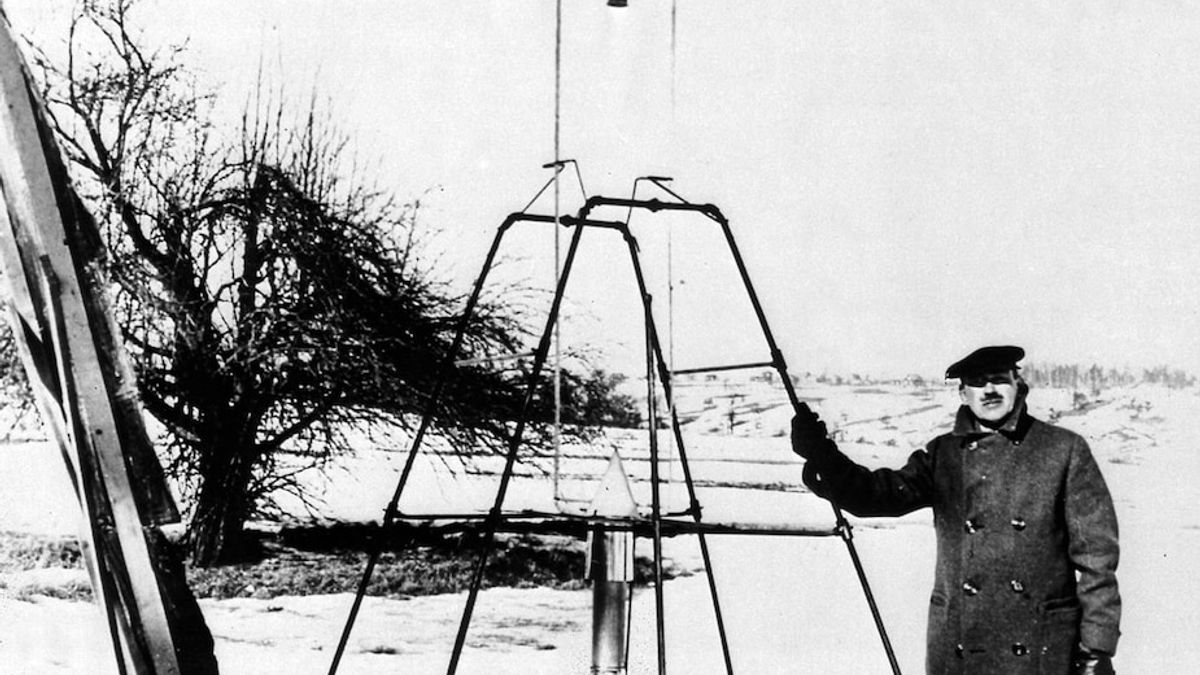
On March 16, 1926, American physicist Robert H. Goddard launched the world’s first successful liquid-fueled rocket from a farm in Auburn, Massachusetts.
The rocket was small, only about 10 feet long, and the flight brief, lasting only 2.5 seconds, barely toping the height of a telephone pole and landing in a nearby cabbage patch.
Other WRAL Top Stories
But it demonstrated a revolutionary idea that rockets could be powered by liquid propellants with greater control and scaled for far greater performance than the gunpowder and other solid fueled rockets that had existed for centuries.
The launch site is marked today by a small obelisk and plack near 9th fairway of the Pakachoag Golf Course .
The Propellants That Started It All
Goddard’s rocket combined gasoline as the fuel and liquid oxygen (LOX) as the oxidizer. The liquids were stored in separate tanks and fed into a combustion chamber where they mixed and ignited, a first. This produced a high-velocity exhaust generating controllable thrust.
This design solved several problems that plagued earlier rockets. Gunpowder rockets produced maximum thrust immediately and quickly faded. Engineers could control the flow of liquid propellants allowed engineers to regulate the flow of fuel, providing smoother acceleration and much greater potential speed.
From Gasoline to Kerosene: The Rise of Modern Rocket Fuels
Goddard’s gasoline / oxygen combination proved the concept, and the engineers that followed tested fuels with higher energy and greater stability. By the mid-20th century, many launch vehicles used refined kerosene (RP-1) instead of gasoline.
The first stage of the Saturn V that sent the Apollo missions to the Moon was fueld by RP-1. SpaceX has continued use of RP-1 in each of its more than 600 launches of the Falcon 9 rocket.
Hydrogen: The Fuel of High Efficiency
Deep-space missions often use liquid hydrogen with liquid oxygen (LH₂/LOX). Hydrogen provides very high energy density in liquid form and produces extremely high exhaust velocities, making it one of the most efficient rocket propellants ever used.
Liquid hydrogen powered the three Space Shuttle main engines as well as the four which will lift the Space Launch System (SLS) rocket which will bring astronauts around the Moon in a few weeks.
Methane: A New Generation of Rocket Fuel
Today’s newest launch systems are experimenting with yet another fuel: liquid methane. Rockets like SpaceX Starship and Blue Origin New Glenn use methane which continue to paired with liquid oxygen.
In many ways, methane rockets represent the next evolutionary step in the same design philosophy Goddard demonstrated a century ago.
The Goddard Spaceflight Center was established on May 1, 1959 as NASA’s first facility dedicated to space flight reasearch.