As the parent of a kid who is closer to 22 than 2, I’m admittedly jealous of today’s parents of toddlers. Our Australian friends sent us The Wiggles. You get Bluey. We got “Fruit Salad” (yummy, yummy). You get “Fruit Bat.”
Bluey is widely praised by educators, child psychologists, and other social scientists as a strong model of healthy childhood development. The series showcases how imaginative play helps children develop problem-solving skills, build resilience, and navigate social relationships.
Other WRAL Top Stories
Researchers and practitioners often point to the show’s portrayal of attentive parents who are emotionally available and willing to acknowledge their own mistakes, although Bandit and Chilli arguably present an unrealistically high standard for parenting.
Physical scientists are Bluey fans too, especially because STEM topics are woven into stories in a way that doesn’t talk down to kids, or the adults who watch with them … or sometimes without them. My favorite is “Sleepytime” (Season 2, Episode 9), which incorporates some excellent astronomy into the story.
Astronomy in Bluey
The episode follows Bingo in a dream that carries her across the Solar System to the majestic movement “Jupiter” from Gustav Holst’s classical suite The Planets. The episode uses imaginative space imagery to explore themes of growing up, family, and the enduring comfort of a parent’s love. It is also widely regarded as one of the series’ finest episodes and, for a time, ranked among the highest-rated television episodes on IMDb.
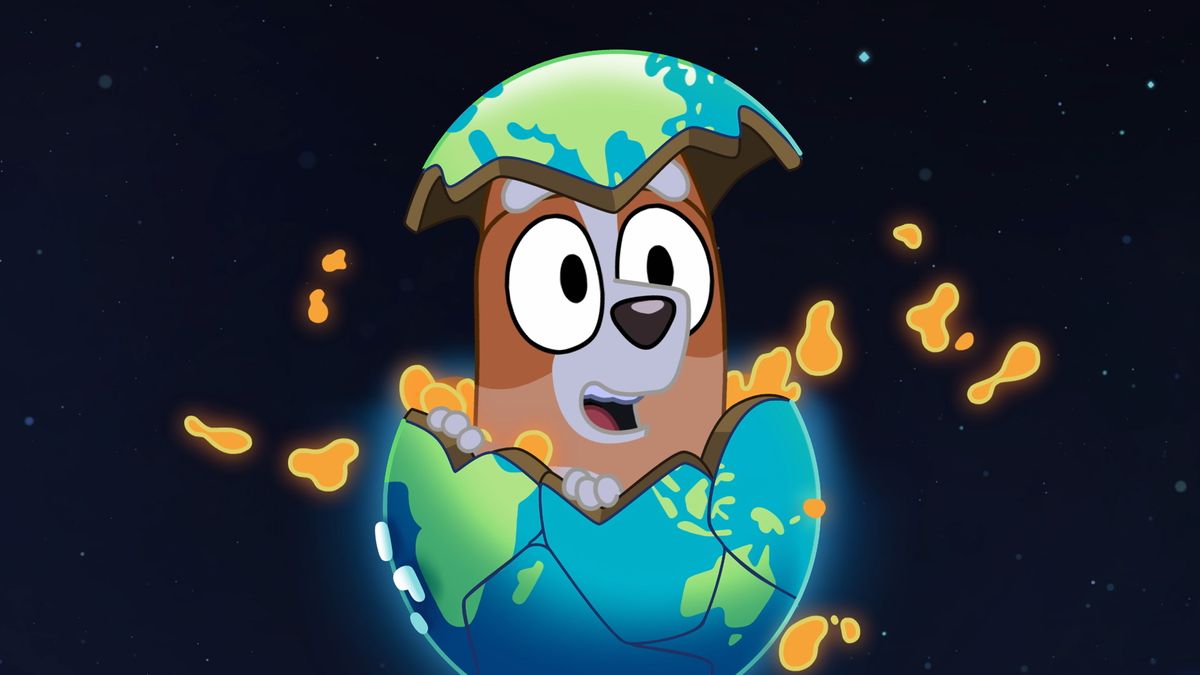
Bingo’s dream begins as she emerges from a hollow Earth, spilling out its molten core. The worlds she visits are not just generic orbs floating through space. They are recognizable planets, complete with textures, rings, and colors that closely resemble their real counterparts.
In many cartoons, celestial objects simply drift around randomly. In “Sleepytime,” planets and moons often follow curved paths and orbital patterns that reflect the gravitational rules governing motion rather than pure chaos.
Bingo’s father, Bandit, is represented by Jupiter, the largest planet in the Solar System. Jupiter’s immense gravity helps shield the inner planets from many comets and asteroids, just as Bandit serves as a protective and comforting presence when his daughters wander into their parents’ room during the night.
As Bingo kicks off her covers, she finds herself on a cold, distant outer planet. She later races past Saturn on a comet. While the scene is fantastical, comets are among the fastest objects in the Solar System, capable of reaching speeds of hundreds of thousands of miles per hour as they swing around the Sun.
Mom (Chili) is represented as the Sun, a source of warmth, light, and stability who reassures Bingo that she will always be there. For a seven-minute cartoon about a child learning to stay in her own bed through the night, that’s a remarkable orbit to achieve.
“Space” (Season 3, Episode 35) also incorporates astronomy, including discussions of asteroids, black holes, and the possibility of life elsewhere in the universe. The animators’ attention to astronomical detail appears again in “Bin Night” (Season 2, Episode 13), which quietly demonstrates the lunar cycle through changing Moon phases while also featuring Bingo’s aspiration to become an astronomer.
Other STEM topics in Bluey
“Flat Pack” (Season 2, Episode 24), which was briefly retitled “Evolution and Deep Time” in some international releases, explores evolution through a progression from marine life to amphibians, dinosaurs, mammals, and eventually humans, all imagined through play with a cardboard box and flat-pack furniture.
Other STEM topics appear throughout the series. In “Seesaw” (Season 2, Episode 28), Bluey and her friends demonstrate how a lever can provide mechanical advantage, allowing the smallest child to balance a much larger seesaw. “Pizza Girls” (Season 3, Episode 19) showcases the engineering process of trial and error as Bluey and Bingo repair their pedal-powered mud-pizza delivery vehicle. “Daddy Robot” (Season 1, Episode 4) introduces basic concepts of automation and programming through step-by-step instructions that produce unintended results. “Copycat” (Season 1, Episode 38) touches on biology and wildlife rehabilitation as Bluey helps her father rescue an injured bird.
STEM lessons aren't presented as lectures, they are woven naturally into stories about family, friendship, curiosity, and play. Much like the best science teachers, Bluey understands that wonder comes before understanding.