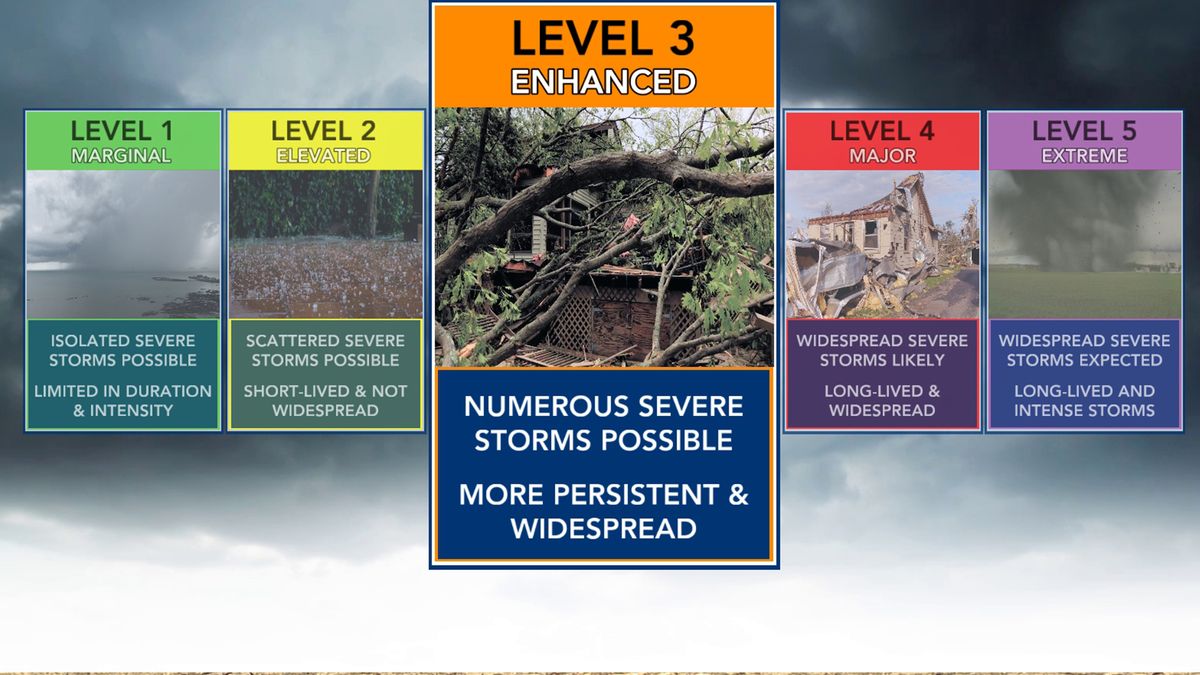
On WRAL-TV and on WRAL.com, our team of meteorologists often references a threat for severe weather on a scale of 1 through 5 with 1 being the lowest and 5 being the highest.
Spring is the top severe weather season in North Carolina, but storms can come at any time, so it is important you understand what these threat categories mean to better assess your risk and prepare ahead of bad weather.
Other WRAL Top Stories
Definition of severe weather
Severe weather is officially defined as a storm that produces one of the following: wind gusts 58+ mph, tornadoes or hail over 1 inch in diameter. Only these three factors are considered when the Storm Prediction Center places a region under a threat Level 1-5.
I did some digging through recent storm data to see how common it is to be placed under a risk in central North Carolina and how often these risks verify with at least one warning in the same region.
Levels of risks and what they mean
Level 1 risk: A Level 1 threat is common, with an average of 50 days per year under a Level 1 threat. A Level 1 risk results in at least one severe thunderstorm or tornado warning 44% of the time.
Level 2 risk: A Level 2 threat is less common, with an average of 17 days per year under a Level 2 threat. Level 2 risks result in warnings 64% of the time, a much higher correlation.
Level 3 risk: A Level 3 threat is rare, and central North Carolina only sees an average of four Level 3 risks per year. The correlation with warnings was very high. Warnings were issued 82% of the days central North Carolina was under a Level 3 threat.
Level 4 risk: Level 4 threats are extremely rare, and there have always been warnings issued when central North Carolina was under a Level 4 threat.
The bottom line is the higher severe weather risk levels result in higher chances that severe thunderstorm warnings or tornado warnings will be issued. Level 3 and 4 threats are not only rare in central North Carolina, but they also verify with warnings more than 80% of the time.
I hope this deeper dive into severe weather levels helps you appropriately gauge your risks during future severe weather events.