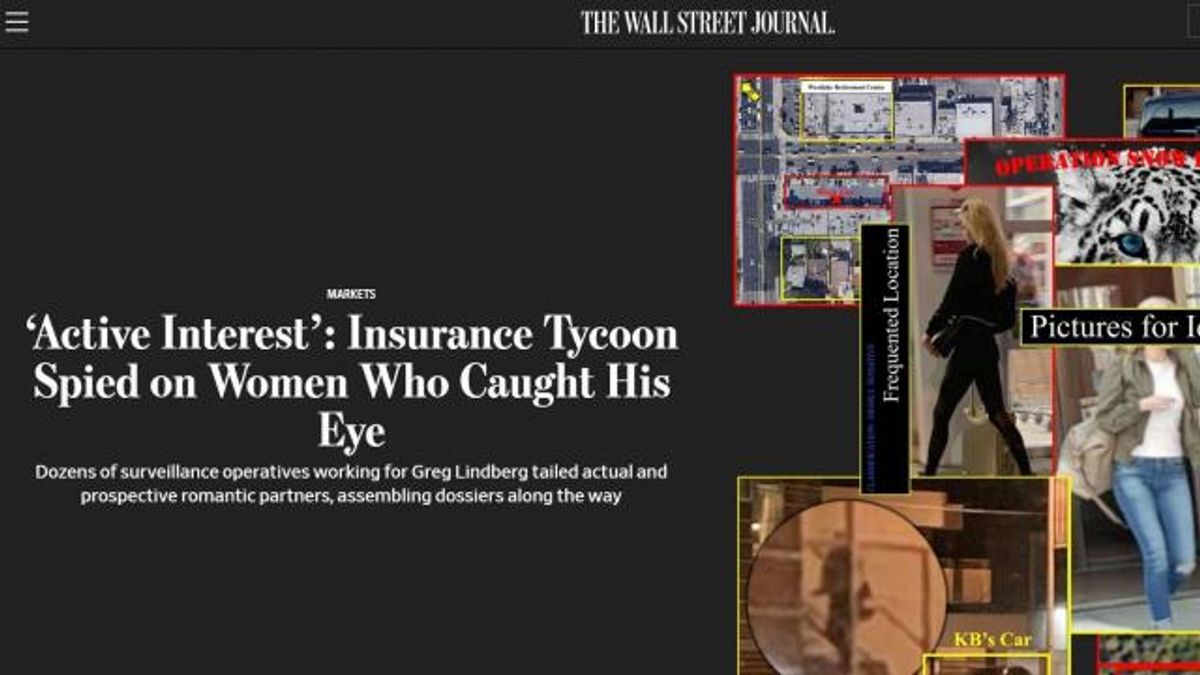
North Carolina's biggest political donor tracked women he was interested in, using his security firm to research and surveil them, according to a lengthy report published this week by The Wall Street Journal.
The article, based on months of reporting, interviews with some of the women involved, interviews with security personnel and a review of internal reports and messages they provided, details Durham insurance magnate Greg Lindberg's approach to dating and to identifying potential egg donors to help him have a baby.
Other WRAL Top Stories
The newspaper said Lindberg scoured social media, often keying on aspiring models, then had a surveillance team research each woman's habits and whether or not she had a boyfriend. At one point, they staked out a "Sports Illustrated" swimsuit model's apartment, The Journal said.
Lindberg's team used GPS trackers and reported back if the women saw other men, the newspaper said. One investigator enrolled in a culinary school to keep watch, The Journal reported. In another case, staff rented an apartment across the hall and "chronicled her entrances and exits via camera," the newspaper said.
The Journal reported that some of the women were aware of this surveillance and others surprised by its extent, with one calling it "creepy" and "alarming."
Lindberg, who is under federal indictment and accused of trying to bribe North Carolina's state insurance commissioner, pushed back against the article Friday with a statement released by Robert Gaddy, president of the security firm Lindberg owns and whose methods were detailed in The Journal's piece.
Gaddy said the report was based on the word of "a disgruntled ex-employee of the firm who was terminated and was sued for breach of contract, theft, misappropriation, fraud and for making representations that falsified his military record."
“The truth is that there is nothing salacious about Mr. Lindberg's personal life," Gaddy said in the statement.
The statement acknowledges Lindberg had Apex International "look closely at the lives of potential egg donors to make sure they were safe and healthy." It says Lindberg is now expecting a child "via gestational carrier."
It also points to Lindberg's marriage, which led to lengthy and acrimonious divorce proceedings that were finalized this summer in Durham County. The file in that case is more than a foot thick, with accusations and counter-accusations between Lindberg and his former wife, Tisha Lindberg, who separated in 2017.
Both Lindbergs accuse the other of abusive behavior. In court filings, Tisha Lindberg describes a family compound in Durham surrounded by a 15-foot wall and monitored by security cameras, guard dogs and a 24-hour security team.
"I often wondered if Mr. Lindberg was trying to keep people out or keep me in," Tisha Lindberg said in one affidavit.
Greg Lindberg responded in the divorce case that he had little choice but to surveil his wife, with whom he has three children. He accused her of drug abuse and trying to murder him. They accused each other of having mental issues.
The Journal's report was released online Thursday, and it was on the front page of Friday's print edition. It's the latest in a saga with potential national implications for the insurance industry and political ramifications in North Carolina.
Lindberg came from political obscurity to give more than $5 million in campaign donations to various political groups in the last few years. On Wednesday Robin Hayes, a former congressman and chairman of the North Carolina Republican Party, pleaded guilty to lying to the FBI during the federal sting that saw Hayes, Lindberg and two of Lindberg's associates accused of trying to bribe state Insurance Commissioner Mike Causey.
All four initially pleaded not guilty in this case, and Lindberg's trial may begin in November.
WRAL News reached out Thursday to entities that got at least six figures from Lindberg – the state Republican Party, the North Carolina Democratic Party, the House Republican Caucus and a pair of political committees supporting Lt. Gov. Dan Forest – to see if The Journal's revelations changed their minds on keeping his money.
Most did not respond. None indicated they'd give the money back or donate it to charity, as is sometimes done when scandal envelops campaign donors. All indicated in July that they planned to keep the money.
Lindberg owns dozens, if not hundreds, of companies, including four regulated by the state Department of Insurance, which is headed by Causey. The department took control of the companies following the indictment, and Causey shared concerns in a court filing at the time that they might not have enough liquidity to meet their obligations.
The Wall Street Journal has reported extensively on Lindberg's business dealings and the way money flowed from his insurance companies into other companies that he owned, partly during former state Insurance Commissioner Wayne Goodwin's time in office.
Goodwin now chairs the state Democratic Party and has said repeatedly he did nothing wrong. He has not been charged in the federal case.
Goodwin worked as a Lindberg consultant after losing the insurance commissioner's race to Causey in 2016, and two of his top deputies from the Department of Insurance went to work for one of Lindberg's companies after the election.
Regulators in multiple states have reviewed Lindberg's holdings, and The Journal reported this week that some fear the money he loaned to his other businesses may not be collectible, potentially triggering one of the biggest U.S. life insurance insolvencies in decades.
Gaddy said in his statement Friday that these allegations are false, though it was unclear why the head of Lindberg's security business was commenting on the financial health of Lindberg's other companies. But Gaddy said in his statement that "the North Carolina Department of Insurance said recently that there are no defaults with loans to Mr. Lindberg's companies and said this week that Mr. Lindberg's insurers have substantial 'financial wherewithal.'"
The department has indeed said in court filings tracking the takeover of Lindberg's insurance companies that none of the insurance companies' "affiliated investments" in Lindberg's other businesses is in default, though it noted one $35 million investment in a company called Agera Energy is considered "permanently impaired."
But it's unclear where the "substantial financial wherewithal" language in Gaddy's statement came from.
The Department of Insurance's general counsel said in a statement that the department can't comment on the health of the businesses beyond what it files with the court, but "with regard to the words attributed to the DOI by one of Mr. Lindberg’s associates, all we can say is that we do not recall making any such statement."
WRAL News asked a Lindberg spokesman to source the statement or supply an explanation Friday afternoon. He did not immediately respond.
Someone answering at a phone number listed online for Gaddy said he didn't have time to speak with a reporter Friday and hung up.