As Green Party leaders waited for North Carolina election officials to decide whether their candidates would be on the state’s ballot this year, they started getting weird messages.
They had collected thousands of signatures, far exceeding, they believed, state petition requirements for smaller political parties to put candidates on the ballot. Then the party’s candidate for the U.S. Senate, Matthew Hoh, got a text message asking whether he would remove his signature from the party’s petition.
Other WRAL Top Stories
In effect, an unknown texter - presumably working off a list of petition signers - was asking Hoh whether he’d like to help undo the party’s work and make it impossible for his own candidacy to advance. The rationale behind the text campaign: Leftist Green Party candidates might take votes away from Democrats, including in the highly-contested North Carolina Senate race that could decide which party wins the majority in the U.S Senate.
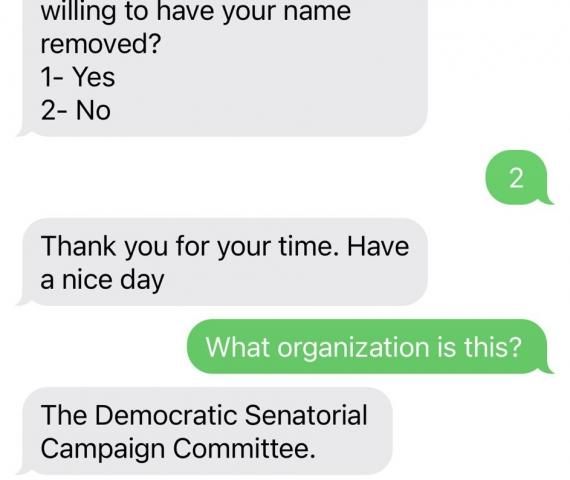
“It will give Republicans a huge advantage,” the writer said in an exchange that Hoh posted to Twitter. “Are you interested in asking the elections board to have your name removed?”
The Green Party’s North Carolina co-chair, Tony Ndege, got a phone call along the same lines, and he recorded some of it. Three times Ndege asked whether the caller was working with the Green Party. Three times the caller said yes.
Ndege confirmed that he had signed the petition, and that he indeed wanted Green Party candidates on the ballot. Then, based on Ndege’s recording, the caller seems to read from a script.
“If the Green Party’s on the ballot it will take votes away from Democrats, giving Republicans a huge advantage,” the caller says. “There’s far too much at stake to let this happen.”
“I’m confused,” Ndege replies. “So, if you’re with the Green Party, why are you asking to remove?”
“Yes, I totally …” the caller responds. Then the call disconnects.
About a week later the State Board of Elections’ Democratic majority voted not to certify the Green Party, citing questions about some of the 22,521 signatures submitted. Though it may not be the final word, for now the vote effectively keeps Hoh off the ballot in November.
State elections officials say they’ve been reviewing Green Party petition signatures since May, after county election officials noticed problems with some of what the party turned in. There is an “active criminal investigation with specific targets,” State Board spokesman Pat Gannon said Tuesday, and the people being investigated “are suspected of being responsible for well over 2,000 signatures.”
The are “obvious signs of fraud,” according to a summary compiled for State Board of Elections members, including signatures that seem to be in the same handwriting and indications that some petition pages may have been resubmitted from a 2018 party effort to get on the ballot.
But it wasn’t state investigators calling Green Party officials and other petition signers. That was a separate effort by Democratic operatives. In his text exchange, Hoh was told that it was the Democratic Senatorial Campaign Committee reaching out.
And ahead of last Thursday’s State Board of Elections meeting, board members received several letters from a Michael Vincent Abucewicz of Raleigh, questioning dozens of signatures and the Green Party’s methods.
One of those letters included 145 affidavits or declarations from people who said they wanted their signatures removed, with at least 35 saying they were misled by signature collectors. There were three declarations from voters whose names appeared on the petitions but who said they never signed.
Abucewicz declined to speak to WRAL News this week. A LinkedIn page in his name indicates that he’s a former North Carolina Democratic Party operative, but a party spokeswoman did not respond to messages seeking comment.
The letters list Jacquelyn Lopez, of the Elias Law Group, as Abucewicz’s attorney. She also didn’t return messages seeking comment, but the firm submitted an open records request June 3 seeking the Green Party’s petition submissions, which would have enabled it to identify signers.
The Elias Group is a well-known Democratic law firm. Marc Elias was general counsel for Hillary Clinton’s 2016 presidential campaign, and his firm has been involved in multiple lawsuits pushing back against Republican election laws, including in North Carolina.
The Democratic Senatorial Campaign Committee also didn’t respond to WRAL News questions, but a spokeswoman confirmed to The News & Observer last week that the DSCC was “reaching out to voters to ensure they have not been deceived.”
Hoh acknowledged that some of the signatures – he put the count at about 200 – were “doctored by two people we hired" and said party leaders “feel as defrauded or more defrauded as anyone else.”
But Hoh also said the Green Party cooperated with state investigators for a month ahead of last week’s hearing, that they believe they collected more than enough valid signatures, and that they were shocked by the board’s decision. They’d been told, he said, that the problems were limited.
Another vote possible
State Board of Elections Chairman Damon Circosta told WRAL News this week that he didn’t want to vote to deny the Green Party ballot access when the board met last Thursday. He had hoped, he said, that the board could delay its decision, giving staff more time to investigate signatures.
But Republican board member Tommy Tucker called for the vote, and it broke entirely on party lines, with Circosta and the board’s other two Democrats voting not to recognize the Green Party.
“I couldn’t sit there and say, during that meeting, whether they met the threshold,” Circosta said.
Circosta is also head of the A.J. Fletcher Foundation, which was started by the founder of Capitol Broadcasting Company, which owns WRAL. Capitol Broadcasting leadership sits on the foundation board.
Tucker said he called for that vote to get everyone on record. He complained that Republican pushes for more aggressive signature matching for absentee ballots have been set aside, “yet we’re making a whole-hearted effort on the Green Party.”
“Why are we making such a grandiose effort now?” Tucker said. “It smells to me.”
There was also a July 1 deadline – one day after the board’s meeting – for party candidates to file paperwork with the state.
Despite that deadline, it’s possible the State Board will undo its decision. Gannon said the board can take the matter up again and that investigators are working “as quickly as possible so that the Board will be in a position to accurately determine whether the petitions are sufficient.”
The Green Party may also file a lawsuit, though Hoh and Ndege would only say that they’re considering all options. The most important deadline may be in mid-August, when the state plans to print paper ballots.
The Green Party submitted 22,521 signatures to county boards of elections around the state, which validated 15,953 of those signatures. This method of qualifying for the ballot requires a party to collect .25% of the number of voters who voted in the last election for governor, which works out to 13,865, according to the State Board of Elections.
Party leaders thought they’d overshot that mark by at least 2,088 signatures, but in the summary for board members, State Board of Elections staff said the “number of known questionable signatures exceeds the 2,088-signature threshold.”
State Board of Elections staff also stressed that their investigation is separate from the Elias Group’s, and Gannon said Tuesday that it began “before any submissions by the Elias Law Group related to the Green Party petition process.”
Green Party officials, and some Republicans, remain suspicious.
Circosta pushed back against any insinuation that the State Board worked with Democratic operatives to keep the Green Party off the ballot. He, and fellow Democratic board member Stella Anderson, both told WRAL they had no contact with the Elias Group or Democratic operatives ahead of last week’s board meeting, other than letters on the case that are part of the public record.
“Absolutely, unequivocally not,” Circosta said.