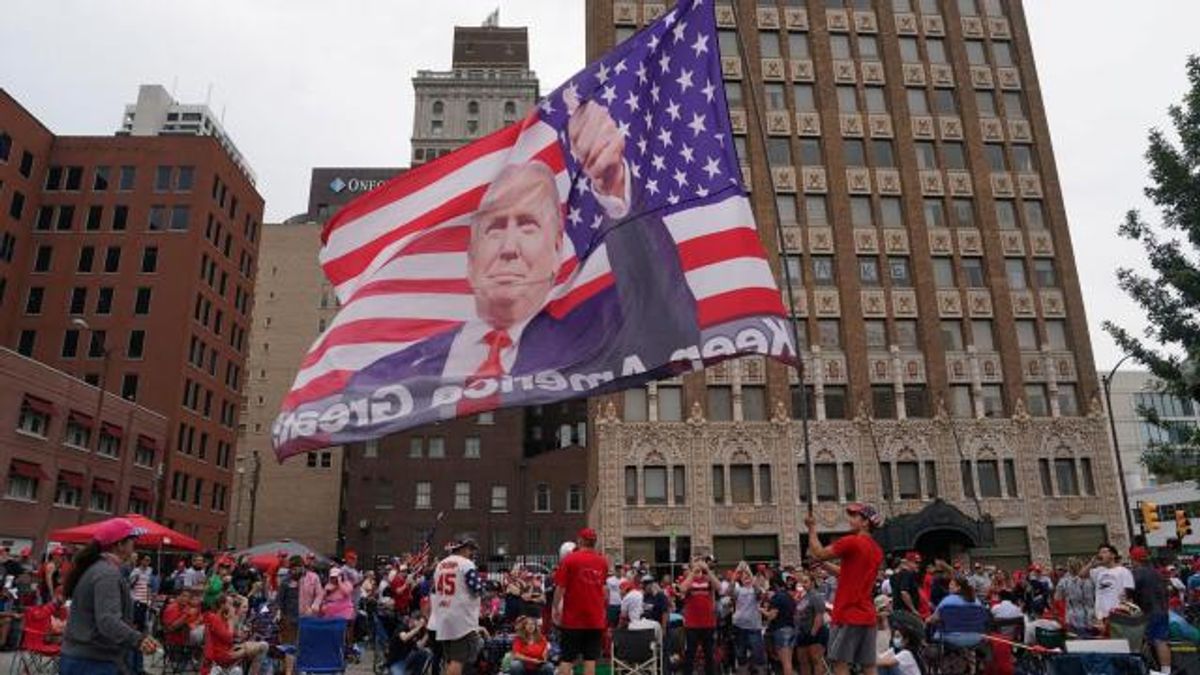
TULSA, Okla. — Public health experts issued dire warnings. Local officials expressed unease. The coronavirus cases continued to climb.
And still, they came.
Other WRAL Top Stories
President Donald Trump’s most faithful supporters — intensely devoted, but ultimately fewer in number than the campaign had hoped — piled into tents or lounged in lawn chairs, some wearing masks and others dismissing the need for face coverings, as they waited hours and, in some cases, days to join in his return to the campaign trail. By Saturday afternoon, the line of voters waiting for Trump’s evening rally was bustling with attendees eager to enter the 19,000-seat BOK Center in defiance of public health recommendations — though as the program began in the evening, the arena was far from full and an overflow stage was dismantled.
Despite the adoring fans willing to risk illness to see him in this deep red state, Trump arrives in Tulsa at a moment of political peril. His poll numbers nationally and in critical battleground states have plummeted, he faces disapproval of his stewardship of the coronavirus and outrage over his posture toward peaceful protesters of police brutality, and he has struggled to press a clear case against Joe Biden, his Democratic opponent.
The rally itself had produced a chaotic several days in Tulsa, coming on the weekend of the Juneteenth holiday, which celebrates the end of slavery in the United States. Trump’s discordant stance toward the holiday — he originally was unaware of it, then later took credit for making it “very famous” — and his divisive rhetoric about Americans protesting against racial injustice had added to the fraught nature of the weekend in a city with a painful history for Black residents.
His supporters waited for the rally around 1 mile from Greenwood Avenue, which in 1921 was the site of one of America’s worst racist massacres. Black Tulsans had gathered there on Friday to commemorate Juneteenth and many had denounced police brutality. A number of Trump backers, while expressing support for peaceful protesters, also argued that if the nation countenanced demonstrators congregating in large crowds, then they should be free to participate in the president’s rally without criticism — though public health experts have said that large indoor gatherings are more dangerous than outdoor events.
The Trump campaign on Saturday also acknowledged that six staff members had tested positive for the virus during routine testing ahead of the event.
“You have people who, for political reasons, will be great with a transgender rally in New York or a protest, but if you go to church or a Trump rally, well, you’ve got to be concerned about COVID,” said former Rep. Sean Duffy of Wisconsin, who planned to attend as a Trump surrogate. He called the virus “real” and urged precautions, but added, “This rally is no less risky than the protests that were taking place over the last three weeks.”
The scene here on the sidewalks and roads near the arena offered a vivid illustration of the president’s power over the most committed elements of the Republican base even when he is at his most vulnerable — and empty seats in an Oklahoma arena, a state Trump won by 36 percentage points, was sure to reinforce perceptions of that vulnerability.
Still, the Trump faithful on Saturday lined up wearing Trump hats and shirts, and carrying flags — Trump flags, American flags, flags bearing images of Trump kissing an American flag. A “four more years” chant broke out before 7 a.m. For blocks, the scene was more reminiscent of a sports tailgate than a political rally, as music blared and beer flowed between supporters, some of whom had traveled hundreds of miles.
Salespeople set up tents hawking Trump memorabilia, and as attendees began to enter the checkpoint for the rally, they left lawn chairs abandoned on the street.
As the day wore on and rallygoers congregated in line, the group — which was overwhelmingly white — increasingly included both the most die-hard Trump supporters and also more rank-and-file fans of the president. Both sets of voters were skeptical that the virus posed a serious risk to them.
In interviews, some of them described the virus that has killed nearly 120,000 Americans as overblown. The death toll, they argued, was exaggerated or manipulated — a view experts say is inaccurate. Several people made clear they were more focused on risks from possible protests than they were on getting sick, and there was a heavy security presence visible by Saturday morning.
For many supporters who crowded the sidewalks here, the coronavirus seemed like just one more risk to mitigate, as with anything else in life — but no reason to skip seeing the president.
“This is a chance of a lifetime,” said Sue Williams, 72, of Tulsa. Williams, who was not wearing a mask, is in an age demographic that is especially vulnerable to the coronavirus crisis. But she said she had no concerns. “I’ve been praying. I’m in good health. When they have the rally, I’ll wear a mask.” In interviews, attendees said they viewed the president as a strong leader on the economy, despite millions being out of work during the pandemic. They still appreciated his disdain for political correctness and praised his opposition to abortion rights, echoing views shared by Trump supporters in 2016.
“I like that he’s created more jobs, I like that he’s pro-life, he sticks up for Christians,” said Shelly Braden, 48, a schoolteacher from Lamont, Oklahoma, who said she believed the chances of contracting the virus were “low.”
Trump drew widespread criticism when his administration ordered aggressive police action to clear peaceful protesters in order to be photographed holding a Bible, but to some, the image appeared to break through in a positive way. “I’ve seen him on TV praying, I’ve seen him on TV with a Bible in his hand,” Williams said.
In an interview on Thursday, state Rep. James White, R-Texas, expressed confidence that social distancing would be achievable at the rally because, he said, any event put on by the president would certainly adhere to safety protocols issued by the Centers for Disease Control and Prevention, a federal agency.
“I don’t see why the president would violate his own guidelines,” said White, a Trump surrogate who plans to attend the rally. “If I get there and people are on top of each other, that would look kind of interesting because I believe the CDC works for the president.”
On Saturday masks were handed out, but wearing them was not enforced. Attendees did, however, undergo temperature checks, though that would not prevent individuals who have the virus but are asymptomatic from attending.
Few of those lined up to see Trump seemed concerned about maintaining significant distances from one another. People jammed up next to each other in line on Saturday, where cheering, chatting and the occasional cough took place in proximity to fellow attendees. At least one attendee said he had spent a night this week sleeping in a lawn chair, sharing a tent with others he had met only the previous day.
“This coronavirus is a little bit hyped up,” said that man, who would identify himself only as Jason, 48, an electrician from Seattle. He declined to give a last name, citing a fear of being doxxed. “The media hypes things.”
The coronavirus outbreak combined with a national debate over systemic racism brought two of America’s crises into focus in Oklahoma this weekend.
White, who is African American, said that on his trip he also intended to visit Greenwood Avenue.
“We support the president, my district supports the president, at least based on the last voting tally I looked at in 2016,” White said, explaining his reasons for going to Tulsa. But, he added, “This is not just going up for the president — it’s having some opportunity to visit Greenwood and reflect on that horrible massacre.”
Nevertheless, the president was hardly promoting a moment of national reflection as Juneteenth approached. On Thursday night, he tweeted two fake videos, one about a racist baby that both Twitter and Facebook removed. And on Friday, he tweeted a barely veiled threat at protesters, suggesting there would be no lenience if they caused trouble at his event — a message several people waiting in line could quote nearly verbatim even as they said they supported peaceful protests.
In the Greenwood Avenue neighborhood, that message was instead taken as an unmistakable threat. The Rev. Al Sharpton, a frequent critic of the president who was the keynote speaker at Friday’s Juneteenth event, said of the tweet: “We won’t bend, we won’t bow, we won’t give up.”
The contentious nature of Saturday’s rally, and the split screen of Trump’s Tulsa and the one that embraced Sharpton, stands in contrast to the spirit of racial reconciliation that Tulsa has long tried to foster. Because of the city’s history, and the approaching centennial anniversary of the 1921 race massacre, Republicans and Democrats have sought to form a shared political vocabulary, particularly when it comes to race. Sen. James Lankford, a Republican and staunch ally of Trump, attended the Juneteenth celebrations with his family.
Phil Armstrong, one of the leaders of a commission established to commemorate the 100th anniversary of the massacre, which Lankford has supported, bemoaned the effect that outsiders — including Trump’s fans from across the country — could have on Tulsa’s carefully balanced relationships, both across race and political party.
“When white mobs destroyed Greenwood, there was a mindset that people said, We’re going to rebuild and make this bigger and better,” Armstrong said. “We have that same mindset now. Trump is coming? And on Juneteenth weekend? No. We’re going to come together and we’re going to be a countermessage.” However, he said he was still nervous as Saturday approached, saying he worried about outside groups promoting violence. In Oklahoma, guns may be carried without a license by most state residents.
Back at the Trump encampment, there was at least one person focused on the virus: David Edmondson of Dallas, who said he works at the face shield company TrueHero, coaxed attendees to put on shields he was distributing, in part, by assuring them the goods were not made in China.
“I want people to take them,” said Edmondson, a Trump supporter, citing the risks of the virus. “It’s not political,” he said. “You’ve got some people thinking it’s made up.”
Edmondson did not plan to attend the rally.