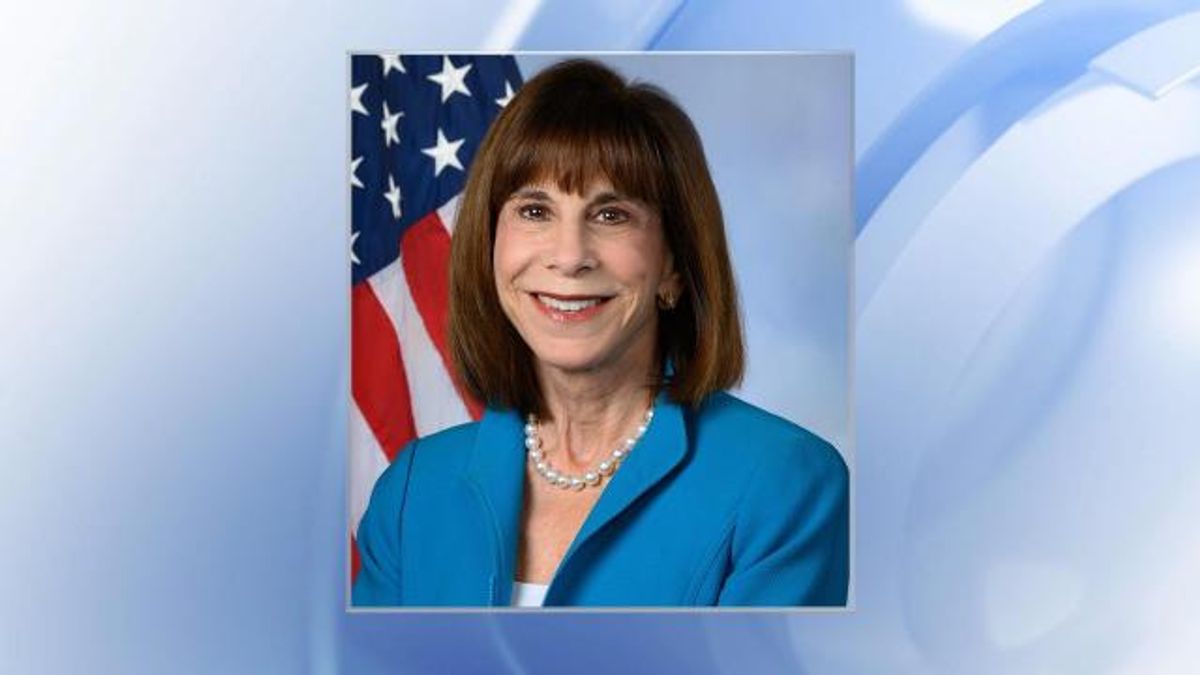
U.S. Rep. Kathy Manning, a Greensboro Democrat who is the only Jewish person to ever represent North Carolina in Congress, won't seek reelection in 2024.
Her district lines were redrawn this year by Republican state lawmakers, who shifted her seat from a safe Democratic seat to a safe Republican seat. She called it an egregious example of gerrymandering that forced her to step down from Congress rather than run an unwinnable campaign.
Other WRAL Top Stories
"As a Greensboro resident of 40 years, I am disgusted by the callous disregard of Republican leaders for the citizens of my district," she said Thursday. "Politicians should not choose their voters; voters should choose their representatives."
If a recently filed gerrymandering lawsuit succeeds in getting the new maps blocked from being used in future elections, Manning added, she would run for Congress again.
Black and Hispanic voters have sued to block the maps, saying the districts were drawn to lessen their political influence. Republican lawmakers, who are in charge of drawing new districts because they control the legislature, say the maps are lawful.
With just two terms in Congress, one of them in the minority party, Manning has held some leadership roles despite her lack of seniority. She's the co-chair of the House Bipartisan Task Force for Combating Antisemitism and serves on the House Foreign Affairs Committee as vice ranking member, in addition to other roles. In her announcement Thursday, she said she's proud to have brought over $600 million in federal investments back home to her district for infrastructure projects, job training programs and other work.
Fellow U.S. Rep. Deborah Ross, a Raleigh Democrat, praised Manning Thursday as a friend and fighter for liberal causes.
"As a champion for reproductive health care and access to contraception, Congresswoman Manning has been an invaluable leader and a critical partner in the fight for women’s rights," Ross said.
A lawyer who's married to a prominent Greensboro real estate entrepreneur, Manning is also one of the wealthiest members of Congress. Business Insider ranked her as richer than all but 18 other members of Congress when she was first sworn in after the 2020 elections, with an estimated net worth of $27 million at the time.
Her current district includes all of Greensboro, High Point and Winston-Salem, commonly known as the Triad. The new map, however, splits the Triad area into four different districts. In the new map, Manning's district now includes a sliver of Greensboro, stretching through Salisbury into the Charlotte suburbs near Concord.
"Republicans have blatantly rigged the map against Democrats by splitting the City of Greensboro into three pieces and combining each piece with far-flung rural counties, with the majority of Greensboro being drawn into a district that goes all the way to the border with Tennessee," Manning said Thursday. "The maps separate the heart of Greensboro from High Point and Winston-Salem, destroying a Triad District, a community of interest that deserves representation."
Manning's newly redrawn district would've voted for Republican presidential candidate Donald Trump by a large margin in 2020, and whoever wins the GOP primary in 2024 is expected to win the general election, too.
Former U.S. Rep. Mark Walker is running, having dropped out of the race for governor after the new maps became law and opened up Manning's district to a Republican. So is fellow Republican Bo Hines, who ran an unsuccessful 2022 campaign for Congress in the Raleigh suburbs. Other candidates seeking the Republican nomination include Christian Castelli, Mary Ann Contogiannis and Jay Wagner.
The National Republican Congressional Committee — a group led by Manning's colleague, North Carolina Republican Rep. Richard Hudson — celebrated Manning's departure and the likelihood that Republicans flip the seat next year.
"After today's announcement by Kathy Manning, House Republicans just grew our 2024 majority by one seat," spokeswoman Delanie Bomar said in a news release.
North Carolina is expected to deliver at least three more seats to Republicans in 2024, possibly four, as the party tries to hold onto its razor-thin majority in the U.S. House of Representatives.
The state legislature is in charge of redistricting, and GOP leaders' original maps following the 2020 Census were struck down as unconstitutionally gerrymandered, replaced by a court-ordered map that in 2022 led to an even 7-7 split in the state's 14 U.S. House seats. But state law says any court-ordered maps can only be used once, so Republican leaders got the chance this year to redraw the maps again. Unless struck down again, these new maps will be used in every election until 2032.
The new lines passed in October are expected to create 10 safe Republican seats and one competitive seat, meaning Republicans will likely win a 10-4 or 11-3 advantage in the congressional delegation. The other Democrats who saw their seats turned into safe Republican seats are Reps. Jeff Jackson and Wiley Nickel. Nickel hasn't said whether he'll run again in 2024; Jackson is leaving Congress to run for attorney general.
The Democrat who currently holds the now-competitive tossup seat, Rep. Don Davis, has filed for reelection.
North Carolina Republicans have lost numerous gerrymandering lawsuits in the past decade. But future lawsuits against GOP-drawn maps could be less likely to succeed, particularly in state court. Republicans flipped control of the North Carolina Supreme Court in the 2022 elections, and one of the new majority’s first actions was to overturn an anti-gerrymandering precedent, giving Republican legislators confidence in their redrawn districts.
Republican redistricting officials have repeatedly said they didn't use racial data in drawing the maps. When Democrats have pointed to heavily Black areas split by the new districts, Republicans have often responded that the lines were drawn purely for political gain — which is allowed — and with no regard to race, which would violate federal law. That distinction, however, could raise questions in court about race and politics in a state like North Carolina, where Black voters overwhelmingly support Democratic politicians, and where 90% of registered Republican voters are white.