Tropical storms and hurricanes are known to be destructive, even deadly, in North Carolina.
Every North Carolina resident and visitor should be weather aware – tracking the tropics for what is coming and preparing your home and family to weather any storm.
Other WRAL Top Stories
Hurricane season runs from June 1 and ends Nov. 30.
What's active in the tropics?
The National Hurricane Center is not monitoring any systems in the Atlantic.
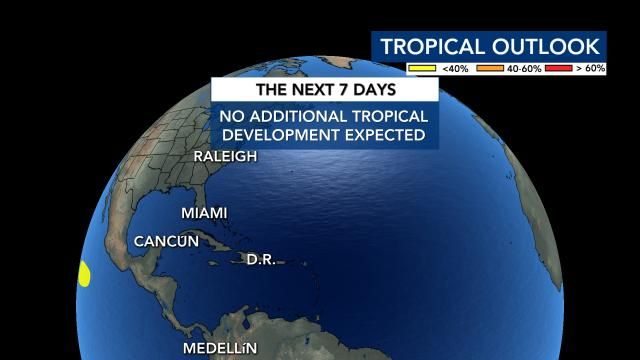
The month of November is typically a slow month in terms of the number of storms, but hurricane season officially ends Nov. 30.
Download the WRAL Weather app to get alerts | Interactive hurricane tracker
Revisiting the WRAL hurricane season forecast
The WRAL Severe Weather team forecasted a near-average number of systems this Atlantic hurricane season.
The 2025 Atlantic hurricane season has had:
- Number of named storms: 13
- Number of hurricanes: Five
- Number of major hurricanes: Four
Overall, the totals landed in the near-normal category.
How many hurricanes will North Carolina get?
Over the past 30 years, an average hurricane season would see:
- 14 named storms – those of tropical storm strength or greater
- 7 hurricanes – Categories 1 through 5. Category 1 storms, with wind speeds of 74 to 95 mph, can still do damage to trees, toss outdoor furniture and knock out power.
- 3 major hurricanes – Category 3, 4 or 5, with winds of a minimum 111 mph. These are storms that can blow off roofs and flatten buildings.
How to prepare for hurricane season
From late spring through the fall, there is always the chance that a hurricane will form in the Atlantic Ocean and impact North Carolina. While rough surf and overwash is a danger along the coast, hurricanes can bring torrential downpours, inland flooding, downed trees and even tornadoes to the Triangle.
Property owners should consider flood insurance and make sure to keep up home maintenance so that roofs, shingle and outdoor furniture are secure when high winds blow.
Make an emergency plan and communicate with each family member so that you can make a choice – to stay or go.
No matter where you live, you could lose power. It always pays to be prepared for a storm that can knock out power with a survival kit that includes non-perishable food, cash and plenty of clean, bottled water.
What's the next name on the hurricane list?
Since the 1950s, hurricanes have been given names, to avoid confusion and streamline communications. There are six alphabetical lists of names, each a mix of traditional male and female names, so the same name may be used for different storms that happen years apart.
When a hurricane produces severe or devastating damage, that name is "retired" or removed from the list by the World Meteorological Organization.
Here is the list of names for the 2025 Atlantic hurricane season:
- Andrea
- Barry
- Chantal
- Dexter
- Erin
- Fernand
- Gabrielle
- Humberto
- Imelda
- Jerry
- Karen
- Lorenzo
- Melissa
- Nestor
- Olga
- Pablo
- Rebekah
- Sebastien
- Tanya
- Van
Worst hurricanes in North Carolina history
In September 2024, Hurricane Helene ravaged western North Carolina. Helene killed at least 107 people in the state. Helene has caused billions of dollars in damage as parts of western North Carolina are still rebuilding, even months later. The state government has already spent about $1.6 billion in Helene aid and are still sorting out how much more to allocate in relief efforts.
One of North Carolina's most destructive hurricanes, Hurricane Fran in September 1996, blasted the Triangle with winds at near-hurricane strength. It left a landscape littered without trees in virtually every neighborhood and power outages that lasted for more than a week.
Hurricane Floyd in September 1999 inundated eastern North Carolina, including Rocky Mount, Wilson, Tarboro and Princeville, and put entire communities under water. The storm destroyed more than 8,000 homes and damaged 67,000 more.
In October 2016, Hurricane Matthew skirted the coast but generated devastating flooding across central and eastern North Carolina. The hurricane dumped more than a foot of rain 100 miles inland, swelling streams and rivers to levels above what Hurricane Floyd produced in 1999.
Hurricane Florence, in September 2018, brought a record 8.27-foot storm surge. Over the next three days, it produced up to 30 inches of rainfall over eastern North Carolina. Interstates 95 and 40 were both closed due to flooding, and 42 people died across the state.
Arguably, the most powerful hurricane in NC, Hurricane Hazel in October 1954 caused major flooding and damage as it made landfall. More than 1,000 people were killed, and it caused about $409 million in damage. The massive amount of destruction left by Hurricane Hazel earned it the nickname “the Bulldozer."