A political battle over traffic jams in the fast-growing Wake County suburbs could soon determine not only who pays the bill to widen one of the area’s most congested roads, but also whether that work will be measured in years or decades.
Local leaders say they reluctantly want to create a new toll road on a stretch of U.S. 1 between Raleigh and Wake Forest to pay for road widening work. State lawmakers, meanwhile, are trying to shut down that plan — an effort they say will protect low-income families, but which local officials predict could delay the work by decades.
Other WRAL Top Stories
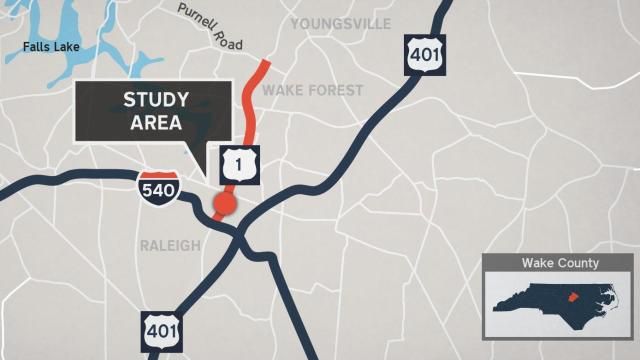
The road, known as Capital Boulevard in most of Raleigh and northern Wake, has been notorious for years for its congestion as the area has grown. On any given day, about 50,000 vehicles travel along the stretch of Capital Boulevard that might be tolled — about 10 miles between the northeastern arc of the Interstate 540 Outer Loop and the Franklin County line. Most of the segment offers only two lanes of traffic in either direction.
Local leaders say tolls are the only realistic option to widen the road anytime soon. But the state House of Representatives recently voted to ban the toll road plan. And even if that outright ban doesn’t become law, it’s still a signal that any needed legislative approval for a toll proposal will face an uphill battle.
Leading the push is state Rep. Mike Schietzelt, a Republican who was elected in 2024 to represent Wake Forest and other far-north parts of Wake County — home to the people who would be most affected by any potential tolls along Capital Boulevard.
“I’ve got to go back home and answer to my constituents,” Schietzelt said in an interview. “And I have not had a single person tell me, ‘Yes I want that toll.’”
Lawmakers, however, haven’t articulated any plans to provide the funding that’s needed to widen the state-owned road.
Blocking the toll plans likely would result in even more delays to the project — which is already more than a decade behind schedule, and now projected to cost about 14 times more than a scuttled 2012 widening plan.
Banning tolls to pay for the project would also likely continue to leave the fate of the project in the hands of the state Department of Transportation, which some local officials blame for the years of delays and rising costs.
“The toll road’s dead now, as far as we’re concerned,” Wake Forest Town Commissioner Adam Wright said in an interview. “It seems like [Schietzelt’s] going to get what he wants, and we’ll just have to wait on NCDOT to get around to us. Maybe we’ll get an expanded Capital Boulevard by 2060.”
Growing traffic, rising costs
In 2012, transit planners said they could widen the road for $93 million and have it done by 2023. That never happened. Wright said the money was diverted to hurricane recovery work, then to road construction in Fayetteville, among other delays.
The newest estimates project a 2035 finish date — if the work starts next year. The new price tag: $1.3 billion. And the cost will likely only keep increasing. As the area’s population grows, so does demand for land. Rising land prices in turn drive up the cost of widening the road, since the state will have to buy the land needed for the new lanes. Construction costs have also surged in recent years.
Raleigh Mayor Janet Cowell agrees that a toll road now seems like the most feasible option, given the rising costs and the lack of funding from the state legislature. The Raleigh City Council recently voted 7-1 to support tolling the part of the road in question.
“If we don't have the ability to do it, obviously, the road project will not go through,” she said in an interview. “And we’ll continue to just sit in traffic.”
A state DOT spokesman didn’t respond to a request for comment. The main regional transit planning group for the Triangle, the Capital Area Metropolitan Planning Organization, declined to comment beyond pointing to its recent vote to back toll road plans.
While state lawmakers say tolling Capital Boulevard is unfair to people accustomed to driving for free — and could set a concerning precedent for other cities turning to toll roads as a revenue source — local political leaders say they have no choice given Wake County’s booming population and the state legislature’s low funding for road projects.
One middle-ground option could be to create a hybrid road, with some lanes free and others tolled. Several local residents interviewed by WRAL in the past have said they’d favor that option. But that strategy, while offering more choice, would also raise less money and could cause further delays in the effort to widen the road. It’s also unclear if the legislature would be open to that.
In the coming days, the Wake Forest Town Council plans to pass a resolution urging the legislature to reconsider its anti-tolling stance — or, alternatively, to approve the $1.3 billion needed to build the new lanes without a toll option.
“We don’t want tolling,” Wright said. “But if you’re going to prevent us from tolling, can you at least give us the money? That’s the long and short of it. None of us want tolling. But [road construction] has been massively under-funded by the legislature for years.”
Businesses, commuters impacted
The sense of frustration from Wright and other local leaders has been palpable.
“We risk undercutting years of work by our communities and experts, disrupting a carefully coordinated transit and land use plan,” Rep. Maria Cervania, a Democrat who served as a Wake County Commissioner before being elected to a Cary-area district in the state legislature, said in the House debate over Schietzelt’s toll ban proposal.
Fellow Wake County Democratic Rep. Phil Rubin asked his fellow lawmakers to “stay out of this Wake County discussion,” saying that if the toll road idea is banned, “the most obvious outcome is we do nothing.”
The House debate turned stereotypical political ideologies on their head, with Democrats arguing against what they see as big-government overreach by the legislature, and Republicans arguing that tolls unfairly impact poor people.
“These are working class North Carolinians who are going to be burdened worst by this,” Schietzelt told fellow lawmakers during the House debate. “And so I ask for you to put an end to this embarrassing conversation we’re having in Wake County right now.”
Caught in the middle are the tens of thousands of people who rely on Capital Boulevard for their daily commute, or who drive into Raleigh on the weekends for shopping or dining. One of them is John Greene, who told WRAL in April he moved to a new city miles to the southeast, Knightdale, specifically to avoid the “horrendous” traffic in northern Wake County.
But just as some people are leaving the area to avoid traffic, politicians from areas north of Wake Forest are worried that building toll roads to improve the traffic there will also harm their own local economies.
“It really impacts our communities,” said Rep. Matthew Winslow, a Franklin County Republican. “Tolling U.S. 1 seems to be the answer to all our traffic problems, but it’s misguided. What’s not being considered: No new business or industry will ever want to locate on U.S. 1 in Franklin County.”
Schietzelt said he disagrees with critics on one key issue: That banning a toll road will doom Capital Boulevard to decades more delays. He recently sat down with DOT officials, he said, and was told they’re ready to start moving forward. And he’s planning to travel to Washington this summer to ask fellow Republicans in Congress to approve federal grant funding for the project.
Local leaders say they’re willing to do what it takes to help. But some are less than optimistic — especially since Republicans in Washington, like in Raleigh, are also focused on cutting government spending in order to pay for further tax cuts in upcoming budgets.
“I heard people saying ‘It’s good having a Republican representing us, because we’ll start to get some money,’” said Wright, the Wake Forest councilman who’s a Democrat. “Well, where’s the damn money?”
WRAL News Anchor/Reporter Eric Miller contributed to this report.