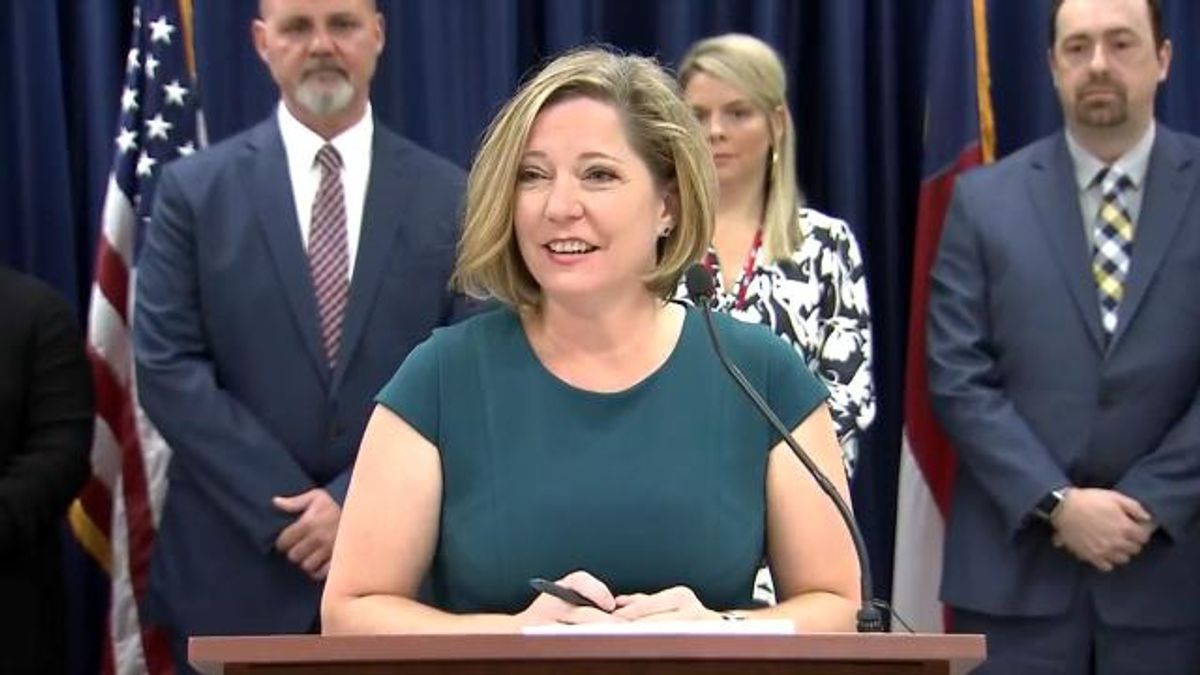
North Carolina's top elections leader was summoned to the state legislature Thursday, where she talked about efforts to combat voter fraud, request funding and answer questions under oath about elections administration in the state and how officials can improve voters' trust at the ballot box.
Karen Brinson Bell's two-hour testimony comes as GOP leaders in the state legislature are trying, again, to overhaul the state elections board to reduce Democrats' influence on the board and transfer power over it from the governor to the Republican-led legislature. Those pieces of legislation, Senate Bills 747 and 749, passed the Senate this week and are now in the House.
Other WRAL Top Stories
Brinson Bell has been the executive director of the State Board of Elections since 2019. The Democratic-led state board hired her that year to replace Kim Strach, a Republican who had previously led the board since 2013.
Thursday's hearing for House lawmakers was led by Rep. Jake Johnson, R-Polk, who focused the questioning on elections integrity and more.
"If people can’t trust the elections process, how can they trust anything else in government?” he said at the beginning.
Brinson Bell then was given the chance to give a lengthy presentation to the committee. She touched on the election board's efforts to educate voters on how elections work or to make data transparent and accessible to the public.
"It's just making sure we don't amplify misinformation," she told the lawmakers. "I think we all have a responsibility to that."
She also pleaded with them for more funding in the state budget for more funding for future elections — which could help the board hire more staff, implement the new voter ID rules that are set to now go into effect, or do more work to fight false claims around elections.
In one instance Rep. Allen Chesser, R-Nash, asked her how often the state board conducts audits to make sure no immigrants have tried registering to vote. Brinson Bell said that while those audits do happen, they could happen more frequently if the board had more staff.
The state elections board has only one database software engineer to help with the technical side of conducting audits like that, she said, but he also has numerous other duties for other audits and more. The board wants funding to create two more of those positions, she said, but the legislature hasn't approved it.
Addressing voter fraud
Democratic and Republican lawmakers alike had the opportunity to ask Brinson Bell questions Thursday, and the meeting lasted two hours.
The questions ranged from highly technical issues to topics like how often the state checks to make sure dead people aren't registered to vote, what kinds of data are publicly available for people who want to do their own research, and — at the heart of the meeting — how much voter fraud exists in North Carolina.
"It is a very small number," Brinson Bell said of voter fraud. "I wish I could sit in front of you and say the answer is zero, but this is not a perfect system.”
But with that being said, she added, the state works to cross-reference voter rolls with many other sources like death records, DMV records, prison records and more to make the system as foolproof as they can. All of that work, she said, has proven that voter fraud is incredibly rare.
“The numbers are in the teens,” she said. “Not hundreds of thousands.”
Republicans, in pushing the new elections changes, have repeatedly cited polls that show many voters — and, in particular, many conservative voters — don't trust election outcomes. Brinson Bell never mentioned former President Donald Trump by name but said it's important for elections officials, as well as politicians like the ones grilling her, to fight back against false claims of voter fraud or rigged elections.
She also noted that a record-high 75% of registered voters turned out to cast ballots in 2020 in North Carolina, suggesting that probably wouldn't have been the case if people actually thought their votes wouldn't count.
Another related concern she asked lawmakers to take seriously is threats against election workers, which have skyrocketed since the 2020 election. Dozens of county-level election leaders around the state have quit in the last few years, she said, and the jobs have proven incredibly difficult to fill.
She also warned lawmakers that constant efforts to change the rules for voting can further confuse and frustrate voters — as well as making it impossible for insiders like her and her staff to figure out if the changes are doing anything, and if so what the effects are.
"When you make all these changes, how can we determine what’s effective?" Brinson Bell said. "You don’t know which things worked and which things didn’t.”
Johnson defended the GOP-backed elections bills, which passed along party lines this week in the Senate and are expected to soon advance in the House too.
"I think we all have a common goal to come together and approve these bills, make sure it’s easier to vote, harder to cheat, and make sure that we close the loopholes that are out there," he said.
Context behind the hearing
This year's Republican-backed attempt to overhaul the elections board, Senate Bill 749, is the latest in a series of attempts that have all so far failed in reducing gubernatorial influence on election rules. The current governor, Roy Cooper, is a Democrat.
State law says whichever party controls the governor's office will get three of the five seats on the elections board, with the other party getting the other two seats. GOP leaders have tried changing that multiple times since 2016, when Cooper defeated Republican incumbent Pat McCrory. Two initial attempts were ruled unconstitutional, so GOP leaders then tried changing the state constitution — but in 2018 North Carolinians overwhelmingly rejected that proposal, with two-thirds of voters opposing the amendment.
Republicans are trying again this year and have newfound hope: They control supermajorities in the legislature once again so can expect the bill to become law even if Cooper vetoes it. And Republicans also took back control of the state Supreme Court earlier this year.
The new GOP-led court has already overturned several legal precedents on key voting rights and election cases, in order to hand victories to the Republican-led legislature, and top lawmakers have said they hope to get a similar result on the elections board changes, too.
Senate leader Phil Berger told reporters when the new bill was filed earlier this month that he thinks the new court will see things differently from previous courts. His son, Phil Berger Jr., is one of several Republicans who have newly joined the court since the last time the legislature lost one of its attempts to change the elections board.