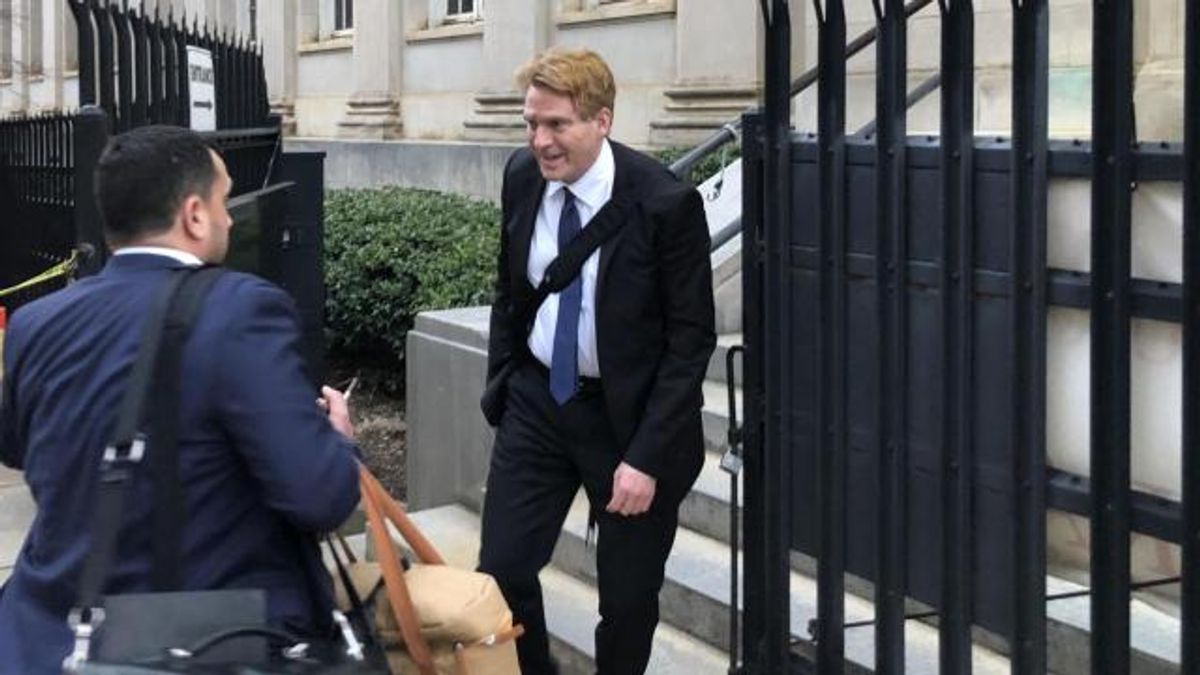
A federal judge on Wednesday sentenced the state's largest political donor to more than seven years in prison for his role in a bribery scheme unearthed by an FBI sting.
The judge said a former congressman involved in the case could simply serve probation, and a third man got a two-and-a-half-year sentence for his part in an effort to bribe North Carolina's insurance commissioner.
Other WRAL Top Stories
Prosecutors asked the judge to send financier Greg Lindberg straight to prison, saying his massive wealth, private jet, yacht and connections in multiple foreign countries made him a flight risk. U.S. District Judge Max Cogburn declined, but said he also was "a little bit concerned" about the risk.
Assistant U.S. Attorney William Stetzer told the judge that Lindberg mused, in an email to himself, about buying a Russian peninsula and setting up his own country complete with "IQ passports" and a private militia. Stetzer said Lindberg has bank assets in 18 countries and connections in Russia and bordering Kazakhstan, where he's sent money over the years to buy unfertilized eggs from women.
The assistant U.S. attorney suggested Lindberg might be using the egg purchases to squirrel money away in these countries.
Lindberg's legal team said that's simply not the case.
"He wants to grow his family, your honor," Aaron Tobin, one of Lindberg's attorneys, told the judge.
Cogburn sentenced Lindberg to about half the time the U.S. Attorney's Office requested. A jury found the insurance magnate guilty earlier this year of trying to bribe Insurance Commissioner Mike Causey, whose department regulates the insurance companies within Lindberg's empire of hundreds of businesses.
The judge said he wanted to send a message, not just about the illegal bribery in the case, but also the legal bribery so prevalent in modern American politics.
"It was shocking to me, when I heard the trial ... that so much could be done in terms of buying and selling government, like sacks of potatoes, without crossing the line," Cogburn said.
The judge sentenced former Congressman Robin Hayes to probation in the case, which was in line with the U.S. Attorney's Office request. Hayes was the North Carolina Republican Party's chairman until he resigned last year – after he was indicted – and he agreed to funnel $250,000 from Lindberg to Causey's campaign coffers to get around North Carolina donor limits.
Lindberg promised Causey up to $2 million in campaign donations if the commissioner would get rid of a pesky regulator looking into Lindberg's companies, according to evidence presented at trial.
Hayes, 75, pleaded guilty last fall to lying to federal investigators in the case. He was never called to testify at trial, but prosecutors said he cooperated.
Causey wore a wire for repeated meetings with Lindberg and a political fixer named John Gray, a connected North Carolinian who met Lindberg through a real estate deal that put the land together for Lindberg's mansion near Durham. Lindberg accuses Causey and the FBI of entrapment, and he plans to appeal his conviction.
He has also filed a civil lawsuit against Causey in federal court and asked state Attorney General Josh Stein's office to investigate Causey. Stein's office has declined.
Lindberg, 50, read a brief statement to the court Wednesday, saying he disagrees with the jury's decision and that he would have backed off if he had "one little inkling of warning" that what he was doing was illegal.
Lindberg's lack of remorse fed into his sentence, Cogburn said. So did Gray's, though the 70-year-old's health issues – he recently had open heart surgery – and his role as a lieutenant to the apparent billionaire got him a lighter sentence.
Gray may not serve much of the prison time Cogburn handed down because the U.S. Bureau of Prisons is releasing prisoners particularly susceptible to the coronavirus outbreak to serve sentences from home.
Hayes represented North Carolina in the U.S. House from 1998 to 2008. He apologized Wednesday as family watched from the courtroom, where a handful of reporters and other onlookers also sat socially distanced.
"I have caused embarrassment, grief, pain to members of my family," Hayes said, his voice breaking.
Hayes, Lindberg and Gray were sentenced separately, with short breaks in between for courthouse personnel to sanitize chairs and tables. The hearings were delayed for hours by a backup in the court's morning schedule, and proceedings didn't wrap up until close to 8 p.m.
All three men offered up character witnesses, mostly in the form of written letters attesting to their good nature. Lindberg's came, for the most part, from people he has employed. His head of security and his personal assistant both spoke during the proceedings.
He has an ex-wife and three children who did not attend, plus a fourth child carried by a surrogate mother using donated eggs and born some nine months ago.
Lindberg's legal team argued an inherent unfairness between their client's sentence and the one handed down for Hayes. Stetzer argued for the prosecution that, if Lindberg had his way, "the Department of Insurance would have been a wholly owned subsidiary of Mr. Lindberg's company."
Lindberg donated more than $5 million to North Carolina politicians over a span of less than three years. He gave to the GOP, the North Carolina Democratic Party and a pair of committees backing Lt. Gov. Dan Forest's bid this year for governor.
Each of these groups can take unlimited donations, and Lindberg gave $2.4 million just to groups affiliated with Forest, making him the Republican politician's largest donor by far.
Lindberg also backed former Insurance Commissioner Wayne Goodwin's re-election campaign in 2016, a race Goodwin lost to Causey. Goodwin, who did consulting work for Lindberg after he left the Department of Insurance, is now chairman of the state Democratic Party, and he's running this year to get his old job back from Causey.
Lindberg also donated to help re-elect Congressman Mark Walker and enlisted Walker's help to get Causey on board with the plan to replace a key department regulator.
None of those donations were targeted by prosecutors in the case, though some were mentioned at trial. Western District U.S. Attorney Andrew Murray would not say Wednesday night whether more charges might ultimately be brought. A subpoena obtained by WRAL News in January indicated a second federal investigation on Lindberg, apparently targeting his business practices.
Throughout Wednesday's proceedings, Cogburn, who was nominated to the bench by former President Barack Obama, made clear his distaste for money's corrupting influence in politics.
"The rich have just got it bought," he said.