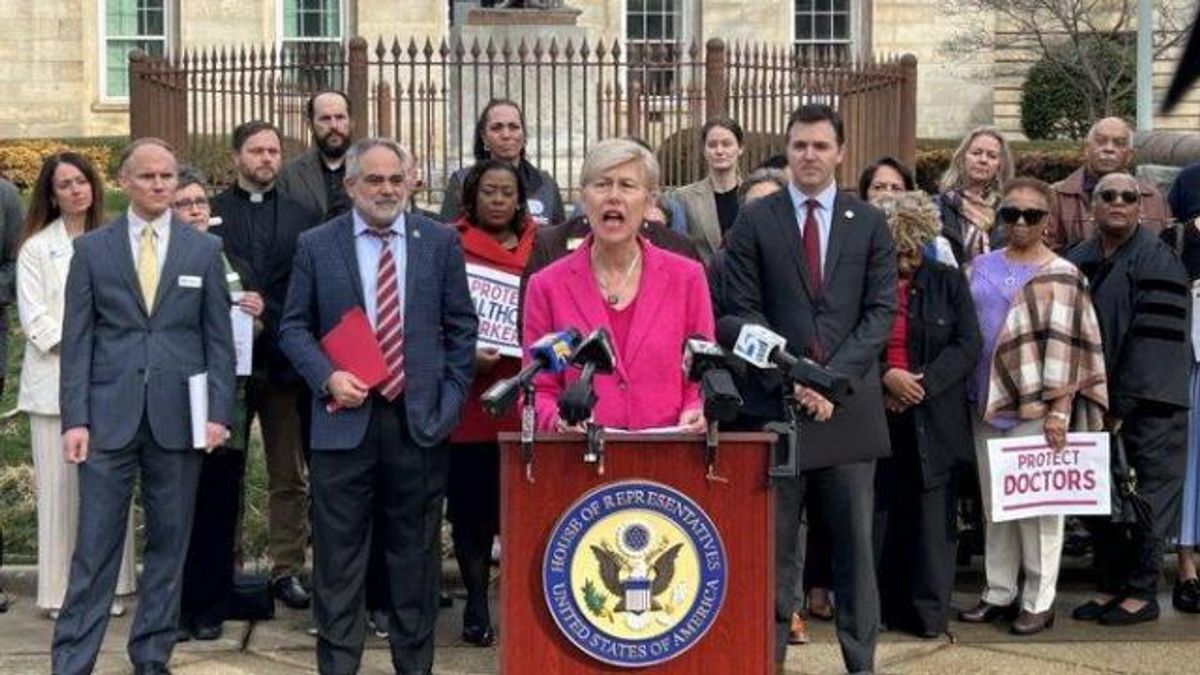
North Carolina stands to lose billions of dollars if President Trump's executive order freezing many federal grants and other projects is allowed to go into place, local community leaders and Democratic politicians said Friday.
Going beyond the dollar signs, they said, the loss of that funding will have a host of real-world impacts. Public school teachers and university researchers could lose their jobs, children whose parents can't or won't feed them at home could lose access to free lunches at school, police and firefighters could lose out on new equipment, and the relief aid that victims of Hurricane Helene are waiting on might never come, the Trump critics said.
Other WRAL Top Stories
Some Republican members of Congress have said they don't think Trump meant to cut off disaster relief funding for Helene victims. But after Trump issued his order Monday night, the FEMA portal that North Carolina officials use to draw down relief funding was shut down Tuesday. The FEMA portal went back up on Wednesday — after a judge issued an order temporarily blocking Trump's order — according to testimony one of Gov. Josh Stein's top Helene advisors gave to state lawmakers on Wednesday.
On Friday U.S. Rep. Deborah Ross (D-Wake) referenced the broad confusion, even in the nation's capitol at the highest levels of power, about what Trump's order will or won't do. She also said she hopes it never comes to pass, and that it's eventually struck down as unconstitutional on a more permanent basis. But even if that happens, she told the crowd Friday, it's important to recognize what's at risk.
"We cannot give up," Ross said. "We cannot give in. We will not let this administration threaten our community, our state, and the millions of people who rely on the federal government to do its job."
The judge's initial order left open the possibility that Trump's order could go back into place as soon as Monday.
North Carolina Attorney General Jeff Jackson, who as a former member of Congress voted on some of the funding programs Trump is now trying to stop, has made North Carolina a party to the lawsuit that succeeded in getting Trump's order blocked at least temporarily. He has argued in court, and said again in Raleigh on Friday, that the U.S. Constitution clearly gives Congress — and not the president — control over government spending.
"Here's the bottom line," Jackson said. "No one is more powerful than the Constitution, and when our government violates the Constitution, we will take them to court."
Teaching jobs, programs in question
Ross said she spoke with some N.C. State University employees who expected layoffs to hit their department if federal grant funding dries up. And the chairman of the Wake County Public Schools System, Chris Heagarty, said it's also likely teachers would need to be furloughed or laid off, given the large amount of federal funding schools receive for programs like Title I schools and magnet schools. Heagarty specifically referenced Broughton and Enloe magnet high schools in Raleigh, in addition to other middle and elementary schools.
Heagarty listed off other WCPSS efforts paid for by federal grants that might be affected by Trump's order if it goes back into place: mental health services for homeless students, specialty programs for 20,000 students with disabilities such as autism, and the school lunch programs that exist in every school.
Trump has defended the attempted cuts as necessary to both lower and de-politicize federal funding, saying he's most interested in targeting programs focused on diversity, climate change and other topics unpopular in conservative circles. Many Republican Congressmen have backed his efforts.
"President Trump’s leadership is focused on ensuring resources are prioritized for the Americans who need them most, and not for the previous administration’s woke and wasteful policies that diverted funds away from their intended purpose," U.S. Rep. Tim Moore (R-Cleveland) said earlier this week.
Early childhood education
One of the programs that fears massive cuts is Wake County Smart Start, a charity that funds Pre-K classes for low-income children. Smart Start's most recent annual report lists "advancing racial and ethnic equity" as being among its top priorities — the type of language Trump has targeted since becoming president.
It serves more than 40,000 students a year in Wake County, according to its annual report. But half of the group's funding comes from federal grants, and it also receives additional state funding that's reliant on matching federal funds, said Gayle Headen, the group's executive director.
Headen said the group has proven success and provides a return-on-investment: For every $1 spent on early childhood education, society benefits up to $1.13, she said. In part, that's due to Pre-K programs allowing parents the flexibility to get a job rather than staying at home — which not only improves the local economy but also, for low-income families, can help lift them out of poverty and off government assistance programs.
"Early education also benefits families, allowing parents to return to work, providing stability and reducing financial stress, this strengthens our workforce, boosts the economy, and ultimately benefits the entire community," Headen said. "Losing half of our funding will have far reaching consequences. Children won't be able to attend school, forcing parents to leave their jobs to care for them, which affects their livelihoods, their income and home stability."