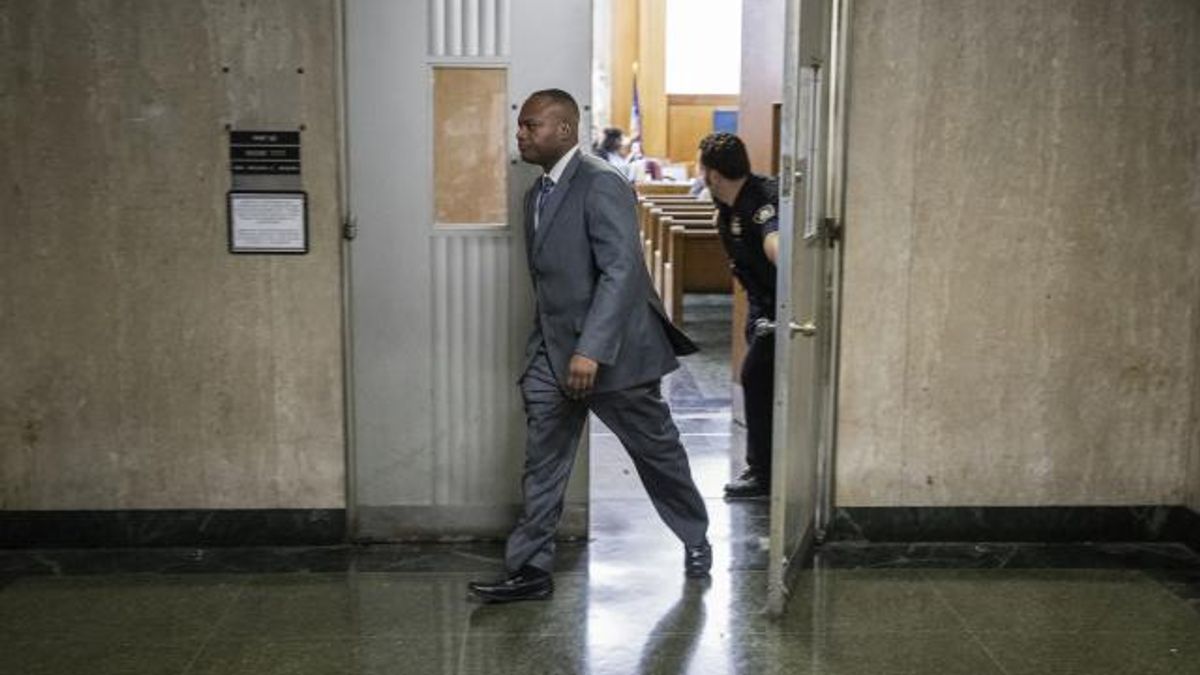
NEW YORK — A state judge handed a light sentence on Wednesday to a once-decorated detective who had been convicted of perjury, sparing him jail time and accusing prosecutors of hypocrisy in their handling of the case.
The former detective, Kevin Desormeau, 34, was convicted at trial earlier this year of lying under oath in a drug case. Justice Michael Aloise sentenced him in state Supreme Court in Queens to a three-year term of probation and fined him $500, saying he had eroded public faith in the police.
Other WRAL Top Stories
But the judge saved his harshest words for the prosecution, accusing the Queens district attorney’s office of relying on an untruthful witness to win the conviction. “This entire case disgusts the court,” Aloise told Desormeau. “I will not become complicit in the district attorney’s hypocrisy by incarcerating you.”
Prosecutors had asked that Desormeau be sentenced to six months in jail for having “violated his oath” as a police officer.
Desormeau was once regarded as among the city’s most effective street cops, leading police officers in Queens in gun arrests and ranking third among officers citywide, his lawyer, John Arlia, said before the sentencing.
Arguing against jail time, Arlia said that Desormeau’s “fall from grace” was already accomplished. He had lost the “career he cherished” as a police officer and had been reduced to working as an Uber driver, the lawyer said.
Desormeau, who still faces a separate criminal case in Manhattan, did not speak during the sentencing. Arlia assured the judge Desormeau felt “remorse and contrition.”
Arlia, the defense lawyer, also argued that jail was unnecessary from the perspective of deterrence. The prosecution and conviction of Desormeau alone was enough to deter other officers who might be willing to lie in order to justify an arrest or make a case stick, Arlia said.
“This case screams to every member of service: ‘Don’t even think of embellishing or making up facts to support an arrest,'” Arlia said.
A jury concluded Desormeau had done just that in 2014, when he claimed to have witnessed a man sell drugs to two women on a street corner in Queens.
According to Desormeau, after observing those two transactions, he and his partner got out of their unmarked car and stopped the man, Roosevelt McCoy, in front of a nearby Jamaican restaurant. Desormeau testified that he quickly recovered crack cocaine from behind McCoy’s waistband.
But surveillance videotape from the Jamaican restaurant showed McCoy shooting pool inside the restaurant when the detective said he was outside dealing drugs. The two detectives can be seen approaching McCoy inside the restaurant, bringing him outside and then searching him. On the video, they do not appear to find any contraband.
The case raised troubling questions about the prevalence of police perjury, particularly because a gun arrest which Desormeau and his partner made in Manhattan less than three months later became the subject of additional charges, including perjury. That case is pending.
The New York Times examined Desormeau’s career in an article in October. More recently The Times investigated the phenomenon of “testilying” within the New York Police Department in a series of articles.
On Wednesday, Aloise criticized Desormeau for undermining his fellow officers, but did not address the broader issue of police perjury, other than to suggest that Desormeau’s actions could encourage a tendency to regard police testimony with undue skepticism. “It helps feed the false narrative that police officers are not to be trusted and their testimony is not to be believed,” Aloise said. Then Aloise accused the prosecution of allowing McCoy, who was the main witness against Desormeau, to lie on the witness stand. Desormeau had said he found a rock of crack cocaine on McCoy, and testing indicated that the twist bag in which the crack was found contained DNA that matched McCoy’s sample.
Yet McCoy testified during Desormeau’s trial that the police had never recovered drugs from him, not during a search on the sidewalk, nor during a strip search at the precinct. That claim, according to Aloise, cast a shadow over the entire prosecution. Calling McCoy “a bum,” the judge accused the district attorney’s office of relying on a lying witness in order to convict the detective of another lie.
“This was the most transparently disingenuous testimony this court has ever witnessed,” Aloise said.
The Queens district attorney’s office said in a statement it stood by the prosecution and pointed out both the defense and the jury were made aware of questions about McCoy’s credibility.
“We will not be deterred from pursuing bad cops by the court’s ill-advised comments,” the statement read. “Kevin Desormeau was a New York City police detective. He should be and was held to a higher standard. He violated his oath and framed the complainant.”
McCoy had spent much of his adult life in prison for killing two men. After Desormeau arrested him on the cocaine charges, he spent 51 days in jail. He later received a legal settlement that cost the city $547,501.