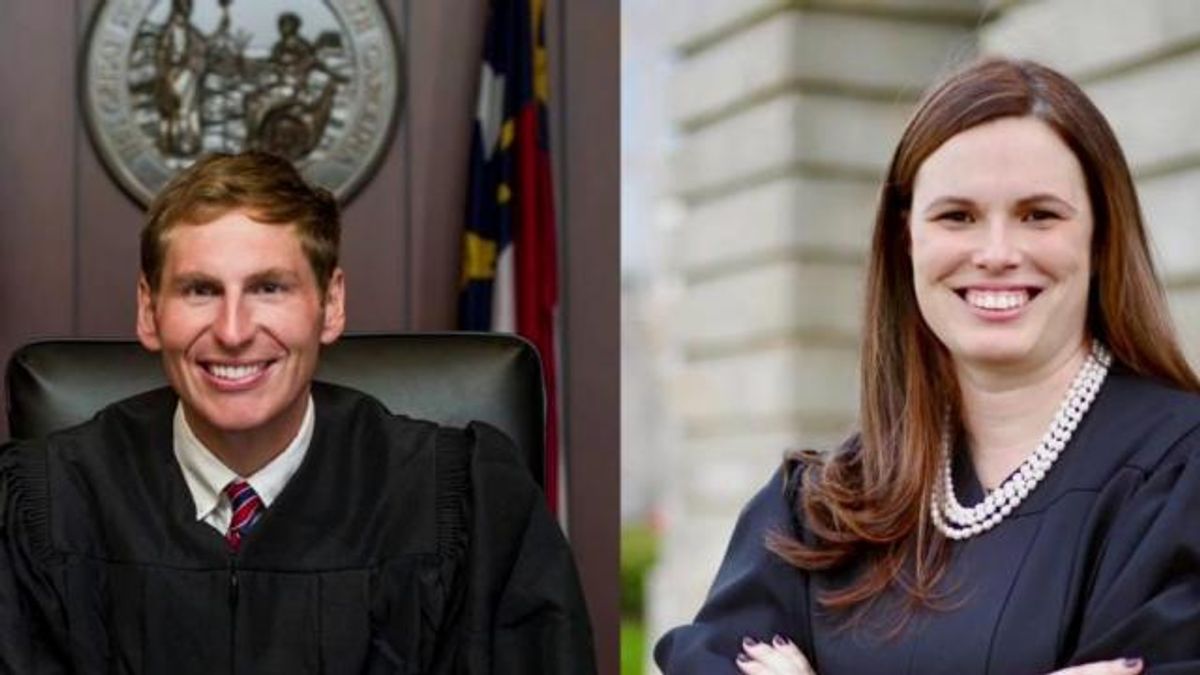
North Carolina's Republican-majority state Supreme Court ruled partially against the Republican candidate seeking to join its ranks, rejecting his effort to fast-track a lawsuit seeking to throw out more than 60,000 people's 2024 ballots.
The case — which could decide a razor-thin, undecided race for a seat on the high court — must go to trial first, the justices ruled ruled Wednesday, shooting down what it called an "extraordinary" effort to skip a trial, bypass the state Court of Appeals, and have the issue decided quickly and directly by the state's highest court.
Other WRAL Top Stories
The complaint was brought by Republican Jefferson Griffin, who received 734 fewer votes than Democratic incumbent Justice Allison Riggs in the November election, a result confirmed by multiple recounts. But the race still hasn't been called in Riggs' favor, as Griffin and the state Republican Party fight in court.
Griffin has previously told WRAL he won't comment on the case. He says he doesn't believe sitting judges should comment on pending litigation. Riggs reacted Thursday to the order, writing on social media that she was glad the Supreme Court rejected Griffin's request to fast-track the case but remains disappointed that Griffin won't concede defeat.
"Judge Griffin’s determination to waste taxpayer dollars in a baseless attempt to overturn his electoral loss won’t change my commitment to the people who elected me to this office," Riggs wrote. "While I agree with the North Carolina Supreme Court’s decision yesterday to dismiss Judge Griffin’s inappropriate request for a writ of prohibition, I am disappointed that the door has been opened to dragging this out for so long."
The legal battle has attracted national attention due in part to the drastic nature of Griffin's claim that tens of thousands of North Carolina voters shouldn't have been allowed to cast a ballot in November. Republican supporters have adopted claims of election integrity, while Democrats call it a dishonest attempt to steal the election.
Griffin, who for now remains a judge on the state Court of Appeals, claims that the state should never have counted more than 60,000 ballots and is asking to have them thrown out.
He's targeting some overseas voters, but mostly people who voted by mail or during early voting. The voters are being challenged, for the most part, because the state's database of voter registrations doesn't include certain information it is required to have about them, such as their driver's license numbers or Social Security numbers. In many cases, that's due to mistakes made by government workers in charge of recording the data: Mistyping numbers, misspelling names, forgetting to hyphenate a double last name or similar errors.
The list disproportionately includes women and minorities, groups that tend to vote Democratic. Griffin has said in court filings that he expects to end up being declared the winner if those ballots are thrown out and the results are retabulated.
The issues were brought to light in unrelated challenges by other Republicans before the 2024 election, but the State Board of Elections and a federal appeals court ruled in those cases that the voters should be allowed to vote anyway. Griffin is now asking the state Supreme Court to ignore those past decisions, rule in his favor, and throw out the ballots in question.
Griffin says the state can't be sure the voters are who they say they are. Critics, including the state elections board, say that's not true because North Carolina requires voters to show photo ID to vote — or, if they don't have an ID, to provide their Social Security number.
After the State Board of Elections rejected Griffin's arguments in December, state law dictated that he was supposed to appeal by bringing his case to trial in Wake County Superior Court. Griffin, however, attempted to skip that and bring his case directly to the Supreme Court. On Wednesday, the Supreme Court rejected that request and told him he must go through a trial first.
It's a major decision that will likely add months to Griffin's efforts to unseat Riggs. The Supreme Court has a 5-2 Republican majority at the moment; Riggs has been allowed to continue serving while the election remains contested. She has recused herself from this case.
Justices mostly unanimous
Wednesday's decision was essentially unanimous. However, in an indication that the justices are aware of the close attention on the case, every member of the court wrote a separate opinion explaining his or her decision — except for Riggs due to her recusal.
The majority opinion sending the case back to trial was written by Republican Justice Trey Allen. The court's other Republican justices — Chief Justice Paul Newby and justices Phil Berger Jr., Tamara Barringer and Richard Dietz — each wrote concurring opinions. The court's other Democratic justice, Anita Earls, wrote an opinion that concurred in part and dissented in part.
Earls said she would have gone a step further and fully denied Griffin, allowing Riggs to be officially declared the winner. Allowing the election to remain in limbo while this goes back to trial, she said, sets a troubling precedent for future elections. "It sets up courts to be the arbiters of election outcomes instead of voters, and weakens faith in the democratic processes of this state," she wrote.
In the court's majority opinion, Allen ordered the State Elections Board not to certify a winner in the race until after the case goes to trial and winds its way back through the appellate system, likely back to the Supreme Court, for a final decision. The order indicated that should still happen quickly, even while acknowledging it's not as quick as Griffin was hoping for. "The Superior Court of Wake County is ordered to proceed expeditiously," Allen wrote for the court.
Complicating factors, however, is a separate but essentially identical lawsuit that is also proceding in federal court. The U.S. Court of Appeals for the Fourth Circuit will hear oral arguments on Monday over how to procede with Griffin's challenges. That same court issued an order in October ruling that the voters Griffin is challenging were eligible to vote in the 2024 elections, despite the issues raised about their data.
Griffin and his GOP allies have since fought to keep the case out of federal court and limited to hearings in state court, while Riggs and her Democratic allies have asked for it to be heard only in federal court. So far neither side has gotten their entire wish, and the case is proceding in state and federal courts simultaneously.
Wednesday's state Supreme Court order sending it back to trial, however, indicates there could be a ruling in the case in federal court before there's one from state court.