Another biotechnology company has set its sights on the Triangle with major plans to develop obesity drugs.
San Francisco-based Genentech plans to create up to 420 high-paying jobs in Holly Springs — a project expected to bring an investment of up to $700 million to the southern Wake County town, state officials said Monday.
Other WRAL Top Stories
The subsidiary of Swiss healthcare giant Roche is expected to create a new manufacturing facility in the southern Wake County Town by the end of 2030, according to state Commerce Department officials, who discussed the project Monday during a special meeting of the department’s Economic Investment Committee.
The 700,000-square-foot facility would be the company's first East Coast production facility. It's also Genentech's first new manufacturing facility globally in the past two decades, executives said. The project will support development of Genentech’s obesity medicines — and it could expand in the future, depending on the business U.S. policy environment, the company said.
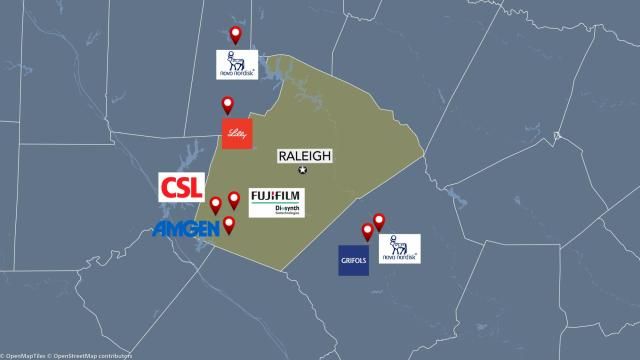
Genentech is at least the third major biotech company to announce major expansion plans in the town in recent months. Companies such as Amgen and FujiFilm Diosynth Biotechnologies have also been ramping up manufacturing in Holly Springs.
It’s also the latest drugmaker to target North Carolina for expanded production of weight-loss or diabetes treatments.
Novo Nordisk, which has long manufactured treatments for diabetes and obesity in Johnston and Durham counties, announced plans last year for a $4.1 billion expansion that is expected to create up to 1,000 jobs in Johnston County. Since 2020, Eli Lilly & Co. has committed at least $16 billion to develop new manufacturing sites in the U.S. and Europe, including locations in Research Triangle Park and Concord. And Amgen, which has been expanding in Holly Springs, is currently developing a GLP-1 weight-loss drug, aiming to compete with Novo Nordisk, which makes Ozempic and Wegovy, and Eli Lilly, which makes Zepbound and Mounjaro.
Genentech is also developing a GLP-1 drug.
To entice the company, state commerce officials approved an incentives package worth up to $13.1 million, including a jobs grant of about $9.8 million. Local incentives worth about $33.5 million are also being considered, state officials said. The project is expected to grow the state economy by $3.1 billion over the 12-year term of the incentives deal, state officials said. Such incentives are paid out in installments, provided the company meets hiring and investment targets. County officials expect the project to create an estimated 4,578 direct and indirect jobs.
The Genentech jobs would pay an average annual wage of about $120,000 — 56% above the average private sector wage in Wake County, according to state data. The company — which also makes treatments for cancer, multiple sclerosis and other diseases — plans to add the employees over five years, between 2028 and 2032, state officials said.
“These are meaningful, good paying jobs that will help hundreds of North Carolinians build their career and support their family over the next decade.” North Carolina Gov. Josh Stein said Monday at a news conference in Maryland, where he was attending an economic development conference.
Biotech magnet
More than 800 life sciences companies do business in North Carolina, and another 2,500 companies serve the industry, according to the governor’s office. North Carolina shipped nearly $13 billion in pharmaceutical products globally in 2024, state officials said.
The Triangle has long been a magnet for life sciences and biotech companies due to its affordability compared with other biotech hubs such as the San Francisco Bay area and the Boston metropolitan area, as well as access to a strong talent pool and access to an international airport.
Biotech companies that have relocated to or expanded in the Triangle have cited the region’s talent pool and proximity to major research universities such as North Carolina State, Duke and the University of North Carolina, as well as access to workforce training through the region’s community colleges.
Genentech, which picked Holly Springs over a finalist site in Ohio, was courted by many states, state officials and executives said.
North Carolina rose to the top in large part because of its talent pool and specialized services, according to Ashley Magargee, the company’s chief executive. “We believe we can hire many skilled people to run this facility, as well as the skilled construction and specialized construction it will take to build this manufacturing facility,” she said during Monday's news conference.
She also noted the region’s proximity to strong academic research and health care institutions and investments in infrastructure and the transportation network. The incentives package and government for the sector were also factors, she said.
Holly Springs in particular has benefitted from its proximity to other life sciences companies in Research Triangle Park. Efforts by local officials to expand infrastructure and make way for shovel-ready sites capable of handling biotech companies have also helped.
Amgen — which makes medicines that treat cancer, heart disease, osteoporosis and inflammatory diseases among others — cited many of those reasons in December when it announced plans to add up to 370 jobs as part of a new, $1.02 billion investment in Holly Springs. It was the second expansion announced by the company in recent years. The latest expansion brings the company's total planned investment in Holly Springs to about $1.57 billion, with expectations to create about 725 jobs. As part of Amgen's second expansion, the state approved an incentives package worth up to $6.5 million.
Fujifilm Diosynth, a contract manufacturer for biotech companies, announced plans last year to add 680 high-paying jobs at its Holly Springs campus — part of a $1.2 billion expansion of what is expected to be one of the biggest biomanufacturing facilities of its kind in North America. In total, the company expects to invest $3.2 billion and hire up to 1,400 people at the campus by 2031.
Global vaccine maker Seqirus, which finished a $156 million Holly Springs plant in 2022, said last year that it had received a combined $155.4 million in grants to help it increase the inventory of a key component of a proprietary bird flu vaccine and to deliver finished doses of the vaccine.
Wage competition
Research and development jobs have long been sought after by corporate recruiters. But state economic development officials have also paid close attention to biomanufacturing in recent years, which benefits Holly Springs due to its proximity between RTP, where lots of research jobs exist, and places such as Lee County, which has attracted large pharmaceutical plants.
Pfizer, which has had a Lee County plant for years, has been one of the county's biggest employers, but it recently conducted layoffs after a drug in the pipeline failed to win federal approval. Last year, Japanese pharmaceutical company Kyowa Kirin announced plans to more than double the scope of its new Sanford plant, with more than half a billion dollars in planned investments.
Genentech will be competing for talent with those and other growing companies that are also offering wages well above the county average.
The jobs Amgen is planning for its second phase — including engineers, technicians, quality control analysts and supply chain managers — are expected to earn a minimum average wage of $91,527, which was about 22% above the average annual wage for private sector jobs in Wake County at the time of the announcement.
Diosynth’s latest expansion is also focused on hiring engineers, scientists and manufacturing personnel — jobs expected to pay an average annual salary of about $110,000.
Roche and Genentech’s current U.S. footprint includes 13 manufacturing and 15 research-and-development sites across the company’s pharmaceutical and diagnostics divisions and 25,000 employees in 24 sites across eight U.S. states.
In April, the company announced plans to invest $50 billion in new R&D sites, including the one in Holly Springs. The company is also planning new and expanded manufacturing facilities in Indiana, Pennsylvania, Massachusetts and California.