To donate a kidney, it takes a big heart.
In January 2002, Anne Kelly worked as a nurse at UNC Hospitals. Having been blessed with good health for much of her life, she wanted to leave a lasting impact in some way. In talking with a nephrologist, Kelly learned kidney donations generally required the donor and recipient to be related or have some sort of direct connection.
Other WRAL Top Stories
Having seen patients wait for months and years for a kidney, Kelly challenged that idea in what was the start of something special.
“I knew that there were a lot of people waiting for kidneys,” Kelly said. “I just remember that moment and thought ‘wow,’ I want to do that one day.”
The anonymous donation to an unknown person was not common practice in the Triangle then. The choice meant Kelly would need to undergo rigorous testing and evaluations from UNC medical teams to ensure she would be able to go through with what wound up being UNC Hospitals' first non-directed living kidney donation.
'One to give, one to live'
Kelly knew of the ‘one to give, one to live’ mantra regarding functioning kidneys. She mentions that phrase often when talking about the choice. However, this was an unprecedented move for one of the area’s bigger hospital systems.
“In 2002, the only living donor pairs that we had done were people who knew each other,” said Amy Woodard, living donor transplant coordinator with UNC Health. “This was the first time we had someone approach us about donating a kidney just because they could, to help someone in a true altruistic way.”
Early in her career, Kelly remembered seeing a young woman in the hospital on a ventilator and on hemodialysis in the wee hours of the morning. It was a harrowing sight. As a critical care nurse, she regularly saw people in emergency and critical situations, moving her to action. Kelly was scheduled to be an organ donor but felt called to do more.
“You see a lot of how things just aren’t fair to people,” Kelly said. “I was healthy all my life, I saw a lot of what people go through when they’re not so lucky.”
After many physical and psychological tests, Kelly was approved to donate and was asked to choose a potential donor.
“You pick,” she responded. “Whoever you think.”
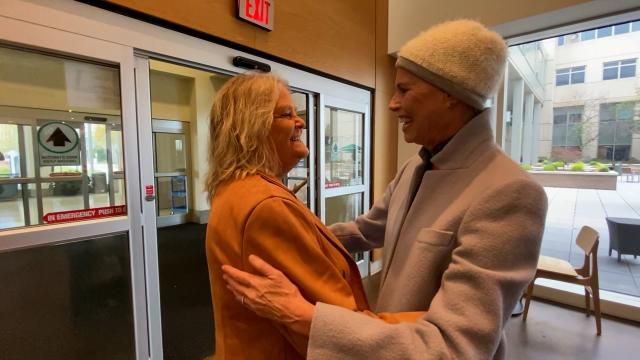
Kelly’s decision would lead to the first-of-its-kind gesture for the hospital with two people with no relationship to each other suddenly becoming forever linked.
Debra Norris, the eventual recipient, was struggling. She was battling end-stage kidney disease and on dialysis at 45, needing a kidney to live. The Clayton resident had been on a waitlist for three years and faced long odds on a match for a donor.
“I was beginning to think that I wasn’t going to get a donor because I had been there so long,” Norris said. “So when they called me up and said they had a donor, I was so tickled.”
A kidney from a living donor usually lasts longer and leads to a higher quality of life for the recipient.
A meeting decades in the making
This fall, Kelly and Norris met in person for the first time after decades of writing letters to each other through the hospital.
For 22 years, Anne and Debra kept correspondence with holiday cards at Christmas and well-wishes sent on the anniversary of the donation. The two were in each other’s lives from a distance. Years passed, holidays came and went, milestones were celebrated.
That all culminated with a meeting at the UNC Lineberger Cancer Center, where their story started decades ago.
For Debra, she could finally put a face behind the letters and the giving of life.
“I knew how important it was to meet her because of what she did for me,” Norris said.
A new battle
The week of Thanksgiving, they came together again for a WRAL feature piece. Although they were just weeks removed from their much-anticipated reunion, the circumstances were different. Anne was diagnosed with terminal brain cancer in September. She’s now the fighter as the cancer has spread. Kelly has limited time left, but carries a peace about her thanks to a strong faith, built by her upbringing and time at Campbell University’s divinity school.
“I know where I start and stop,” Kelly said. “God has filled me with a peace…and a joy. I’ve had to look at life differently.”
Norris, now 69, recalls all the things she’s seen in the past 22 years knowing the donation from a stranger made it all possible. She’s seen her children grow up and bring grandchildren into her life. She was on the waiting list for three years before getting a call and at that juncture, a lasting and fulfilling life seemed distant.
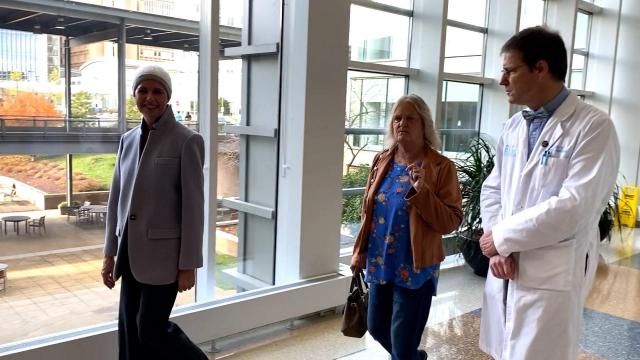
“I feel like she’s part of my family,” Norris said.
Now, donating kidneys toward a general wait list is more common, possibly because of stories like Anne and Debra’s. In 2023, more than 6,900 people became living organ donors, according to the United Network for Organ Sharing. The risk of death for people who donate kidneys has dropped by more than half in the last decade, according to a New York University study published in August.
“I absolutely encourage people, if they’re thinking about a living donation, because that can make such a big impact on people’s lives,” said nephrologist Dr. Eddie Fuller with UNC Health.
Kelly says she likely won’t be able to be an organ donor given her cancer, making her choice decades ago all the more important.
This Thanksgiving, Kelly and Norris are both grateful for putting a face on the other person, giving new depth to a friendship born out of giving. It’s a guiding force in a world full of unknowns, fostered by a piece of Anne that’s always inside of Debra.
“God called me to be a nurse,” Kelly said. “He called me to be a donor.”