Some of North Carolina’s closest elections will likely remain in limbo for at least two more weeks as the election officials review more than 60,000 ballots following Republican protests over voter eligibility.
The North Carolina State Board of Elections on Wednesday voted unanimously to move forward with a plan that requires Republican petitioners to submit briefs on or before Nov. 27 and calls on Democrats to submit their responses by Dec. 6.
Other WRAL Top Stories
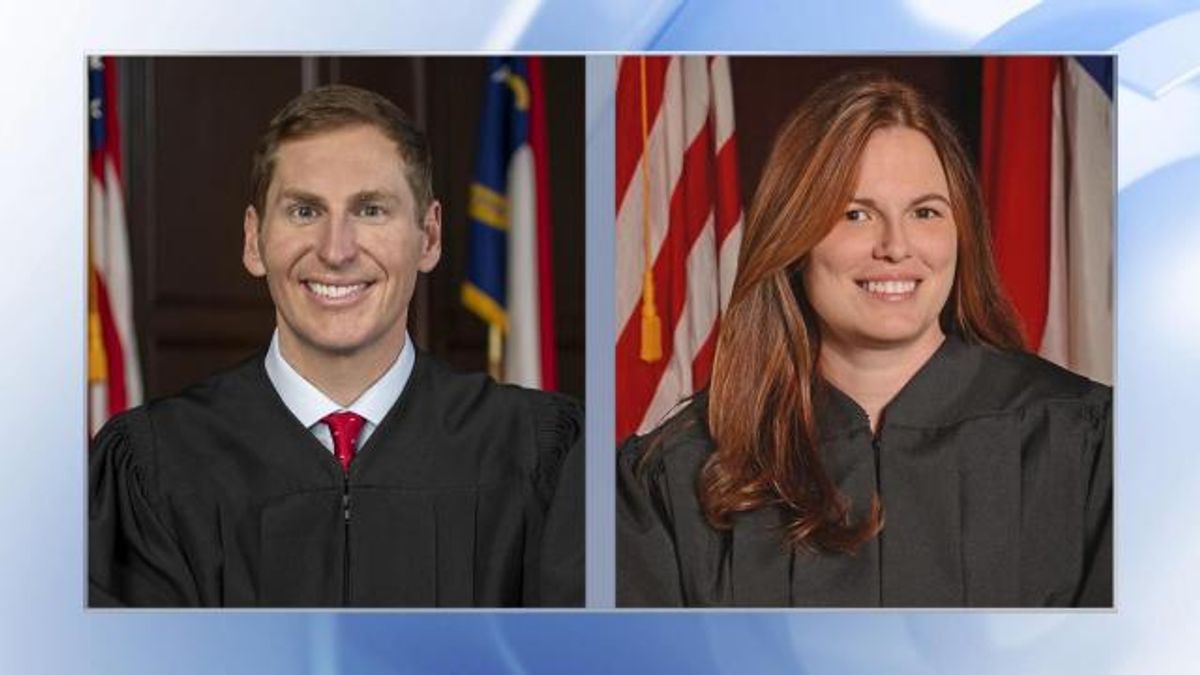
Most of the 60,000 protests have been filed by Republican Jefferson Griffin, who trails incumbent Democrat Allison Riggs by 625 votes in the state’s lone Supreme Court race and has asked for a recount. Just hours after the elections board announced its plan Wednesday, Riggs declared victory in the race.
“This victory shows our democracy in action," Riggs said in a statement. "Every voter’s voice matters in shaping the future of our state and our judiciary.”
The board has yet to certify the final race results, so Riggs' declaration of victory only represents her opinion of how the vote-counting process will bear out. Republican legislative candidates Ashlee Adams, Frank Sossamon, and Stacie McGinn also filed protests. The protests feature a range of complaints, including that ballots were improperly counted because they were cast:
- By voters who died before Election Day.
- By voters who may be ineligible because they have felony records.
- By absentee voters who may have not properly submitted identification.
- By absentee voters who are alleged to have never lived in North Carolina.
- By voters who may have lacked proper identification when they registered to vote years ago.
Many of the claims have already been looked into, and rejected, by elections officials or federal courts. But Republicans see the issues as unresolved and pertinent to some of North Carolina’s tightest races.
The state board, on which Democrats hold a majority, plans to manage the investigation into the eligibility. The board plans to rely on county elections boards to investigate some of the localized complaints, such as whether a voter’s criminal record disqualifies them. The state elections board will deal with higher-level legal issues, such as the claim that voters are ineligible because their registration applications filed years ago are incomplete.
The protests about incomplete registrations echo complaints the North Carolina Republican Party included in a lawsuit against the state elections board earlier this year.
In its August lawsuit, the party called on the board to disqualify the registration of 225,000 voters over allegations that they didn’t provide proper identification when they registered. The federal Help America Vote Act, or HAVA, requires people to show their driver's license or the last four digits of their social security number when registering to vote.
The state elections board previously pointed out that many North Carolinians registered to vote before HAVA was passed in 2002, and therefore are exempt from that requirement. The board also noted that someone's social security number or driver's license number could be missing from their database due to a clerical error — in other words, the voter did provide the information but someone forgot to enter it or entered it wrong.
Richard Myers II, the chief district court judge for the Eastern District of North Carolina and an appointee of former Republican President Donald Trump, ruled last month that the 225,000 voters in question could not be removed prior to this year’s elections. The GOP lost again at the 4th Circuit Court of Appeals, but the lawsuit remains pending and the GOP’s arguments appear in some of Griffin’s ballot challenges.
“Much of what you are hearing and seeing really are issues that we have highlighted yet the State Board [of Elections] has refused to address,” Jason Simmons, the state GOP’s chairman, told WRAL Wednesday.
“The protests that we have before us just continue to expose these problems that we've had concerns about and have not been properly dealt with,” Simmons said.
The State Board of Elections has addressed HAVA complaints similar to what GOP officials are citing. In April, the board’s Democratic and Republican members voted unanimously to dismiss a complaint making the same type of allegations.
The board on Wednesday laid out its plan to review complaints at the same time Republican-led legislature passed a bill to switch the state and county elections boards from Democratic to Republican control, and to also speed up the “canvass” process in which elections officials investigate charges like those the Republican campaigns are making. State elections director Karen Brinson Bell previously told WRAL that speeding up the canvass process would likely lead to more mistakes in which valid ballots are thrown out. GOP lawmakers, however, said it was important to finish the process as quickly as possible.
The board's review also comes as state and county boards are recounting ballots in multiple close races throughout North Carolina.
Adams trails Democrat Terence Everitt by 134 votes in the race for a state Senate seat representing northern Wake County. McGinn trails Democrat Woodson Bradley by 204 votes in a Charlotte-area state Senate district. Sossamon trails Democrat Bryan Cohn by 233 votes in the race for a state House seat in eastern North Carolina.
Riggs is one of only two Democrats on the seven-member North Carolina Supreme Court. If Riggs loses, Democrats would have a tougher path to gaining a majority in 2028, when three Republican-held seats would be up for election. Incumbent Democrat Anita Earls would have to win reelection in 2026 and then Democrats would need to sweep all three 2028 races to regain control.
Griffin has said he’s challenging the ballots to protect the integrity of the election. “These protests are about one fundamental principle: ensuring every legal vote is counted,” Griffin said in protest documents.
The North Carolina Democratic Party believes Riggs will prevail after a recount, according to Anderson Clayton, the party chair.
“Let this race serve as a reminder that every vote counts,” Clayton said in a statement.
Democrats lost a state Supreme Court seat by 401 votes in 2020, when Republican Paul Newby beat Democrat Cheri Beasley to become the court’s chief justice. A recount left that race in limbo for more than five weeks, until Beasley conceded on Dec. 12.