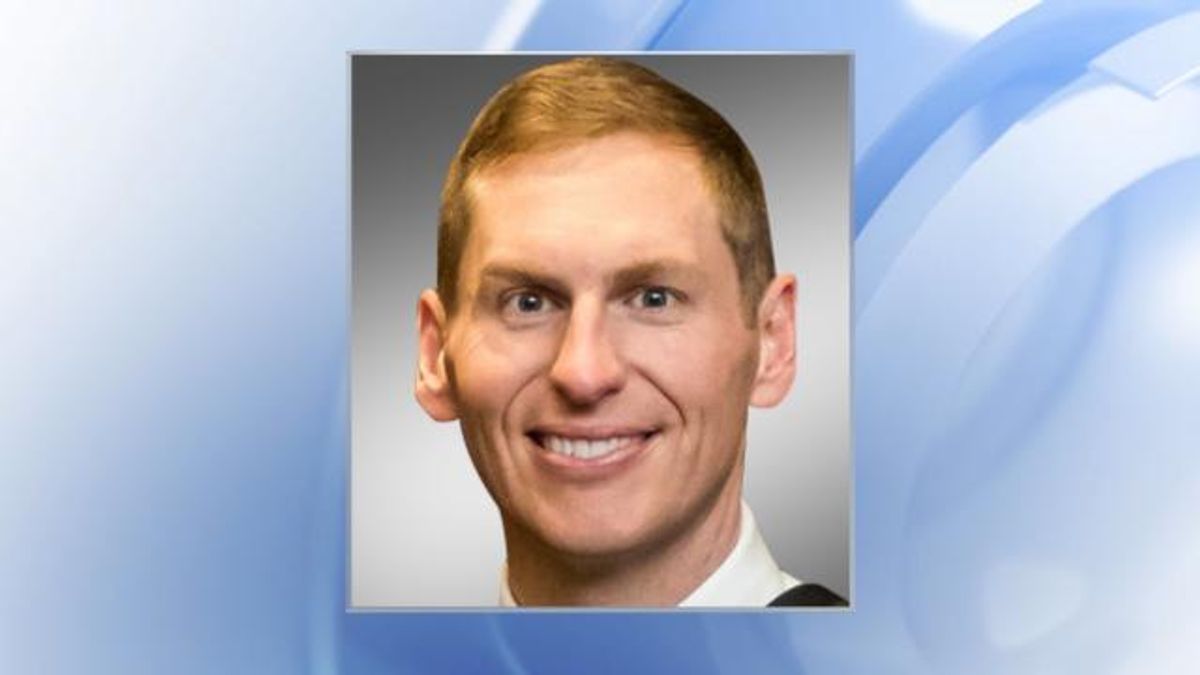
Jefferson Griffin — the Republican candidate at the center of an unresolved North Carolina Supreme Court election — says opponents have targeted his family with a hate-mail campaign that included numerous death threats. Now authorities are investigating.
“For months, the Griffins’ young family has been subjected to vicious personal attacks targeting them at their home — a tactic that has become all too common in today’s angry and polarized political environment,” Blannie Miller, a private attorney for the Griffin family, said in a statement Thursday.
Other WRAL Top Stories
The plea comes as Griffin is embroiled in a high-profile legal battle that could determine the winner of the high-court seat.
Democratic incumbent state Supreme Court Justice Allison Riggs received 734 more votes than Griffin in the November election, recounts showed. But the race remains uncertified while Griffin contests about 65,000 ballots over allegations of voter registration irregularities and other issues.
Griffin’s challenge has drawn protests from Riggs’ supporters in courtrooms and in public squares across North Carolina. They accuse him of undermining democracy. Some Republicans have also urged Griffin to drop his challenge.
Miller, the Griffin attorney, told WRAL that people are also targeting the Republican by sending batches of hateful letters — including postcards with death threats and threats of other violent acts — to his eastern North Carolina home. Opponents have also made threats on social media platforms, she said, adding that babysitters are scared to come to the Griffins’ house.
“We respectfully ask the perpetrators of this relentless harassment campaign to end it,” Miller said in the statement.
Probe amid tragedy
The alleged threats come at a difficult time for Griffin, Miller said. Last month, Griffin’s wife Katye gave birth prematurely to a girl who has since died, she said.
“The past four months have been traumatic for the entire family, and Katye and Jefferson will have more to say about this in the future,” Miller said in the statement. “For now, the Griffins request peace and privacy at their home while they mourn the death of their daughter and as Katye continues to recover from emergency surgery.”
WRAL wasn’t able to independently verify the threats. Miller declined to provide copies of letters to WRAL. She said the family reported the alleged threats to court marshals. Griffin is a judge on the state Court of Appeals.
A spokesperson for the North Carolina Judicial Branch told WRAL News Thursday that marshals for the state Supreme Court are investigating threats against Griffin. The judicial branch spokesperson declined to provide additional details about the investigation.
Miller told WRAL she “will explore all options available to protect the Griffins.”
Riggs, too, has been the subject of violent threats that her campaign reported to authorities, according to a campaign spokeswoman who declined to provide further comment. The courts system spokesman said marshals were conducting a similar investigation into allegations of threats against Riggs.
In 2014, state lawmakers made it a felony to threaten serious injury or death to any judicial officer or any other person in retaliation for the judicial officer's performance of their duties.
Unusual disclosure
Griffin’s statement was unusual in that it provided highly personal information about a candidate who has largely remained in the background while his challenge plays out in court. Griffin, who has recused himself from the case as it goes through the state court system, has previously declined to comment on the legal challenge, saying a sitting judge shouldn’t opine on pending litigation.
“This whole saga has been played out without him being very involved,” said David McLennan, a political science professor at Meredith College in Raleigh. “He's been almost absent since Election Day. He's been communicating through his lawyers.”
The disclosure about the death of Griffin’s daughter could appear to some as an attempt to humanize him and “form a bond” between Griffin and the people of the state following repeated protests against his challenge and his reluctance to discuss it, McLennan said.
Politicians often reveal intimate personal details when they're campaigning, but they might also make such disclosures after an election if they’re facing a public relations crisis, McLennan said. And Griffin is under pressure, he noted. “He's been demonized by Democrats and others,” McLennan said, referring to the protests against Griffin’s legal challenges.
But at the center of the statement is Griffin’s primary motive: to spare his family from more threats.
“Our political culture has gotten so toxic and so prone to violence,” McLennan said, “that this is Griffin trying to carve out, saying, ‘Hey, I'm the public figure. My family is not.’”
Political violence concerns
Concerns over attacks on politicians of all kinds have increased in the years since. Early last year, an Ohio man was charged with threatening to kill North Carolina Sen. Todd Johnson, a Republican representing Cabarrus and Union counties and his family. And then there were the assassination attempts on President Donald Trump on the campaign trail late last year.
U.S. Sen. Thom Tillis, R-NC, has also faced death threats in the leadup to next year's reelection campaign. The magazine Vanity Fair reported that Tillis was told by the Federal Bureau of Investigation that he was the subject of death threats due to having publicly voiced concerns about Trump's nominee for secretary of defense, Pete Hegseth. Tillis ultimately voted for Hegseth. And Tillis' office said Thursday that people were arrested in 2022 and 2023 for threatening to kill Tillis, including one man who also allegedly threatened to cut off the hands of his staffers.
This week, state lawmakers began debating a new proposal to make threatening local officials such as school board members or county commissioners a felony, just as it’s already a felony to threaten state officials. Rep. Keith Kidwell, R-Beaufort, is leading the charge for that bill on behalf of one of his local county commissioners who reported being threatened during the 2024 elections.
Kidwell’s bill would also change the rules for anyone accused of threatening any politician, allowing them to be jailed for up to 48 hours with no bail, or to be involuntarily committed to a mental hospital if found to be dangerous due to psychological or substance abuse concerns.
A 2023 poll by the nonprofit Public Religion Research Institute last fall asked whether "true American patriots may have to resort to violence in order to save our country." Nearly a quarter of Americans — 23% — said yes, up from 15% in 2021. The increase cut across party lines: 33% of Republicans agreed, 22% of independents and 13% of Democrats.
In recent years, many North Carolina voters have also become worried about efforts to manipulate the results of elections, particularly after the 2020 presidential election which was challenged by Republican President Donald Trump after he lost to then-Vice President Joe Biden. A large majority of the state’s registered voters were bracing for politically motivated violence after the election, polling from Elon University indicated last year.
WRAL State Government Reporter Will Doran and WRAL Capitol Bureau Chief Laura Leslie contributed to this report.