The North Carolina Supreme Court ruled Thursday that it won't fast-track the lawsuit by the Republican candidate for a Supreme Court seat who's trying to throw out the ballots of more than 60,000 voters in an attempt to reverse the 2024 election results.
The decision could play a major role in who ultimately wins the seat.
Other WRAL Top Stories
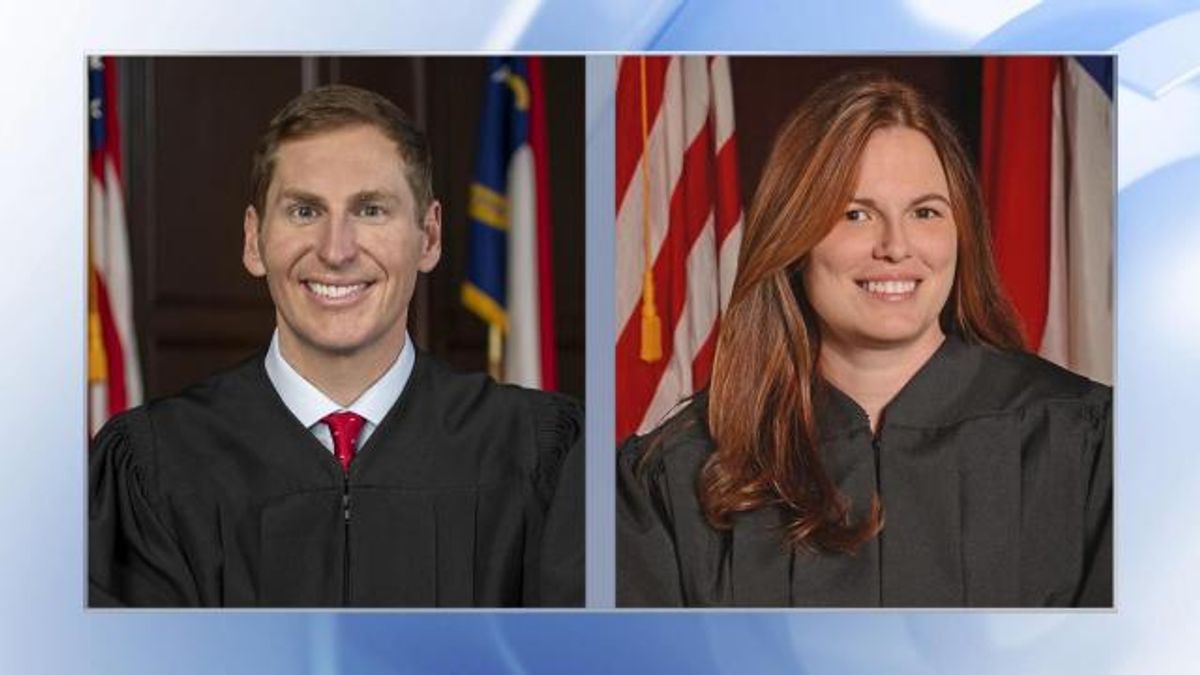
Republican Jefferson Griffin received 734 fewer votes than Democratic incumbent Justice Allison Riggs, recounts show. But the race hasn't been certified as Griffin challenges the eligibility of tens of thousands of voters whom he says shouldn't have been allowed to vote in the first place.
Griffin's legal arguments were rejected by the State Board of Elections and again by a trial court judge in Wake County. He says data inconsistencies made it impossible for the state to verify the identities of the voters he's challenging. Griffin is also challenging several thousand overseas voters, saying some should have been required to present photo identification and alleging others weren't eligible to vote because they never lived in the state.
For all of the rules Griffin is claiming were broken, however, he's not challenging every voter who committed the alleged violations. His challenges target certain demographics and counties that lean Democratic.
After his loss at trial this month Griffin appealed to the Court of Appeals, where he's currently a judge. But the Board of Elections then asked the Supreme Court to speed up the case by allowing it to skip the Court of Appeals and head directly to the Supreme Court. Riggs supported that strategy as well.
On Thursday the justices shot down that request in a 4-2 vote, allowing it to take the slower path through the Court of Appeals that Griffin sought.
Fight over timing more than it seems
While Thursday's ruling appears procedural on the surface, it doesn't only affect how quickly a decision will be made in the case. It could also have immense repercussions for who ultimately wins the lawsuit, and perhaps the seat.
Because Riggs has recused herself, the Supreme Court now has six justices who will ultimately rule on whether to accept Griffin's challenges. Griffin contends in court filings that he expects to win the race if his challenge prevails in court.
Two of the justices — Democrat Anita Earls and Republican Richard Dietz — have made it clear they will rule against Griffin. They've written that he's essentially trying to change the rules after the election is over, and that voters shouldn't be punished for not following rules they didn't know about.
The other four justices, all Republicans, haven't directly said how they would rule in the end but have all voted so far to let Griffin's lawsuit move forward.
If one of those four ends up joining Earls and Dietz in the end, the court will deadlock in a 3-3 tie. In that case, it wouldn't be able to issue a ruling and the most recent court decision would become the final word in the case.
Right now, the most recent ruling is Griffin losing in Wake County Superior Court. Judge William Pittman ruled earlier this month that the state Board of Elections did nothing wrong when it dismissed Griffin's attempts to throw out the ballots.
However, if and when the case goes to the Court of Appeals — which Thursday's ruling sets the stage for — there's a much higher chance that Griffin will win. Nearly all of his colleagues on the bench are fellow Republicans. Griffin has recused himself from the case.
At the Supreme Court, the justices recognized the stakes of what they decided Thursday. The ruling was another 4-2 decision with Earls and Dietz dissenting. Earls accused Griffin of hypocrisy, using her dissent Thursday to quote from Griffin's own previous legal filing asking to speed up the case because, as Griffin wrote in December, "the candidates and the public have a vital interest in this election receiving finality as expeditiously as possible."
The only thing that has changed since then, Earls wrote, was the fact that Griffin lost at trial and subsequently has also lost his interest in speeding the case along.
"Griffin’s opposition to the bypass petition begins by asserting that this court should not hear this case because, as a court of six members, we might split 3-3 leaving the lower court’s ruling as the final ruling in the case," Earls wrote. "In other words, he asks us not to hear the case because he might lose. Such outcome-determined reasoning has no place in a court committed to the rule of law."
Some of the Republican justices who had also previously said the case needs to be heard quickly attempted to explain their own change of heart Thursday, in now slowing the case down by sending it to the Court of Appeals first. Justice Trey Allen blamed Pittman, the Wake County judge, for not writing a thorough enough ruling when Pittman ruled against Griffin.
"Perhaps influenced by this court’s order directing it to move expeditiously, the superior court simply ruled against Judge Griffin without explaining why, in its view, his claims should be denied," Allen wrote. "Consequently, if we were to take this case now, we would do so in the absence of any meaningful examination of those claims by a lower court."
Allen concluded by asking the Court of Appeals to also move quickly in reaching its own decision.
In the meantime, while the case plays out, however, the status quo remains in place: Griffin remains on the Court of Appeals and Riggs remains on the Supreme Court. While each has recused themselves from this specific case, they continue to participate in other work on their respective courts.