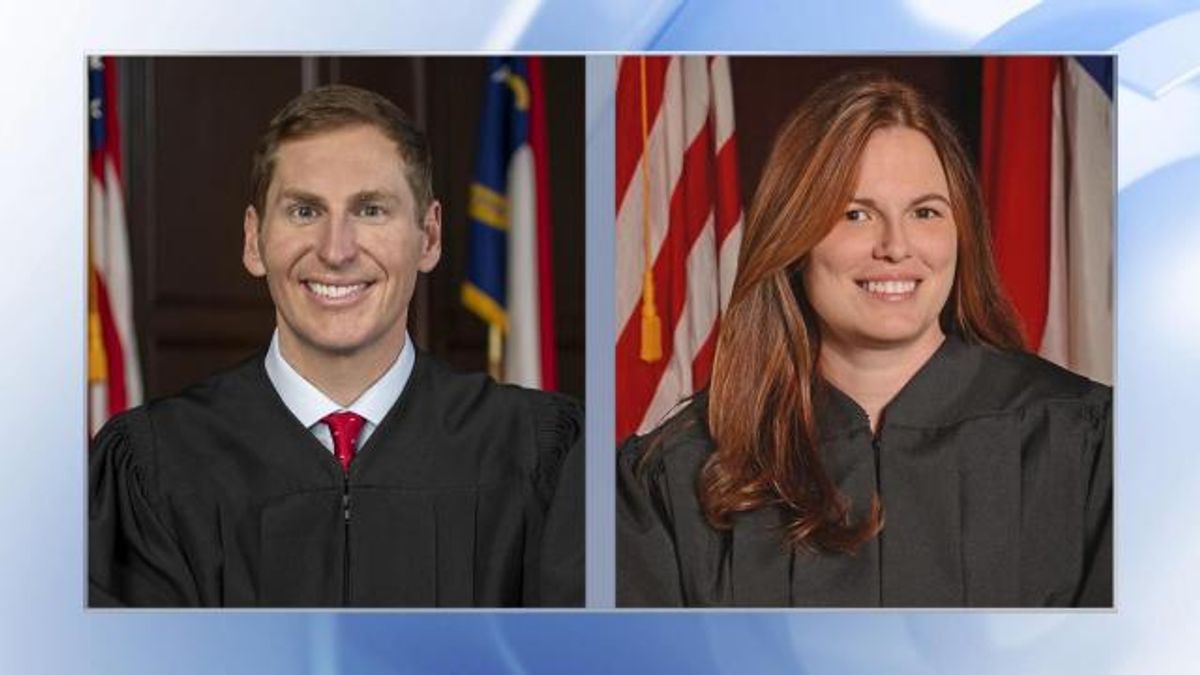
A federal appeals court says North Carolina judges should be the first ones to rule on a legal challenge that could ultimately determine who wins an open seat on the state’s Supreme Court.
The federal decision, issued late Tuesday, is a win for the state Republican Party and its candidate, who are seeking to overturn the results of the November election for the seat. The state's top courts have sizable Republican majorities.
Other WRAL Top Stories
Democratic incumbent Justice Allison Riggs received 734 votes more than Republican challenger Jefferson Griffin in the November election. But Griffin sued, arguing that more than 60,000 people who voted in the race shouldn't have been allowed to vote at all.
The same argument was rejected in a separate Republican Party-backed lawsuit during the election by federal trial and appellate courts, which ruled that the people in question were allowed to vote. Because of that, Griffin has sought to keep his case out of federal court.
Griffin, who is a judge on the state Court of Appeals, wants the case to be decided in state court — where the issue hasn't been directly ruled on yet.
Griffin won at least a temporary reprieve Tuesday, when the U.S. Court of Appeals for the Fourth Circuit ruled in his favor and said the case could continue in state court, at least for now. The ruling left open the possibility that federal courts might take the issue back up if state courts don't adequately resolve it.
Griffin has declined to comment on the case, saying judges shouldn't comment on pending litigation. The NCGOP has been handling communications on the case for him.
“We’re pleased the Fourth Circuit has agreed that state courts should decide state elections,” Matt Mercer, a spokesman for the North Carolina Republican Party, said in a statement Monday. “Judge Griffin’s protests were filed exclusively under state statutes and should be decided here in North Carolina’s courts.”
Riggs — who remains on the high court but has recused hersself from this case — she was reassured that a federal court could ultimately hear the case and she criticized Griffin for what she called a wasteful and baseless effort to "thwart the will of North Carolina voters."
“I remain committed to upholding the rule of law protecting the rights of every North Carolina voter, including the more than 65,000 who Judge Griffin has challenged," Riggs said in a statement issued Tuesday, a day after the federal ruling was issued. "I will continue to hold accountable any elected official who tries to disenfranchise voters or trample on our freedoms. Voters deserve a swift resolution in this case.”
The first trial court hearing in the case is scheduled for Friday in Wake County Superior Court.
Tuesday's ruling wasn't a total loss for Democrats and the North Carolina State Board of Elections, which has heavily opposed efforts to throw out the ballots it says were legally cast and counted.
In their opinion Tuesday, the three judges who heard the case left open the possibility that the case could wind up in federal court again, depending on how exactly the forthcoming state court battle turns out.
The case has been gaining national attention, and the new chair of the Democratic National Committee, Ken Martin, weighed in Tuesday calling on Griffin to drop out, or at least suffer a quick loss in court.
"Today’s decision from the 4th U.S. Circuit Court of Appeals will drag this out even longer, wasting the tax dollars of hardworking families.," Martin wrote in a statement. "Judge Griffin needs to give up this desperate attempt to overthrow a free and fair election. If he won’t, the courts need to step in to ensure the will of the voters is heard.”
The complex procedural details of the case reflect not only the complexity of the legal arguments — but also the massive amount of money pouring in to fund the legal wrangling, from state and national political groups interested in advancing the arguments of one side or the other.
The opinion from the Fourth Circuit on Tuesday was a unanimous ruling by the three judges, two Republicans and a Democrat. In it, they wrote that the case had been properly sent to federal court in the first place. But because the state Supreme Court took action on the case in the interim, the judges felt they had lost their authority to take the case back.
WRAL covered oral arguments in this case in Richmond, Virginia last month and reported that the senior judge on the panel, Ronald Reagan appointee Judge Paul Niemeyer, appeared to favor of Griffin's argument that federal courts couldn't touch the case due to the state Supreme Court's actions.
Tuesday's ruling largely goes in Griffin's favor. But it also leaves open the possibility that it could go back to federal courts, as the elections board had asked for.
"Federal courts have discretion to refrain from resolving a case pending in federal court that involves state law claims and potential federal constitutional issues if the resolution of those unsettled questions of state law could obviate the need to address the federal issues," the ruling says. "However ... the federal court retains jurisdiction of the federal constitutional claims while the state court issues are addressed in state court."
Meanwhile, it's possible that one or more of the multiple parties involved in the case might try to appeal this ruling further to the U.S. Supreme Court. Immediately after the ruling was published Tuesday, spokespeople for the elections board and lawyers in the attorney general's office declined to comment.