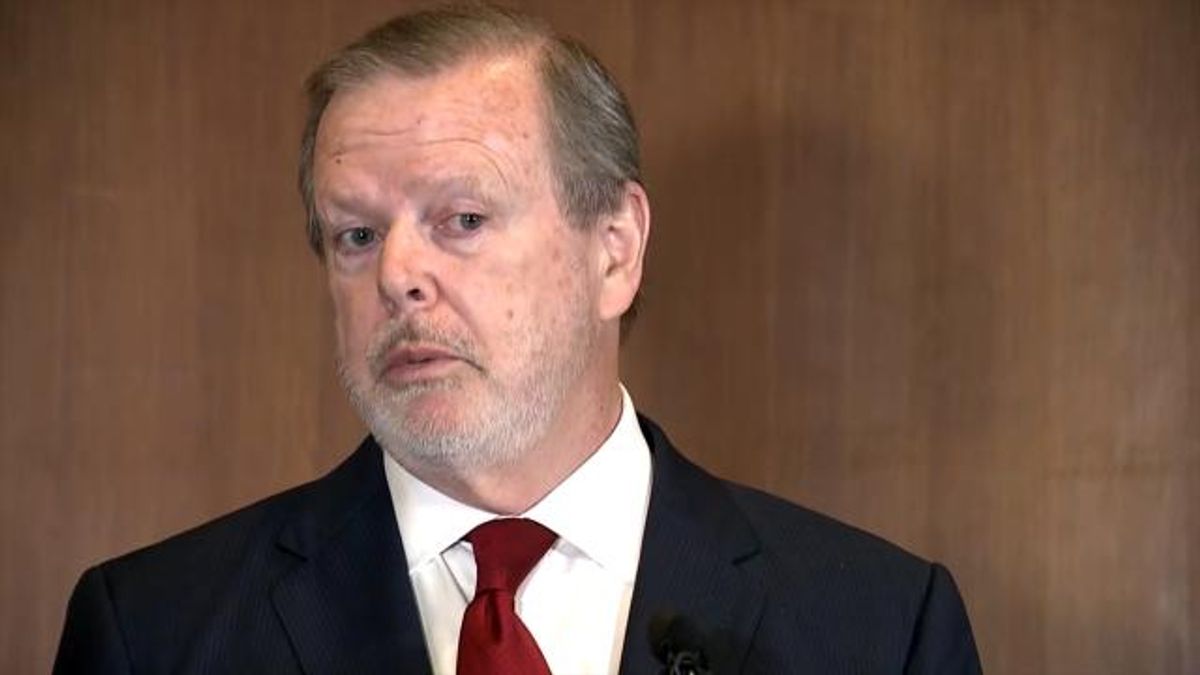
One of the most powerful Republican politicians in North Carolina is spreading false claims about election fraud and needs to publicly retract his statements before his supporters resort to violence, the state's top elections official said Thursday.
“When you tell your fellow citizens that an election is being conducted fraudulently, they listen,” Karen Brinson Bell, who leads the State Board of Elections, wrote in a letter to Senate leader Phil Berger. "I fear for the people running elections in this state, including in your own community, that some misguided people will conclude from your statements that actions must be taken, perhaps through the use of threats or violence.”
Other WRAL Top Stories
Spokespeople for Berger, R-Rockingham, didn’t immediately respond to a request for comment on Brinson Bell’s letter.
Berger told reporters Wednesday he was concerned about the vote-counting process in North Carolina being rigged for Democrats. His remark came after his chamber passed a bill to give Republicans more control over elections, and as a key race for a seat on the state Supreme Court underwent a recount.
The Democratic incumbent in that race, Justice Allison Riggs, appears to have won by 625 votes. But that narrow advantage — a mere fraction of the 5.5 million votes cast — was well within the margin for a recount. Republican challenger Jefferson Griffin requested one on Tuesday.
Berger indicated Wednesday that he was concerned with how Riggs won. Griffin was leading on election night by about 10,000 votes when roughly 98% of the state's ballots had been counted. But after the remaining tens of thousands of ballots were counted, Riggs ended up with a 625-ballot advantage. She claimed victory on Wednesday night, hours after the recount had begun. State elections officials said the recount could take a week to finish.
Berger suggested not all the votes should’ve been counted, alleging the process was somehow rigged in favor of Democrats. He didn’t explain how. His comments came immediately after the legislature passed a bill that, critics say, will make it more likely that valid ballots are thrown out in future elections.
"We're seeing played out, at this point, another episode of ‘count until somebody you want to win wins,’” Berger told reporters at the state legislature Wednesday.
Brinson Bell took umbrage. In her letter to Berger on Thursday, she reminded him that many people believe what he says and asked him to take back that remark. “This is an accusation of wrongdoing that has absolutely no basis in fact,” Brinson Bell wrote. “You are a top leader of our state government. What you say matters.”
She used the 2020 elections as a cautionary tale, alluding to disproven accusations of rigged elections that fueled an exodus of seasoned elections workers.
Brinson Bell also told Berger she’d be happy to explain to him how elections work, if he’s feeling confused. She added: “If you prefer, talk with the 500 bipartisan Republicans and Democrats serving on the county boards of elections who certified the very votes you falsely draw into question. Do you question the integrity of these board members and the oath they took to conduct elections according to law?”
Legislature wants faster results
The changes that Republican lawmakers passed Wednesday in Senate Bill 382 included a number of provisions stripping power away from offices that will be held by Democrats who won the 2024 elections — including another attempt by GOP lawmakers to take away the governor’s control over the State Board of Elections.
The bill, which would only become law if it survives an expected veto by Democratic Gov. Roy Cooper, would also shorten the time period allotted for the state’s “canvass” process to submit final election results from 10 days down to 2.5 days.
Also on Thursday, former Republican Gov. Pat McCrory said he opposes the GOP's efforts to strip power over elections from incoming Democratic Gov.-elect Josh Stein. The new bill would give control of elections instead to the incoming new state Auditor-elect, Republican Dave Boliek. McCrory said that makes no sense.
"North Carolinians, including me, elected the state auditor to investigate waste, fraud, and abuse in state government — not appoint the Board of Elections," McCrory wrote. "The North Carolina Constitution assigns appointment powers of this nature to the governor, not the state auditor. Both political parties should stop playing games with the administration of elections, which shakes the confidence of voters in our voting system."
Brinson Bell told WRAL earlier this week that could cause voters to be disenfranchised, and legitimate ballots to be thrown out. Republicans lawmakers in the House and Senate dismissed those concerns, saying their main concern is getting results as quickly as possible.
In 48 states, voters are allowed to cast what are called provisional ballots if their eligibility to vote requires further investigation, such as showing up to the wrong precinct or lacking a valid photo identification. The canvass period allows county officials to investigate and decide whether to count those ballots.
When reporters asked Berger how elections officials could condense a 10-day process into fewer than three days without mistakes or being forced to throw out ballots, unless they had more money to hire extra staff, Berger said that’s something the legislature might choose to look into later but declined to answer further questions. “We don't need to get into a back and forth,” he said.
Elections leaders questioned what lawmakers are truly attempting to accomplish with the changes slashing canvass time and implementing what they see as a partisan power grab.
The proposal to take away the governor's power over elections comes after multiple recent attempts by the legislature to give themselves power over elections were ruled unconstitutional for violating the North Carolina constitution and its separation of powers rules. Republican lawmakers also asked voters in 2018 to approve a constitutional amendment changing the rules, but it was rejected after receiving just 38% of the vote.
Berger told reporters that he doesn’t think swapping political control of the elections board from Democrats to Republicans is about politics.
Which office controls North Carolina elections in the future, however, might depend on who wins the 2028 elections for those offices. Berger said “it's a fair question for us to step in and maybe make another change” after future elections.