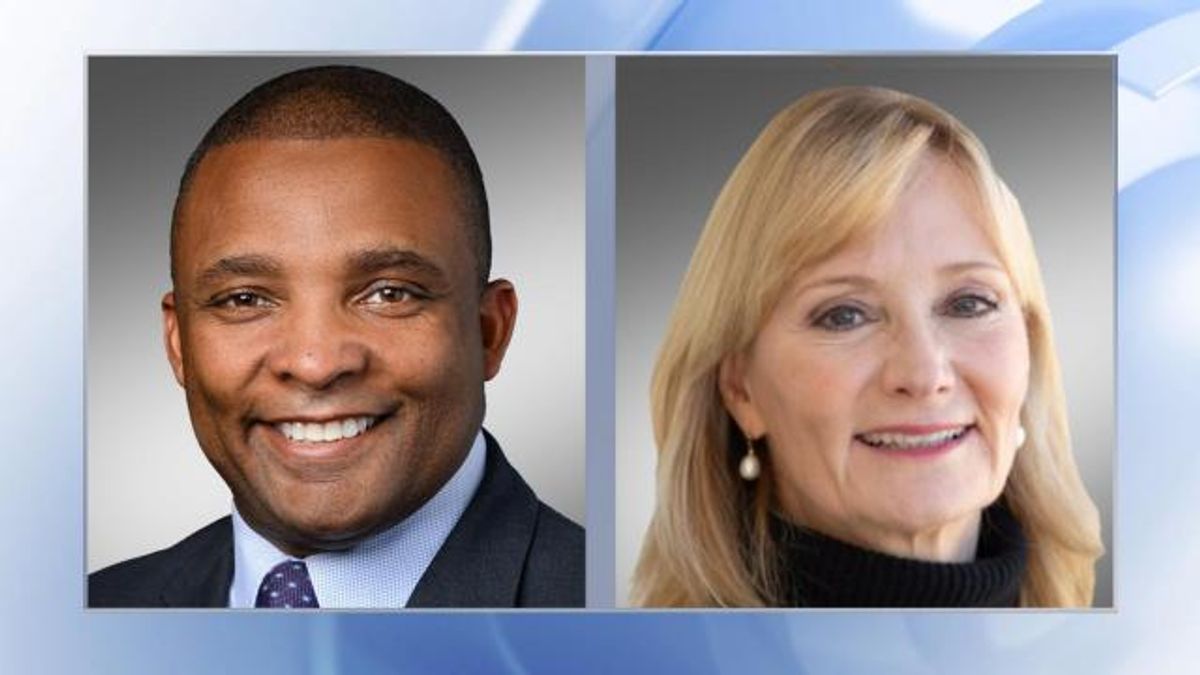
Voters in an often-overlooked part of North Carolina have garnered immense national attention this year: The contest to represent the rural northeastern region of the state in the U.S. House of Representatives is one of the only competitive congressional races in the Southeast.
Due to a combination of factors — gerrymandering, a shrinking population, shifting political coalitions, an unpopular Democratic president — the once solidly Democratic 1st Congressional District is now a tossup.
Other WRAL Top Stories
Republican challenger Laurie Buckhout, a defense contracting consultant and recent transplant to North Carolina who has injected at least $1.7 million of her own money into her campaign, is seeking to unseat incumbent Democratic U.S. Rep. Don Davis by touting her conservative views, her success in business and the fact that, unlike Davis, she hasn’t spent years in politics.
Davis, a Presbyterian minister who grew up picking tobacco in Snow Hill outside Greenville, has also served as his hometown’s mayor and state senator. He’s counting on those local ties and his reputation as a political moderate — willing to vote against his party if he sees it as going too far left — to help carry him over the finish line.
North Carolina’s 1st Congressional district covers 22 counties stretching from the Outer Banks, through much of Eastern North Carolina, and into the outskirts of the Triangle. It goes as far west as Henderson and as far south as Kinston, picking up towns such as Elizabeth City, Edenton, Rocky Mount, Wilson and Goldsboro along the way.
The district isn’t important only to political representation in North Carolina. It’s one of few that could tip the balance of power in Congress. The Republican Party currently controls the U.S. House, but only by three seats.
In the 2020 presidential election, voters in this district narrowly favored Democrat Joe Biden over Republican Donald Trump. But four years later, polling shows Biden is deeply unpopular in the state. Republicans have a real chance to seize on that, flip the seat and give themselves a better shot at keeping control of the House, says East Carolina University political scientist Peter Francia.
“This district has been a Democratic stronghold for more than 100 years,” he said. “But all signs point to a more competitive election in 2024 than in recent history.”
Tying Davis to Biden, however, could be a tough sell for some in the district. Davis’ voting record puts him among the most moderate or even conservative Democrats in Congress.
He was one of just six Democrats to support a GOP resolution this summer slamming Democratic Vice President Kamala Harris, the party’s presidential nominee, over border security concerns. “President Biden’s and Border Czar Harris’s far left Democrat open border policies are to blame for this historic crisis,” the resolution stated.
Davis also received an “F” grade from the group ProgressivePunch, which tracks politicians’ voting records from a progressive point of view.
“I don't look at it as lining up with Democrats or voting with Republicans,” Davis told WRAL when asked in an interview about his voting record. “I look at it as listening to constituents and ultimately voting what I believe is in the best interest of Eastern North Carolina.”
Buckhout, however, is hoping Davis’ constituents are interested in moving in a more conservative direction. Her campaign and other pro-Republican groups have spent millions of dollars on ads trying to tie Davis to Biden, particularly on immigration. Davis’ campaign has gone on defense, airing ads showing him visiting the U.S.-Mexico border.
Immigration a top issue
“There's a lot of fear of the unknown,” Buckhout told WRAL in an interview, regarding voters’ concerns over immigration. “Because they're coming in. We don't know who they are. We don't know where they're going.”
She referenced the case of a Yemeni man, allegedly on a federal terrorist watch list and accused of living illegally in the 1st District, who was arrested in March. And she blamed immigrants for dealing drugs, particularly opioids.
Data shows that, for years, the opioid epidemic has hit rural North Carolina harder than other parts of the state.
“I'll go into a forum and I'll say, ‘Raise your hands if you know someone who has been touched by the fentanyl issue,’ and it cuts across every segment of society,” Buckhout said. “It cuts across big money [families] or public assistance [families]. It cuts across every color. It cuts across genders.”
Attack ads against Davis slam him for not voting for Republicans’ marquee immigration bill in 2023, his first year in Congress. Davis told WRAL he voted against it because it would’ve required farmers to check the immigration status of their workers using a system called E-Verify that’s currently optional.
Many farmers bring in immigrant workers legally, using temporary work permits under the H-2A visa program. But not all farmers or workers follow the rules. The federal government estimates that close to half of crop farm workers in the United States are undocumented immigrants.
Davis said he supports stronger security measures at the border itself but feared the proposed E-Verify mandate would’ve quickly led to higher prices at the grocery store. “For the life of me, I was not going to vote for something that's going to increase costs, or anything that could have an adverse impact on our farmers,” he said.
Other lawmakers voiced similar concerns, and GOP leaders later put forward a similar version of the bill that left out the E-Verify requirements but still had border security measures — such as kickstarting border-wall construction and reinstating other immigration policies enacted during the presidency of Republican Donald Trump. Congressional records show that 199 Democrats voted against. Five Democrats, including Davis, voted for it.
An anti-Davis ad from the National Republican Congressional Committee cites the first version of the bill, which he voted against. It makes no mention of the later version that he voted for.
“Don Davis voted against border security, and that has dire consequences for North Carolina,” a woman says in the ad. “I lost my brother to the fentanyl crisis. So it’s very personal.”
Davis said ads like that are clearly meant to mislead voters about where he stands, and it shows that “some are willing to say whatever they feel is necessary to get elected.”
It could also be misleading about how drugs enter the country. Fentanyl is most often packaged by Mexican cartels, transported across the border by U.S. citizens, and then distributed by domestic gangs, according to government data and policy analysts.
While Davis is accusing Republicans of twisting his record on immigration, Buckhout says Democrats are doing something similar to her: Twisting her stance on abortion.
‘Blatant lies’ on abortion
Buckhout doesn’t hide her opposition to abortion. But she said she supports the current system — in place since the Supreme Court overturned Roe v. Wade two years ago — in which individual states are allowed to decide their own rules for abortion access.
That’s the way small-government conservatives should want it, she said, rather than having Congress pass a national law on abortion.
WRAL’s fact-checking partner PolitiFact recently rated “Mostly False” an ad from Democrats that misrepresented Buckhout’s abortion stance. The ad was paid for by the House Majority PAC, a political action committee that has spent millions on competitive congressional races this election cycle. The ad claimed Buckhout supports efforts “to pass a national abortion ban, allowing politicians to ban abortions with no exceptions and prosecute women if they get an abortion, treating women right here like criminals.”
PolitiFact wrote that while Buckhout’s public stance on abortion is “vague and lacking in detail,” one detail she has been clear on is supporting exceptions such as for women who are raped — the opposite of what one part of the ad claims.
“Those ads are blatant lies,” Buckhout said in an interview. “Absolutely no basis in fact, along with the ads that say I'm going to take away Social Security, and stuff like that. I’ve never said anything like that.”
Buckhout told WRAL she wouldn’t vote to ban abortion nationwide. But when pressed on whether she’d support a federal law to restrict abortion access across the country, without fully banning it, she declined to say how she might vote.
“Right now, it belongs to the states,” she said. “That's where it belongs. So I really can't speculate.”
When Davis was pressed on the ads making misleading claims about Buckhout’s abortion stance, he said federal law bans candidates from coordinating with outside groups like the one whose ad was fact-checked, so he has no control over what they say. But Davis — who in the state Senate in 2019 was one of just two Democrats to vote with Republicans on the “Born Alive Abortion Survivors Protection Act” — said that if he returns to Congress, one issue he will absolutely vote with fellow Democrats on is the party’s attempt to bring back the protections that used to exist under Roe v. Wade.
“My position has been very clear on abortion,” he said. “And that is: If given the opportunity to go back to Congress, and a bill comes before us, I will vote to codify Roe vs. Wade.”
Military important to both
Davis and Buckhout are both former military officers — a key factor in this district that includes an Air Force base, a Coast Guard air station and a Central Intelligence Agency testing site where special forces troops practiced the raid that killed Osama bin Laden. Massive military installations Fort Liberty, Camp Lejeune and Naval Station Norfolk are also just a short drive away.
Davis spent eight years in the Air Force, reaching the rank of first lieutenant. Buckhout spent 26 years in the Army, retiring as a colonel. After their military careers? Davis got a job teaching at ECU and later went into politics and Christian ministry. Buckhout started a consulting company in the DC suburbs focused on the defense contracting industry. She sold it to another defense contractor, made millions from the deal, and moved to Edenton in 2021.
Davis frequently talks on the campaign trail of growing up with his grandmother, picking tobacco in the Eastern North Carolina heat, as a formative experience. “My roots grew deep in the east,” he said. “This is home. I have a great passion for eastern North Carolina, and I've literally seen the shift, for instance in agriculture, from my days as a kid to now.”
And while Buckhout embraces the image of being a political outsider, being an actual outsider could hurt her chances in tight-knit rural communities. She emphasizes the fact that she could’ve gone anywhere but chose to come here. “North Carolina is a place we love more than anywhere else in the world, and we had a lot of choices,” she said. “We came here because we love the people. We love the state. It's home to us.”
Their financial disclosure forms and other public records show more detail about their lives in the state:
- Buckhout makes $274,000 a year at the business she founded after leaving the military, Corvus Consulting, which is now a subsidiary of a larger defense contractor, Castellum. She also gets paid between $1 million and $5 million per year from a family trust fund that business records show is at least partially funded by the sale of her company. Her husband Paul also works for a defense industry consulting firm.
- Davis makes $6,000 a year in his job as a part-time minister at St. James Presbyterian Church, in addition to his $174,000 annual salary as a member of Congress. His wife Yuvonka is a public school principal in Greene County.
- The Buckhouts live in a 9,200-square-foot home on the Albermarle Sound, assessed at $2.4 million. The Davises live in a 2,300-square-foot home in Snow Hill assessed at $214,000.
About the district
There are 435 U.S. House seats, but Washington-based groups tasked with winning control of the House have focused their hundreds of millions in spending on just a few dozen, including North Carolina’s 1st Congressional District.
The Cook Political Report, a nonpartisan group that forecasts elections, lists Davis’ seat as one of 25 tossup districts nationwide in the 2024 elections. Except for a competitive race in the Washington suburbs of Northern Virginia, North Carolina's 1st Congressional District is the only tossup district between Pennsylvania and New Mexico, according to the group.
Unlike other rural areas, which typically lean heavily conservative, the northeastern part of the state has a large Black population. Black voters in North Carolina are overwhelmingly affiliated with the Democratic party, and the district has been represented by a Black Democrat in Congress since 1992 — first Eva Clayton, then G.K. Butterfield, and now Davis.
When Republican state lawmakers recently redrew the state’s congressional districts, they took the population center of liberal-leaning Greenville out of the 1st District and replaced it with several smaller, more conservative counties closer to the Triangle. That move turned the district competitive for the first time in years.
The district will probably be won by whichever party also wins the presidential race, political analysts say, but there might be some wiggle room. A WRAL analysis of past voting data shows that even without recent gerrymandering to speed up the district’s shift to the right, it had already been moving in that direction.
The counties that make up the district voted about 9 percentage points to the left of the state as a whole in the 2016 presidential race. Trump won the state by about 4% of the vote, but this district would’ve voted for Clinton by about 4.5% of the vote. By 2020, however, the same counties were only about 2 points to the left of the state.
Francia, the ECU political scientist, said that if Trump does as well as he did in 2016, he could carry Buckhout to victory as well. “But if it’s a very close race, like 2020, I think Davis could squeak out a win,” he said. “And if Harris wins, then I think she carries him over the line.”