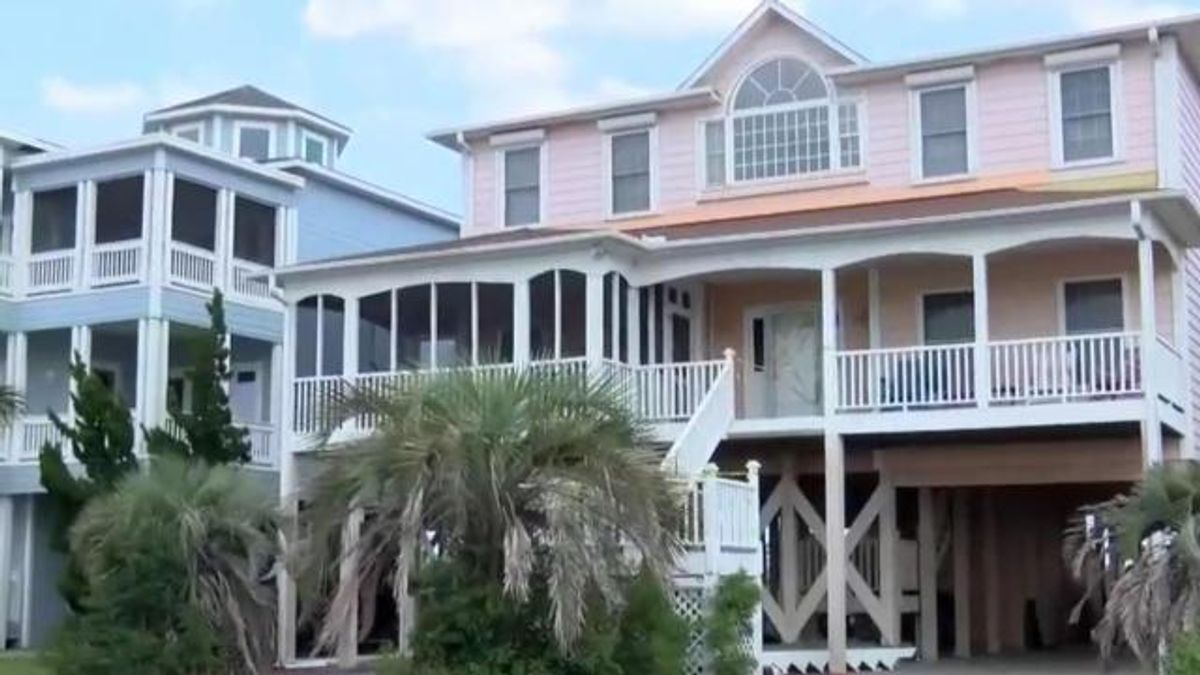
A real estate development company could be allowed to bulldoze a potential Native American burial ground in coastal Carteret County under a new law proposed Wednesday and backed by a state Senator who has received thousands of dollars in political donations from the developers.
Cedar Point Developers LLC wants to build more beach houses in the coastal town of Cedar Point, near Emerald Isle. Campaign finance records show the Jacksonville-based partners behind the company have donated at least $7,500 to the political campaign of Sen. Michael Lazzara, an Onslow County Republican, mostly during his most recent election.
Other WRAL Top Stories
Lazzara’s relationship with the developers didn’t come up when he discussed the proposal during a Senate committee Wednesday. After the meeting ended Lazzara defended the proposal, telling WRAL that the change would affect all developers — not just his campaign donors. He added that their financial support for him wasn’t contingent on this change being proposed.
“It’s really not tied to any sort of support,” he said. “I think it’s just good common sense. Not just for this developer, but for any developer.”
Lazzara wasn’t the senator who officially proposed the changes Wednesday. But as soon as others started asking questions, the lawmaker who did propose the changes deferred to Lazzara, who launched into a detailed explanation.
North Carolina was home to many Native American tribes before colonial settlers and later the U.S. government killed them or forced them to relocate. Under current state law, developers who discover unmarked graves must halt construction until they’re cleared by the county medical examiner or the state archaeologist. And if those bones — or any other archeological finds they dig up — are determined to contain some historic value that the project could harm or destroy, then state law requires construction permits to be denied.
It's that law Senate Republicans are now suggesting should be weakened, to allow faster and cheaper construction. Archeological examinations can add costs to projects, threaten prearranged sales, and can eat into a developer’s profits.
Lazzara, for example, said the Cedar Point developers already spent $500,000 on their unexpected archeological work and could be forced to spend even more unless the law changes. He added they spent millions more buying the land, where they’d like to build several dozen new homes along the intercoastal waterway.
A 2023 report from the Department of Natural and Cultural Resources on that Cedar Point project recommended further investigation, stating that "the area contains numerous human remains, likely from the pre-European contact period, and is believed by archaeologists to be 'a highly significant archaeological site.'"
Concern over 'sacred land'
Wednesday’s proposal would make a number of tweaks to state laws, with a goal of making it harder for construction to be halted for archeological concerns. It would increase the burden on state and local officials to stop construction, and weaken the regulations on builders — for instance by giving them more leeway to disturb potential historic sites but continue working.
The Home Builders Association — an advocacy group for that industry that gives thousands of dollars each year to state lawmakers, including Lazzara — helped craft parts of the bill, Lazzara said.
“It’s all about housing, right?” Lazzara said in an interview. “We have these pressures on housing. We’ve got to find a balance between the regulatory environment and this need for building homes.”
Lazzara made a similar argument in public Wednesday, during the Senate Agriculture and Natural Resources Committee hearing where he backed the changes. That didn’t sit well with Sen. Mike Woodard, D-Durham.
Woodard said he’s also very much in favor of building more housing — but not at the expense of undiscovered historic sites. He said it’s not just arrowheads or pottery shards that were found in Carteret County, but human bones.
“There needs to be a lot more conversation around this, with that community, before we go too far down the path of development on what is pretty sacred land,” Woodard said.
North Carolina recognizes eight tribes that have tens of thousands of residents in the state; the biggest are the Lumbee and the Eastern Band of Cherokee Indians.
Lazzara questioned Woodard’s contentions that the site contained a burial ground, saying the experts the developers hired came back with only “potential findings.”
So before they spend hundreds of thousands of dollars more continuing to chase those potential findings, he said, he thinks the law should change. He said the rules have led to delays and higher costs that drive up home prices not just on the coast but all around the state.
“I think we can all agree that if we dig hard enough and long enough, that we can potentially find things all along the coast,” Lazzara told Woodard. “In places that have already been built, or may be built. I think we need to find a balance in what North Carolina needs for our housing needs, and what our permitting process is making them do. I mean, it’s just ridiculous.”
Woodard asked GOP colleagues on the committee if they had consulted with anyone at the North Carolina Department of Natural and Cultural Resources — the agency that runs the American Indian Heritage Commission, the State Historic Preservation Office and the Office of State Archaeology, among other divisions — to discuss the proposed change. They had not.
A spokesperson for the department confirmed its staff weren't aware these changes were coming before they were announced in the committee Wednesday morning, and are still reviewing the proposal.
Cedar Point project in question
The development in question wasn’t named during the committee hearing but Lazzara confirmed after that it’s affiliated with a Cedar Point company, named for the city where the homes are being built, whose owners have donated to his campaigns in the past.
Cedar Point Developers LLC’s managers include Steven Kellum, who gave Lazzara $2,000 for his 2022 campaign, James Maides, who gave Lazzara $1,000 in 2020 and another $2,000 in 2022, and Chris and Danny Whaley, who gave Lazzara a combined $2,500 in 2022.
Representatives of Cedar Point Developers LLC didn’t immediately respond to requests for comment.
A 2023 article from the Carteret County News-Times reported that the local city commission voted unanimously to approve one step of their project after the developers acknowledged they found Native American artifacts — which they told the commissioners were a “Native American landfill” containing “nothing significant,” according to the News-Times.
That article also noted ancient burial mounds had been discovered in the neighboring town of Indian Beach — hence the name — and that the Department of Natural and Cultural Resources was still investigating the Cedar Point site.