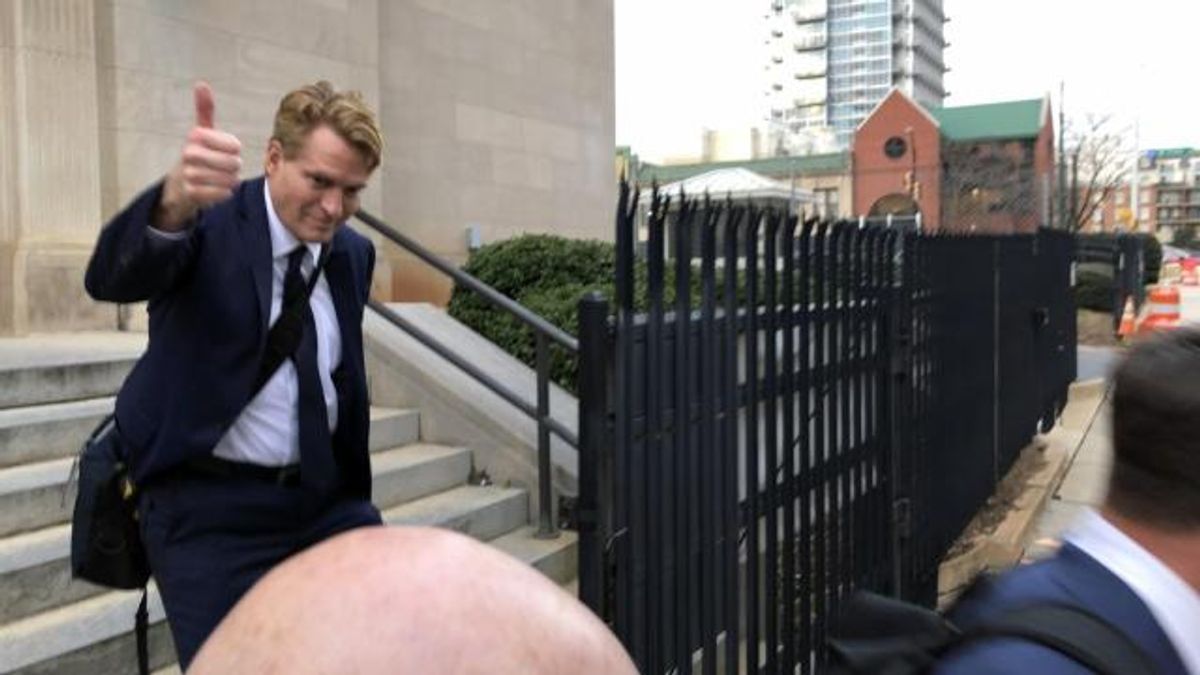
A North Carolina billionaire facing multiple investigations, and three years into a government takeover of insurance companies he owns, said Monday he has agreed to sell those companies to avoid a forced liquidation.
In a news release, Lindberg said he had reached a $307 million deal with Universal Financial Holdings LLC, which would acquire Southland National Insurance Corp., Bankers Life Insurance Co., Colorado Bankers Life Insurance Co. and Southland National Reinsurance Corp.
Other WRAL Top Stories
If approved and consummated, Lindberg said, the deal would allow policyholders of the companies to access all of their policy benefits. Policyholders have worried about whether they’d see returns on investments while regulators investigated what they described as a shortfall of more than $1 billion.
North Carolina regulators would have to sign off for the deal to go forward. A spokesman for the state Department of Insurance said Monday afternoon that details of the deal hadn’t been submitted.
A Lindberg spokeswoman said the prospective buyer had submitted terms of the deal but that Lindberg himself would do so if needed. Department of Insurance spokesman Jason Tyson said Monday evening that the department hadn’t seen details from anyone.
“We have not received anything from either them or the buyer,” Tyson said.
On Tuesday, Tyson followed up to say the terms were submitted to the department about 8:30 p.m. Monday, after this article posted.
Lindberg is awaiting a second trial on charges that he tried to bribe the state’s insurance commissioner, Mike Causey, who recorded their conversations and cooperated with the FBI in a case involving political donations. Lindberg also faces a separate Securities and Exchange Commission complaint accusing him of a “massive fraudulent scheme.”
Causey’s department took control in 2019 of three of Lindberg’s insurance companies, and one re-insurance company, eventually reporting the shortfall. Earlier this year, a Wake County judge overseeing the state’s takeover said Lindberg had defrauded his own companies.
Lindberg has denied the accusations against him and accused Causey and the FBI of entrapping him in the bribery case. Multiple authorities have rejected this argument, and Lindberg went to prison on the bribery charges in 2020, after a federal trial. He was released earlier this year after the U.S. Court of Appeals for the Fourth Circuit found a problem with the judge’s instructions in that trial. He’ll be retried in March.
Lindberg and executives for his Durham-based holding company, Global Growth, have said repeatedly they could turn the insurance companies around if Causey would allow it. The Department of Insurance has said the company is long on promises and short on details. The department has also pointed to a 2019 turnaround agreement which the judge overseeing this saga determined Lindberg broke.
In the Monday news release, Lindberg described the deal as a binding stock purchase agreement, saying it would let them exit the state-overseen rehabilitation. Many policyholders’ benefits have been frozen, and the state’s move to liquidate, already approved by the judge, would trigger protections to pay annuity holders up to guarantee limits. Those limits vary by state, and in North Carolina top out at $300,000.
Lindberg called on the department instead to approve his proposed sale, saying that when the deal closes the companies would have $337 million of capital and surplus, $3.22 billion in total assets and $2.1 billion in total cash and liquid assets. That is “equivalent to approximately 95% of the current annuity account value,” the release says.
A Department of Insurance spokesman said state regulators couldn’t yet evaluate the proposal.
“Before any such sale can occur, Mr. Lindberg is required to submit the proposal to the North Carolina Department of Insurance for approval, which he has not yet done,” spokesman Jason Taylor said in an email. “If NCDOI receives the proposal, it will be reviewed to determine if it meets the requirements of North Carolina law and is in the best interests of policyholders.”