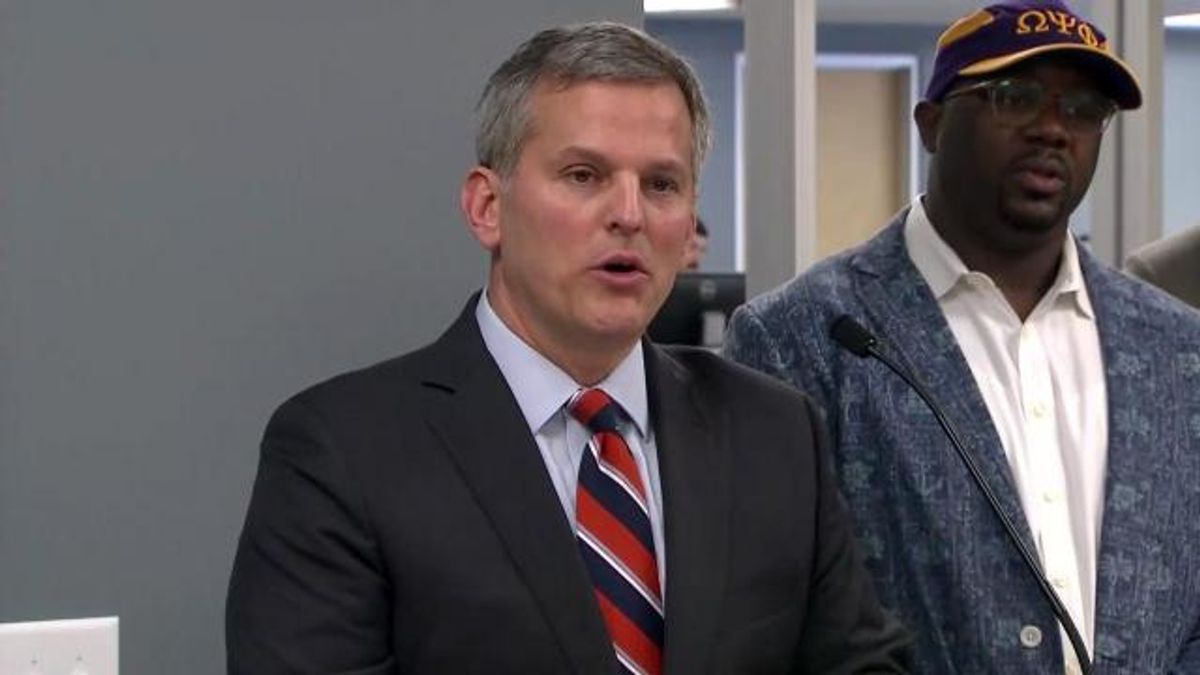
The campaign of North Carolina’s top law enforcement official is being investigated for a misdemeanor election violation by a district attorney of the same political affiliation—a probe that has engrossed the political community not only because the case is unusual, but because it could hold significant ramifications on future elections.
The office of Wake County District Attorney Lorrin Freeman, a Democrat, is investigating whether the campaign of Attorney General Josh Stein, also a Democrat, violated state law in an attack ad against Stein’s 2020 Republican opponent, Jim O’Neill. O’Neill filed a complaint that year claiming that, in airing the ad, Stein’s campaign circulated false and derogatory information about him—potentially violating a 90-year-old law that carries a fine of up to $1,000 and up to 60 days in jail.
Other WRAL Top Stories
The North Carolina State Elections Board, which investigated the complaint and found insufficient evidence for a prosecution, is unaware of any time a candidate’s claims warranted criminal charges under the law, its spokesperson told WRAL.
And yet the Wake DA’s office continues to probe. To date, no charges have been filed.
The unusual nature of the case has prompted speculation among political observers that local prosecutors may have personal motivations for considering the case. Freeman denied those allegations Thursday, noting that she has recused herself from the case and left it in the hands of senior Wake prosecutor David Saacks.
“Those accusations are unfounded and quite frankly belie common sense,” Freeman said in an email. “Understanding that individuals would want to attempt to undermine the integrity of this investigation and any subsequent prosecution on the basis of such false suggestions, I recused myself from this matter from the beginning.”
Stein defended the ad and is surprised that an investigation is occuring at all. “It's a perplexing situation,” he said. “The ad was true. O'Neill had made demonstrably objective false claims about me and those haven't been pursued by her … So I'm just confused."
The state elections board indicated in its report that some comments by O’Neill could be considered for additional investigation. The Stein campaign highlighted three instances in which O’Neill is alleged to have made similar accusations against Stein, including this quote published by the Smoky Mountain News in February 2020: “In January, when I announced, I had had enough of the thought of 15,000 rape kits sitting up on the shelves at the lab that he’s responsible for and he’s done absolutely nothing about,” O’Neill said.
Efforts to reach O’Neill for comment weren't immediately successful on Friday.
The North Carolina Democratic Party has defended Stein and called on the Wake County DA’s office to also investigate O’Neill. Freeman has noted that no formal complaint was filed against O’Neill with the state elections board, a detail the party considers irrelevant.
“Action by a district attorney is nowhere conditioned upon action by the State Board of Elections” in state law, John Wallace, an attorney for the party, wrote to Freeman in an Aug. 11 letter. “We are of the view that you have both the authority and the duty to promptly commence an investigation and to initiate prosecution as we have requested. Your failure to do so will suggest bias or favoritism.”
If prosecutors advance the case, and if Stein’s campaign is ultimately charged, Stein’s political opponents would likely use those headlines against him in future campaign attack ads, regardless of the outcome of the case. Stein is expected to run for governor in 2024. If his campaign is charged and found guilty, not only will critics use the conviction against Stein, the case could invite a new wave of criminal complaints over political speech.
Stein’s ad has been under a legal microscope for nearly two years now, with media outlets recently reporting on the potential for legal action. Here’s a brief summary of how we got here and where things stand.
What did the Stein ad say?
Stein, first elected AG in 2016, won reelection in 2020 against O’Neill, the Forsyth County District Attorney. Stein won by only 13,600 votes, or about one-quarter of a percentage point, making the contest one of the closest in the state.
One topic in the race was rape kits, a term for forensic materials and information obtained when a medical professional examines a victim of sexual assault. North Carolina for years had a backlog of kits that went untested. Stein and O’Neill each accused the other of not doing enough to investigate sexual assault cases.
O’Neill’s campaign filed a complaint with the North Carolina State Board of Elections about a Stein ad titled, “Survivor.” It features a woman who explains why, as a sexual assault survivor, she supported Stein. In the ad, she says:
“When you survive an assault you want to be heard and you want justice. Josh Stein understands that. As our Attorney General, Josh Stein has led the effort to test old rape kits and put more rapists behind bars. As a survivor of sexual assault, that means a lot to me. And when I learned that Jim O'Neill left 1,500 rape kits sitting on a shelf, leaving rapists on the streets, I had to speak out. Jim O'Neill cannot be our Attorney General.”
The O’Neill campaign took issue with the line that he “left 1,500 rape kits sitting on a shelf, leaving rapists on the streets.”
What does O’Neill say?
O’Neill alleges that the ad is defamatory because local law enforcement agencies such as city police departments and county sheriffs departments typically maintain custodial control of rape kits. In other words, district attorneys have no direct control over how many rape kits remain in storage.
While a 2017 survey found more than 1,500 untested kits in Forsyth County law enforcement agencies, O’Neill argued that that figure didn’t represent the actual number of kits that qualified for examination. Some state policies discourage testing of kits in cases where victims want to remain anonymous or where cases were dismissed or settled, O’Neill’s side said, according to a report by the state’s elections board.
Stein’s campaign has said the ad is fair because O’Neill in his capacity as DA has influence over whether sexual assault cases are prosecuted so, by extension, he has some influence over whether rape kits are tested. Stein’s campaign has also argued more broadly that the ad isn’t any more misleading than ads aired by O’Neill and other political candidates.
O’Neill filed a complaint with the North Carolina elections board alleging that the ad violates N.C. General Statute 163-274(a)(9), which says its unlawful: “For any person to publish or cause to be circulated derogatory reports with reference to any candidate in any primary or election, knowing such report to be false or in reckless disregard of its truth or falsity, when such report is calculated or intended to affect the chances of such candidate for nomination or election.”
What did the elections board say?
The state elections board investigation into the complaint, which took nearly eight months, ended in May 2021 with the board finding inconclusive evidence that Stein’s campaign violated the law.
The board’s report, which was obtained by WBTV and later filed as an exhibit in federal court, noted the ambiguity of the issue in stating there were “two plausible interpretations on the falsity of the statement” in Stein’s ad and recommended that the investigation be closed.
The state board says it communicated with the Wake County District Attorney’s office throughout its investigation. However, the two sides have offered conflicting reports of how synchronized their efforts were. Freeman told WBTV that Saacks, the lead prosecutor, asked the elections board staff to take specific steps throughout their investigation, and that his requests were ignored.
“This agency consulted with the Wake County DA and her deputy early on and throughout our investigation. We sent our report and heard nothing back from them requesting additional investigative steps,” elections board spokesman Pat Gannon said in a press statement.
The board’s report also cast doubt on whether the law in question is enforceable. “The NCSBE is concerned that if a violation is found, this might be an unconstitutional application of the statute,” its report says.
Gannon told WRAL on Thursday he believes the law, enacted in 1931, has been cited in only “a handful” of times in complaints to the board and that the board is “not immediately aware of any being referred for prosecution.” Freeman also told WRAL she’s unaware of any case that resulted in prosecution.
Is the law enforceable?
Prior to O’Neill’s complaint, the board most recently dealt with a similar case in 2018 after Republican congressional candidate Scott Dacey claimed in an ad that the late incumbent U.S. Rep. Walter Jones received financial support from liberal donor George Soros. In 2019, the elections board’s deputy general counsel wrote that “it is not feasible for the State Board to become ‘fact checkers’ for political campaigns.”
A federal judge recently declined a request from the Stein campaign to block enforcement of the law.
Bill Marshall, a professor at UNC-Chapel Hill’s law school, said it's unlikely that any complaint filed under the 1931 law in question would survive appeals through the courts.
“The successes of these [types of complaints] are hard to achieve because of the strength of the First Amendment interests involved,” Marshall said. He said the 2014 U.S. Supreme Court case of Susan B. Anthony List v. Driehaus might offer some insight into how the court might rule on North Carolina’s law, if it ever reaches those judicial heights.
While the justices didn’t rule on the constitutionality of the law, “there was strong language in the opinion suggesting that the law was unconstitutional in part because they were concerned that people would use the law to make a political attack, not just to redress a political attack,” Marshall said. “So part of their rationale was that they were concerned about the weaponizing of a law like this in a political campaign.”
Eugene Volokh, a law professor at UCLA, saw the case differently. In an email, Volokh said he views North Carolina’s statutes as one of the more “narrowly crafted criminal libel statutes [that] are generally constitutional under Supreme Court precedents.”
WRAL State Government Reporter Bryan Anderson contributed to this article.