Secretary of Health and Human Services Dr. Mandy Cohen said this week that the state will do a round of proactive COVID-19 testing at every nursing home in North Carolina.
Friends of Residents, an advocacy group for nursing home and assisted living residents in the state, has been pushing Cohen's department for a month to require these tests for staff and residents. The group's executive director said as recently as Thursday that the department hadn't responded.
Other WRAL Top Stories
But Cohen told WRAL News on Wednesday that, in the past week, the state tested everyone in its state-run nursing homes. Private facilities are next, though Cohen said "that doesn’t happen overnight."
The state's response to COVID-19 threats in North Carolina nursing homes has come under increased scrutiny in recent weeks, with much of that scrutiny focused on testing policies and driven by Republican elected officials stepping up their criticisms of a Democratic governor.
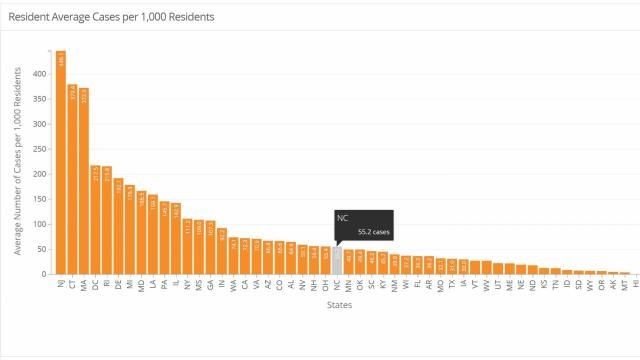
North Carolina's rates of infection and deaths in nursing homes are middle of the pack compared to other states.
Increasingly, GOP lawmakers have pointed to the fact that 60 percent of North Carolina's total deaths from COVID-19 were people who lived in nursing homes or residential care facilities, and they've questioned the state's handling of the issue.
"There's no coherent plan," Republican 3rd District Congressman Greg Murphy, a physician and former state legislator, said this week. "It's throwing things up against a wall and hoping that they stick."
Cohen said she believes the state's response has been good.
"But we're in a pandemic," she said. "Is there always room for improvement? Absolutely."
WRAL worked for more than a week to assess Gov. Roy Cooper's administration's efforts in nursing homes, reaching out to more than a dozen homes and assisted living centers.
Many administrators failed to return calls seeking comment. Those who did said they have few criticisms, though in the pandemic's earlier days they felt like they were on the back burner as state officials focused on hospitals and made preparations for a capacity-stretching surge that has not materialized, even as the state's case counts and hospitalizations continue to rise.
In early April, the state forbade communal gatherings, including meals, at skilled nursing homes, and it recommended similar measures at assisted living facilities. Cooper's administration mandated health checks and mask-wearing for nursing home staff and daily symptom checks for residents.
It restricted visitation in these facilities starting in March.
"I feel like they're trying," Lauren Ware, who owns Tabor Commons Assisted Living, said recently.
Ware's Columbus County facility is one of nearly 150 nursing homes and residential care facilities in the state that have had an outbreak – defined as at least two cases – in the pandemic.
"There's no magic," she said. "But anything we've asked for we've either been given, or it wasn't something that they've had."
The North Carolina Health Care Facilities Association lobbies on behalf of skilled nursing care centers in the state. After several attempts and days of back and forth on this story, the group declined to assess the Cooper administration's response.
"Rest assured, whenever we have concerns about issues that threaten to affect the care of our residents, we raise our hands and speak up – to lawmakers, media and others," spokesman Robert Brown said in an email. "We’ve done that in the past and will do so in the future."
The North Carolina Assisted Living Association lobbies on behalf of assisted living facilities, which offer fewer medical services than nursing homes. Executive Director Frances Messer said she doesn't have "any criticism whatsoever" of the administration's response or the General Assembly's.
"I just think that they've all done well," Messer said. "Can I say that they did absolutely everything right? I don't think anyone can say that."
'Death rate'
North Carolina's official death toll from COVID-19 was 1,064 as of Thursday.
Of those who died, 559 lived in nursing homes, and another 83 were in residential care facilities, according to Department of Health and Human Services statistics updated every Tuesday and Friday.
That's 60 percent of all the state's deaths. Older people, and those with certain medical conditions, are much more susceptable to the virus.
Some, including a Republican dark money group called the Carolina Partnership for Reform, have referred to this as the state's "death rate" for nursing home residents. But the high percentage depends on the state's relatively low number of total deaths.
Thirty-two other states have had more total deaths, per capita, than North Carolina, according to the Kaiser Family Foundation. Neighboring Georgia, with a similar population, has had more than twice as many deaths.
When it comes to COVID-19 cases and deaths in nursing homes, North Carolina is in the middle of the pack compared to other states. According to data reported to the U.S. Centers for Disease Control and Prevention and based on numbers through the end of May, North Carolina has about 55 confirmed nursing home cases per 1,000 nursing home residents.
It's had 12.6 nursing home deaths per 1,000 residents, according to the data.
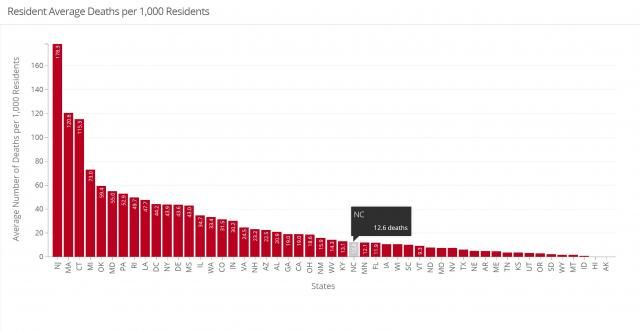
Murphy, the Republican congressman, pointed to Florida as a better example of how to handle COVID-19 in nursing homes. Florida ranks two states below North Carolina when it comes to nursing home deaths, with 11.9 per 1,000 residents.
Republican 9th District Congressman Dan Bishop pointed to Tennessee, which ranks much lower – 3.6 nursing home deaths for every 1,000 residents there.
"Yep, that's what nursing home administrators told me," Bishop said on Twitter late Tuesday. "Essentially no help from Cooper administration following outbreaks."
WRAL asked both Bishop and Murphy to provide nursing home contacts for this story. Neither did.
'I don't know if that would have helped'
Nursing home and assisted living center directors who spoke to WRAL said they had to fend for themselves at first.
"We, as an industry, were put on the back burner for a while," said Lisa Lee, the executive director of Hillcrest Convalescent Center in Raleigh.
But Lee said everyone she's reached out to at the state "has been responsive."
Other nursing home administrators said the supplies that were once hard to come by have come in now. DHHS officials told lawmakers in a presentation this week that the agency has distributed personal protective equipment to more than 3,500 facilities, including skilled nursing facilities and adult care homes.
The department has developed an "online toolkit" and held virtual trainings for more than 2,000 staffers in long-term care centers.
Christina Gardner at Wake Assisted Living said COVID-19 "is an issue that nobody has had to deal with in our lifetime."
"So it's kind of difficult for everybody to get something in place," she said.
Rep. Jimmy Dixon, R-Duplin, sent Cohen a four-page letter in late May, questioning the state's lack of testing requirements in nursing homes, particularly in March and April. Dixon said the state should have required a coronavirus test for anyone discharged from a hospital and into a nursing home or other long-term care facility, regardless of whether they showed symptoms.
In those earlier days, the state's testing guidance focused on people showing symptoms, and Dixon said that discouraged testing people without symptoms, even if they were going from the hospital to a home.
Research now indicates the virus can be spread by people before they show symptoms. Lauren Zingraff, the executive director for Friends of Residents, said the decision "unfortunately, albeit not intentionally ... did contribute to the continued spread of COVID-19."
Cohen acknowledged this week that the state had to "evolve" its testing protocols. But she said the state followed CDC guidance and noted that low testing capacities in the outbreak's first month limited the testing that could be done.
Instead of requiring testing, the state told nursing homes to quarantine residents coming in. Dixon questioned whether every home in the state could do that.
But tests can show negative, even when a person has the virus, Cohen said. The state's current guidance says to quarantine new arrivals and residents returning from the hospital even if they have a negative test.
Lee, at Hillcrest Convalescent, said she does both – requires a test and a quarantine. She said it would have made sense for the state to require testing earlier, but she's not sure it would have prevented outbreaks, and she recognized the supply limits the state once faced.
"I don't know if that would have helped," she said of requiring tests. "In some situations, it probably would have helped; in others, it wouldn't."
Lee said the government recommendations on various protocols change almost daily.
"Nobody is willing to say, 'This is what you do,'" she said. "They're saying they recommend. At times, you're hoping you made the right decision."
'Pandemic prisons'
Going forward, the Friends of Residents group said testing needs to be required in nursing homes.
Zingraff said some people have dementia or other mental issues and don't know to request a test. Some are scared they'll get sent to the hospital if they test positive, she said.
Workers may not have sick leave and worry they'll miss a paycheck if they get sent home sick. Workers are a particular transmission risk, Zingraff said, since they come and go and often work at more than one home.
Asked about testing frequency, Zingraff said the first step is to test everyone once and establish a baseline.
The state is also facing pressure to relax communal gathering rules in nursing homes. Marc Maready, the chief operating officer of a company with homes in North Carolina, South Carolina and West Virginia, told lawmakers last month that seniors are living in "pandemic prisons."
He said "providers, not policy makers" should decide whether residents can gather in common rooms, and he told WRAL in an email this week that he's more concerned now about the restrictions than he is the virus.
"This thing is quickly evolving from a COVID crisis into a humanitarian crisis for our seniors," he said. "Residents are depressed. We’re hearing reports of all kind of negative outcomes of this protracted forced isolation.
"We need a sensible approach that concurrently accommodates safety and allows for some modicum of normalcy for our residents," Maready said.
Zingraff said testing is the key.
"Reopening of long-term care facilities is dependent on testing," she said in an email. "Without testing, we continue to put the lives of residents (and staff) at risk."