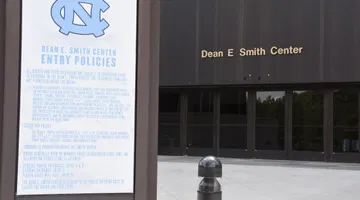
CHAPEL HILL — Generations of North Carolina men’s basketball fans trekked down the hill to the Dean E. Smith Student Activities Center on Saturday night — just as they have done for 40 years — to cheer on their beloved Tar Heels.
Students eager to witness their first Duke-Carolina rivalry game and fans who can recount that January 1986 night when senior Steve Hale set a career-high with 28 points to give the Tar Heels a victory over the hated Blue Devils on the night the great dome opened.
Other WRAL Top Stories
Many then sprinted up the hill on their way to Franklin Street for a raucous postgame celebration after Seth Trimble’s game-winning 3-pointer delivered the Tar Heels a 71-68 victory. Fans rushed the court not once, but twice, in celebration.
It was another unforgettable night in the aging Dean Dome – home to 503 victories (and counting) for the basketball team and countless memories for the generations of fans that have witnessed those wins. The building’s future is now at the center of an increasingly bitter fight pitting history and nostalgia and tradition and the memories of beating Duke on a last-second shot against the new realities of college athletics and growth and progress and revenue.
The debate: renovate the arena or build anew?
“What’s not a solution is the status quo,” UNC Chancellor Lee Roberts said.
Roberts has delayed a final decision on the arena question, one that was expected before the end of 2025. Supporters of renovating the Smith Center said that the administration was set to announce in December a new arena at a proposed development called Carolina North. But that plan received strong opposition from former players, longtime donors and others — including arguably the most powerful voice in UNC basketball, former coach Roy Williams.
Williams led North Carolina to national titles in 2005, 2009 and 2017. He is beloved among the fan base for, yes, those titles, but for his devotion to UNC, athletics and the men’s basketball program. He played on the freshman team, learned and coached under Dean Smith and returned to Chapel Hill after a spectacular run at Kansas to restore a floundering program to its former glory.
He still attends nearly every game and was there Saturday night, drawing the loudest cheer when he replicated his signature sideline stomp on the videoboard as UNC rallied.
Williams, 75, is the most direct link to Smith and North Carolina’s past. In a video posted to social media, Williams made his thoughts clear.
“I’m very much in favor of staying here in the Smith Center, renovating, remodeling, whatever we need to do,” Williams said in the video. “I do not want to go off campus.”
He added that it was Smith’s wish, too.
Williams accepted the North Carolina head coaching job in April 2003, famously saying he couldn’t tell Smith no a second time after passing on his alma mater in 2000. It was then that Rusty Carter first met the new coach.
Carter graduated from UNC in 1971. Williams in ‘72. Carter, a member of the UNC board of trustees in 2000, said he became close friends with Williams. He traveled to games, spent time with the team, played golf with Williams and, occasionally, Smith, who died in 2015.
“I was an outsider allowed to be an insider,” said Carter, a self-described “absolute fanatic” of the men’s basketball team as a teen. “It was heartwarming to me. One of the great parts of my adult life was to reconnect with Carolina and particularly the history and legacy of the basketball program.”
Carter is a huge supporter of the program, the type of donor whose input is solicited in advance. He and Williams were on the outside now, in the dark about a potential relocation of the Smith Center.
Carter said he was “totally unaware” until athletics director-in-waiting Steve Newmark approached him before the Tar Heels game at Kentucky on Dec. 2. Carter said the university was prepared to announce the arena was moving to Carolina North about a week later. Williams, too, had been unaware until a similar meeting, Carter said.
“The outcry was pretty loud,” Carter said. “That’s when a number of us started talking to each other – longtime, loyal donors and trustees and fans and people who have been around the program a long time. Is there something behind this more than we understand? Why has it been so quiet?”
They formed and mobilized The Committee for a South Campus Arena in a matter of days. Carter is the chairman and media spokesman. The group includes former trustees, fundraisers and other distinguished alums.
“We’d like to see the Smith Center renovated and us create the kind of on-campus court advantage that you see at Kansas, UConn, Duke, Indiana, at all of these major top-five historic men’s basketball programs,” Carter said. “Why would Carolina lose that? It’s a tie that binds our alumni together, makes us a family, beyond the basketball family, as much as anything else. Why would you abandon or risk that?”
Coach Roy Williams strongly supports renovating the Smith Center.
— Smith Center South (@SmithCenterUNC) January 19, 2026
Please support Dean Smith's wish and sign the petition: https://t.co/R9kFNQy1H4 pic.twitter.com/y6OIGIkBqF
Problems with the Smith Center
The Smith Center, at 40, is showing its age. But, as proven Saturday night, it can still rock.
It is cavernous at a time when newer arenas are intimate. It lacks luxury boxes or club seats at a time when modern arenas are designed to maximize revenue per seat. The roof leaks. The concourses are too small. Parking is a pain.
None of this is new. The university has been considering its options for more than a decade.
“We need to invest significant capital in the Smith Center to keep it operational,” Roberts said. “It needs a new roof. Everyone knows about the problems with the bathrooms and the concessions. There’s work to be done for [Americans with Disabilities Act] compliance.
“So we need to step back before we spend $80 [million] to $100 million to put a Band-Aid on the Smith Center and replace the roof, to make sure that we’re spending that money as well as we can — especially at a time when it costs much more money to fund elite programs.”
North Carolina’s athletics department expenses reached $172.9 million for the 2024-25 academic year, up more than $50 million from the 2021-22 academic year, according to reports filed with the NCAA and obtained by WRAL through public records requests.
Athletics department expenses for the current academic year are set to swell to over $200 million, given the implementation of direct revenue sharing with athletes and additional scholarships in accordance with the House settlement. And that’s before UNC went all-in on football with the hiring of NFL legend Bill Belichick.
The men’s basketball program generated more than $39.7 million in revenue in 2024-25 and spent $16.8 million. The cost to acquire and retain talented players in men’s basketball has never been higher. UNC’s roster cost about $14 million this season, according to 247Sports, higher than the estimated $8 million average ACC roster.
“Everyone’s trying to figure out how to generate more revenue for their athletic program,” Roberts said. “We’re no exception.”
That revenue almost entirely comes from football and men’s basketball. UNC made more than $17 million in ticket sales from men’s basketball in 2024-25. The Smith Center holds more than 21,000 fans, making it one of the largest college basketball arenas in the country.
“There’s no perfect solution, but the advantage to Carolina North is you could build a new arena with modern amenities, with premium seating, which would certainly help us on the revenue side,” Roberts said. “Again, everyone’s trying to figure out how to generate more revenue. We could address the considerable traffic and parking issues that we have at the Smith Center location. Most new arenas are being built with amenities around them, so you have a place to get a bite to eat before the game or a drink after the game. That also helps with traffic because you’re spreading out the demand.”
A new arena would include additional space for player rehab and recovery, nutrition and other conveniences increasingly expected of big-time college basketball arenas. It would also house the women’s basketball team, which currently plays its games at Carmichael Arena.
“We sometimes say some of the nostalgia and history would be lost,” UNC women’s basketball coach Courtney Banghart said. “I think people like good teams, right? They like really good teams wherever those teams are. If revenue now sort of determines how good your team can be, then we should prioritize revenue.”
She added: “People aren’t coming for the seats or the brick and mortar. They’re coming for the teams.”
What is Carolina North?
Carolina North is a planned campus on university-owned land about 1.5 miles north of Franklin Street, home to the Carolina North Forest and formerly Horace Williams Airport.
The university announced in January plans to develop about 230 acres into a “learn-live-work-play” campus with student housing, academic and research facilities and a hotel during the first phase. The university’s board of trustees signed off $8 million for site and construction planning. A basketball arena wasn’t included in phase one.
Construction on a “full blown campus” could begin as soon as 2027. Rapid bus transit would connect the campus to the main campus.
UNC is adding 5,000 students to its rolls over the next decade as part of an effort to keep up with the state’s population growth.
“Most of our peer universities would give anything to have this additional land available, and I think we have both the ability and the obligation to develop it to serve the people of North Carolina,” Roberts said.
The memories
UNC has moved before.
The Tar Heels played at Woollen Gymnasium from 1939 to 1965 before they moved to Carmichael, where they played until January 1986, defeating N.C. State in their final home game.
Walter Davis, uncle of current head coach Hubert Davis, made an iconic game-tying jumper against Duke at Carmichael. Michael Jordan played his entire career at the old arena. He was in his second year with the Chicago Bulls when the Smith Center opened.
UNC won a national title in 1957 while playing home games at Wollen. It won a national title in 1982 while playing home games at Carmichael.
The fanbase wasn’t necessarily on board with the move from Carmichael, in the heart of campus, to the Smith Center, all the way down that hill at the far end of South Campus in the mid-1980s.
“When we first moved to the Dean Dome, they called it the Dean Dome in Pittsboro,” Banghart said. “Change can be hard for folks. I understand that. … I trust that the decision makers are going to make the right decision for basketball being such an important thing at Carolina in 2025. We’re not making these decisions for 1984 or for 2005, we’re making them for 2025 through 2045.”
But 40 years means a lot of memories. Forty games against Duke. Buzzer beaters and court storms. Four national titles. Dean and Roy. Kenny Smith and JR Reid. Jerry Stackhouse and Rasheed Wallace. Vince Carter and Antawn Jamison. Sean May, Tyler Hansbrough, Brice Johnson, Justin Jackson, Armando Bacot and RJ Davis.
And now Caleb Wilson, North Carolina current star. The Smith Center is all he’s ever known. It’s the backdrop to those games he’s seen on TV. All those memories.
“It’s beautiful,” Wilson said. “Even sometimes when I’m driving to practice or something like that, when I’m up on the hill, you look down and see the Smith Center, it’s just like, ‘Dang, that’s where I’m going to be playing at.’ It’s kind of really cool. It’s a beautiful arena, a beautiful court, and it’s historic.”
He’s not alone. Rusty Carter’s committee created a website with a petition urging the administration to “renovate, don’t relocate” the Smith Center. The petition had nearly 29,000 signatures as of Friday — more than the capacity of the building.
Hansbrough, the 2009 national player of the year and national title winner, released a video in support of staying, posted on a social media account for the group. Other former players weighed in, too, with a letter to Roberts and social posts of their own. The committee has bought ads in The Daily Tar Heel newspaper, which students have brought to games.
“We want Lee Roberts to listen,” he said. “We have a sense that all the energy is going into a new arena at Carolina North and very little energy from the administration is going into a true and legitimate comparison of a renovation. We would like to see some balance in that, then everyone can make a better determination.”
Students have embraced the cause. The arena is a short walk for many who live in large student dorms on South campus. Some wore “Renovate. Don’t Relocate” t-shirts to Saturday’s game against Duke. Among them was UNC junior River McBride, who was sitting — really standing – in the front row of the student section Saturday. He bought the shirt at a Franklin Street store.
“It’s important to keep it on campus,” he said before the game. “It makes it easy for students to get here and, ultimately, that’s the most important part about college basketball is the students. Without it, it’s a pro league and that’s what makes it special. So keep it on campus.”
McBride doesn’t sound all that different from Roberts, who identified students as one of three key questions in the final decision on an arena.
“How do we get as many students in the arena and as close to the court as possible?” Roberts said. “It's their program. It's their team. It's what makes college basketball so great, and it also makes it a tough place to play. What helps a competitive advantage in a basketball arena is the students on their feet and hollering, not people like me chatting to their friends and looking at their phones.”
The desire to get more students in better seats leads to one of the thorniest parts of the debate: What happens to legacy seat holders at the Smith Center, who financed the construction of the building in return for access to the best seats over generations?
The other major factors, Roberts explained, are winning (“How do we win as many games as possible at a time when that’s becoming more expensive for everybody?”) and the fan experience (How do we “upgrade and enhance the fan experience to get people to fight the traffic, deal with the parking, get out of their living rooms and their rec rooms to come cheer on the Heels?”).
Roberts said that the strong response from Carolina fans and those connected to the program shows the passion for UNC basketball, a good thing. He said last month that two additional committees — one made up of students and another of members of the UNC basketball community — would be formed to provide additional feedback.
“University leadership continues to have ongoing conversations with various stakeholders about the future of the Dean E. Smith Center and the long-term success of Carolina basketball,” Dean Stoyer, the university’s vice chancellor for communications and marketing, said in a statement to WRAL.
“Among them are former players who have been integral to gathering critical input. In fact, the conversations with the broader Carolina basketball community have been some of the most substantive and have fostered the need for more conversation. No decision has been made at this time, but the long-term success of Carolina basketball and what it provides for Carolina athletics and the university community is imperative.”
More deliberations, more information
A 2024 report from a working group commissioned by Roberts outlined six options for a future basketball arena. The options included replacing the Smith Center on its current location, renovating the arena and building a new one in the next-door Bowles Parking Lot as well as building new in Odum Village, at the Friday Center and at Carolina North.
A 16,000-seat arena fits on all sites, according to the report. A renovation or on-site replacement for the Smith Center would require the men’s team to play off site during construction and would require the construction of a new natatorium to accommodate UNC’s swimming programs. The Carolina North site is “not within safe walking distance from campus” and would require further study of utility infrastructure to quantify cost and schedule, according to the report.
The pro-Smith Center group wants “transparent and legitimate” financial modeling to compare the costs and revenue generation associated with a renovation of the Smith Center as compared to a new venue at Carolina North. The university hasn’t yet released such a comparison or full costs.
Carter said the group is in favor of “significant upgrades” at the Smith Center – luxury boxes, extensions of the concourse, food courts, a new look at how and where students are seated.
“The proper renovation would address most of the same components that a new arena would,” he said. “It might not be as shiny, but it also would have jerseys in the rafters and banners on the other end and Roy Williams Court. The emotional attachment can never be duplicated."