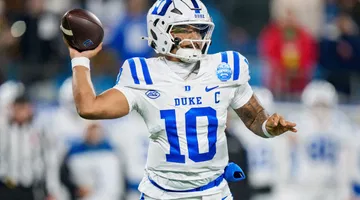
Duke University and quarterback Darian Mensah reached a settlement that will allow Mensah to transfer, his agency and Duke announced Tuesday, ending a brief but potentially precedent-setting lawsuit from the university.
Mensah announced Tuesday night that he committed to Miami, his expected destination since announcing his plans to transfer on Jan. 16.
Other WRAL Top Stories
Duke sued Mensah over his attempt to transfer, alleging the quarterback had violated the terms of the two-season name, image and likeness contract he signed in 2025. A judge agreed to a temporary restraining order last week, keeping Mensah from enrolling at another college. A hearing was set in Durham for Thursday.
The sides filed a joint motion to dissolve the temporary restraining order Tuesday afternoon. In it, it says the sides have “reached a confidential agreement.”
“Both sides saw this outcome being decided by a judge and weren't really comfortable with it,” said Landis Barber, a lawyer with Safran Law Offices in Raleigh and an expert on sports law.
Mensah, who led the Blue Devils to the ACC championship in December, was paid a reported $4 million per season, a top-of-the-market sum in 2025 but one that has been surpassed this offseason. His redacted contract, which was set to expire at the end of 2026, was included in the court documents.
“It was wise for everybody to settle this case, but I think Duke had the stronger case,” said lawyer David McKenzie, a Duke graduate who specializes in intellectual property law.
McKenzie said the filing of the lawsuit showed that Duke is serious about its contracts. The school announced in a statement that it had reached a resource “that enables both parties to move forward.”
Both Barber and McKenzie said the settlement likely includes payments, probably in a series of installments, from Mensah to Duke to get out of his contract.
"We are committed to fulfilling all promises and obligations Duke makes to our student-athletes when we enter into contractual agreements with them, and we expect the same in return. Enforcing those agreements is a necessary element of ensuring predictability and structure for athletic programs. It is nonetheless a difficult choice to pursue legal action against a student and teammate; for this reason we sought to resolve the matter fairly and quickly.
"Duke remains dedicated to the welfare of all student-athletes, and we appreciate them for the talent, dedication, and commitment to excellence they demonstrate both on and off the field. We also remain committed to upholding the integrity of our athletics programs and institutional guidelines. We thank Darian for his contributions to Duke University.”
Mensah was due 18 “NIL License Payments” over the course of the contract. The dates and payment amounts were redacted in the court filing. The contract wasn’t an employment contract.
“No court has ever deemed an NIL or intellectual property contract to be an employment contract, until someone tests that at a court of appeal, we’re going to have some ambiguity for the school and the player,” McKenzie said.
Mensah was a second-team All-ACC selection in 2025 and passed for 3,973 yards, which ranked second in the nation. He transferred to Duke from Tulane.
"Through close collaboration and principled negotiation, we have successfully navigated an unprecedented path, one that has now reached a fair and mutually agreeable resolution," Young Money APAA Sports said.
In December, Mensah announced that he was returning to Duke, foregoing early entry into the NFL Draft. But on Jan. 16, the final day that players could enter the transfer portal, Mensah announced he was leaving Duke. The Blue Devils' top receiver, Cooper Barkate, is expected to follow Mensah, according to media reports.
Duke plays at Miami on Nov. 14, part of a difficult final month for the Blue Devils.
The case could lead to additional and more specific language in contracts between players and schools, Barber said. Clear terms for buyouts are commonplace in coaching contracts, but Mensah’s deal lacked specifics in terms of damages or timelines.
“I think you’re going to see just larger buyout terms, more buyout terms included in contracts,” Barber said. “I think we’re going to see less multi-year deals, honestly. I think we’ll see more sort of single-year deals and then renegotiation after that.”