This article was written for our sponsor, UNC Charlotte School of Data Science
Whether driven by curiosity, fear, or excitement, Artificial Intelligence (AI) is an omnipresent topic in current national conversation. Offering significant benefits, with a side of undeniable risk, AI challenges users to consider ideals and ideals surrounding bias, morality, pragmatism and philosophy.
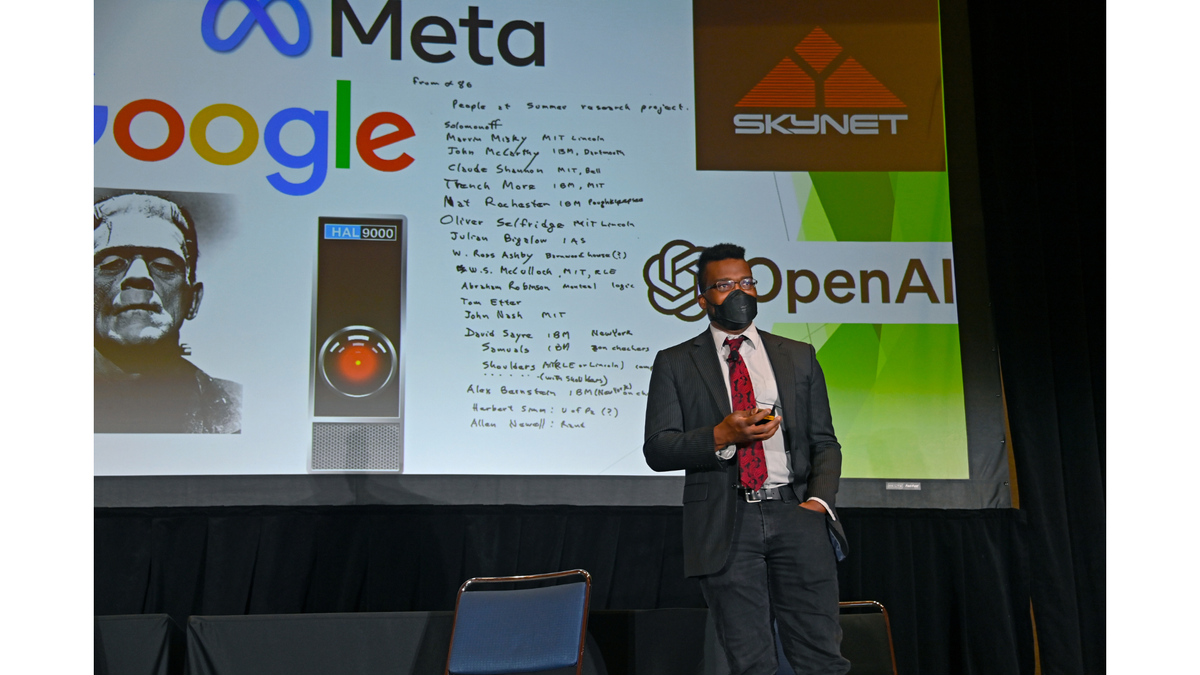
Dr. Damien Williams is an Assistant Professor of Data Science and Philosophy at UNC-Charlotte. With a PhD in Science, Technology and Society from Virginia Tech, and an MA from Georgia State University in Philosophy and Religious Studies, Williams has spent years studying and teaching the complexities and opportunities of ethical AI usage. Considered a thought leader in the AI usage space, Williams gave the keynote address at UNC Charlotte's Analytics Frontiers Conference.
In the address he did not shy away from the fact that fear plays a big role in people's perception of AI. One of the most common fears surrounding AI is that it will become so advanced and cost effective, it will lead to mass unemployment. In 2022, PwC's annual global workforce survey showed that almost a third of respondents said they were worried about the prospect of their role being replaced by technology in three years.
However, according to Williams, AI and automation often create different types of work for human beings rather than eliminating work entirely. He explained how companies have implemented automated systems, yet still rely on large teams to monitor, correct, and supplement the AI.
He suggested the conversation should shift to how AI can supplement human capabilities, not replace them. This underscores the adaptability of humans to new technologies and the innovative ways in which they repurpose AI for diverse applications.
"People have learned to integrate these systems or versions of these systems into their workflow or repurpose it for things that maybe they weren't intended for," said Williams. "Even artists have figured out how to not just completely rely on those systems, but to use them to create drafts."
Williams also emphasized the limitations of AI in the realms of art, music, and creative writing. Ultimately, the impact of AI on jobs is still uncertain and will depend on factors such as industry, job type, and the ability of individuals and organizations to adapt to technological advancements effectively.
Another risk arena for AI is ethics. In programming and utilizing AI, there is a potential for bias and accountability issues. Williams discussed the complexity of defining equity in the context of AI and suggested the need to reframe these conversations. He highlighted the nuanced differences between concepts like responsibility, bias, fairness, equity, prejudice, and justice in AI, emphasizing the importance of understanding these distinctions to develop more ethical and equitable AI systems.
"An equitable solution is not necessarily always going to be the solution that feels fair to everyone, but it's more intentional and it's more clear as to why that is the case," Williams said. "We are currently in a moment where conversations about equity are politically fraught because the word 'equity' has been saddled with a number of connotations and conceptual baggage that doesn't necessarily apply to it."
Because of his unique expertise in religious and philosophical studies, in addition to technology and machine intelligence, he was recently featured in TIME Magazine. Originally, Williams agreed to help with the article, humbly assuming he was not the focus. "It wasn't until fairly late in the process that I realized it would be a full interview focusing on my contributions, rather than quotes pulled for attribution with others quoted as well. I was kind of shocked," he said.
In the realm of education, the professor noted that students often have misconceptions about AI and its capabilities. Students tend to assume AI systems possess human-like intelligence, caring about facts and truth. However, AI systems simply respond to the prompts they are given and will output whatever humans are willing to accept from them.
Last, in terms of fears addressed, AI systems collect and analyze large amounts of data, raising questions about how this data will be used and protected. Supposedly, 65 percent of consumers have lost trust in organizations due to their AI practices, and 76 percent want the ability to opt out of AI use by applications. Additionally, 75 percent are eager for legal AI ethics management programs to implement safeguards.
Despite the risks, AI holds tremendous potential to drive innovation and solve complex problems. Proper regulation and ethical frameworks can help harness these opportunities while mitigating associated risks. Turning to the research and work of experts like Williams can help lay that path to thoughtful usage.
"Morality cannot be legislated, but behavior can be regulated," Williams observed. He added, "I hope that people understand that human biases, perspectives, and values will always be part of the technological tools and systems that humans make, but also while there is no such thing as an 'unbiased' technology, we can be careful and intentional about which kinds of perspectives we build into them. Rather than letting our assumptions and unexamined biases make their way into our technologies, we can work to make sure the values we put in are ones which will help us all to survive and thrive."
This article was written for our sponsor, UNC Charlotte School of Data Science