This article was written for our sponsor, Fifth Third Bank
You may not know it, but right now you’re using a rare earth magnet. Whether on a tablet, phone or computer, the technology at your fingertips relies on magnets. In fact, rare earth magnets are all around you. From your transportation and your power tools, to the satellites delivering these words, almost all technology relies, in some way, on rare earth magnets. As John Maslin, CEO and co-founder of Vulcan Elements explains, “Three components enable [virtually all advanced] technologies: semiconductors, batteries and rare earth magnets. Where semiconductors are like the brain and batteries are the heart, rare earth magnets are like the spine, they convert electricity into motion.”
We use magnets every day, but there is a problem. The United States produces less than 1% while China produces between 94-98% of the global supply. That means from appliances in our homes to defense technologies for our military and national security, our supply chain necessarily goes straight through China. Maslin said, “Both for economic resilience and national security, if there weren’t companies scaling up to fix this problem here, we were going to have to ask China permission on what we’re allowed to build and buy.” That, he added, was unacceptable.
A former U.S. Naval officer, Maslin spent six years active duty at the Navy’s Nuclear Energy Program. As the financial manager for the ballistic missile submarine program, it was his job to secure critical components and materials for submarines. After the Navy, he attended Harvard Business School and continued to think about the three components which would define the future global economy, especially magnets.
From aerospace and robotics to automotive and defense, he kept landing on those three building blocks: semiconductors, batteries, and rare earth magnets. While founding a business was not, “on his bingo card,” he couldn’t shake the feeling that someone needed to step up and fix the magnet production issue.
He said, “If I knew about this problem and didn’t do anything and in 20 years we lost because of one supply chain, that would be hard to explain to my daughter. I want my 80-year-old self to look back and smile because we took the risk, did something that mattered, and did it honorably.”
In 2023, he co-founded Vulcan Elements, a U.S.-based manufacturer of prototype and commercial rare earth magnets. And in just two years, the company is becoming one of the most consequential industrial efforts in the world.
Why North Carolina?
When choosing a location, two categories mattered most: a state that was ‘open for business,’ and willing to support advanced manufacturing, and a location capable of providing a deep talent pool which includes PhDs, skilled technicians, and engineers with backgrounds in chemical, electrical, mechanical and aerospace.
“When you crunch the numbers empirically, only about three places in the entire United States make sense for a company like this,” Maslin said. The Research Triangle Park area was one of them. Add the fact that North Carolina has the fourth largest veteran community in the country, which is a key talent demographic for Vulcan, and the choice was clear.
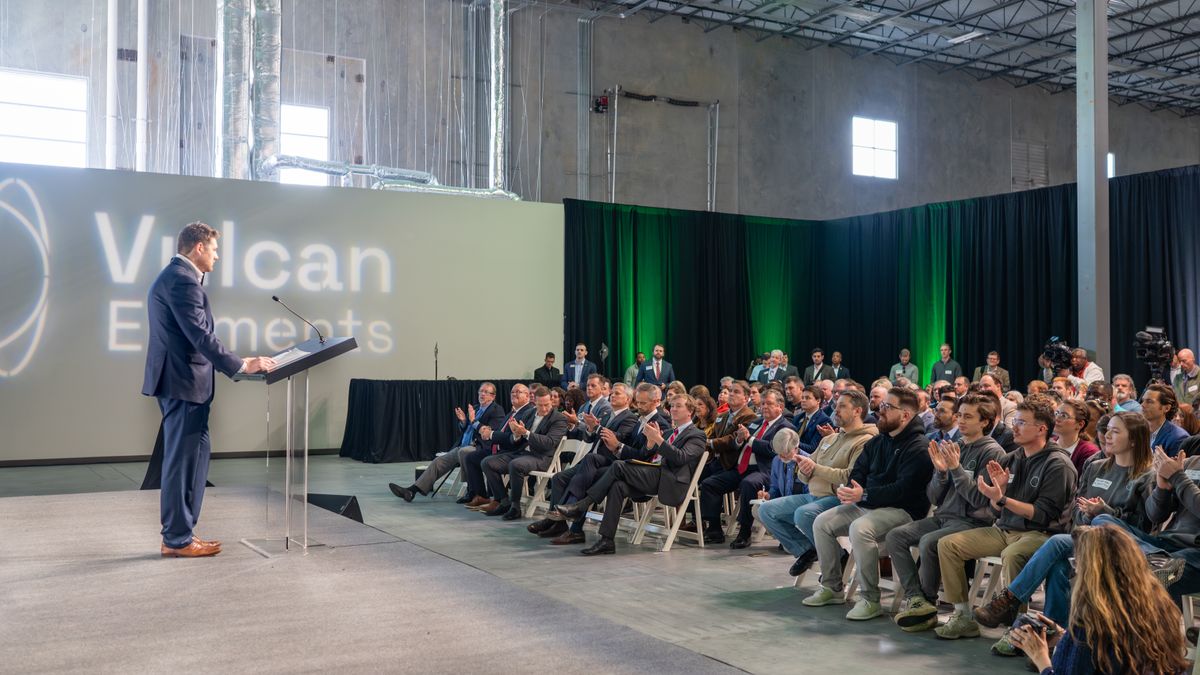
Vulcan opened its first facility in Durham and recently announced its commercial plant in Benson, which will be the largest rare earth magnet plant in the world outside of China, capable of producing 10,000 metric tonnes of magnets annually.
The Benson plant is enabled by Vulcan’s $1.4 billion partnership with the United States Government, which the company announced in November 2025. Over the next several years, the project is expected to create roughly 1,000 high-quality jobs, including operators, technicians, and engineers. But even if you don’t currently fit one of those titles, there may be a spot for you.
The key pillar to Vulcan’s hiring philosophy is not pedigree; it’s character and drive. Maslin noted they are seeking applicants with five key traits: intellect, intellectual curiosity, work ethic, teamwork, and a focus on mission. “We don’t care if you went to Harvard and you don’t have to have a PhD. We want smart, mission-driven people who work well with others and want to solve a difficult problem for the country.”
Offering training to people who fit those traits, Vulcan encourages applicants from a wide range of backgrounds, including those just finishing high school, seasoned manufacturing workers, transitioning veterans, and professionals from other industries who want to contribute to reindustrializing the U.S. In fact, he encourages people to send an inquiry even if they’re unsure their skill set matches a posted job. “We have a general interest page for people who might not fit a specific job opening, we hope anyone who just wants to do something important for the country will apply through that.”
What does Vulcan Elements do?
In order to solve the supply-chain problem, Vulcan Elements is committed to producing rare earth magnets that are critical to economic and national security. The facilities in North Carolina will take the raw materials and transform them into the building blocks that create motion.
Maslin is quick to point out that the supply chain problem is not due to source materials. “One hundred percent of our material is from the United States or allies,” he said. It’s a common misunderstanding, but the name “rare earth” doesn’t mean that the necessary raw materials are rare. On the contrary, they are fairly commonly found. However, finding large concentrated deposits is rare and the needed elements are difficult and costly to separate from the earth (rock) that normally surrounds or encompasses them.
Vulcan Elements takes those rare earth materials and, through several processes, transforms them into a precise market-ready magnet. Like batteries, these magnets can be produced with tailored strengths, shapes, heat tolerances and coatings. There are several commonly manufactured magnets (like the one in most mobile phones), but Vulcan Elements is also focusing on providing highly customized magnets for the most critical technologies and national security applications. This allows industries, from commercial to defense, to “decouple” from China.
“This is going to be a long-term resiliency solution for defense and for any companies that need resilience in their supply chain,” Maslin said.
Vulcan Elements Chief of Staff, Jonah Glick-Unterman added, “One of the most important supply chains in the world for the next 25-50 years is going to have its home in North Carolina. It’s not just going to be transformative for the country, it’s going to be transformative for this community as well.”
To learn more about how you can become part of the mission, please visit the Vulcan Elements career page at: https://job-boards.greenhouse.io/vulcanelements
This article was written for our sponsor, Fifth Third Bank